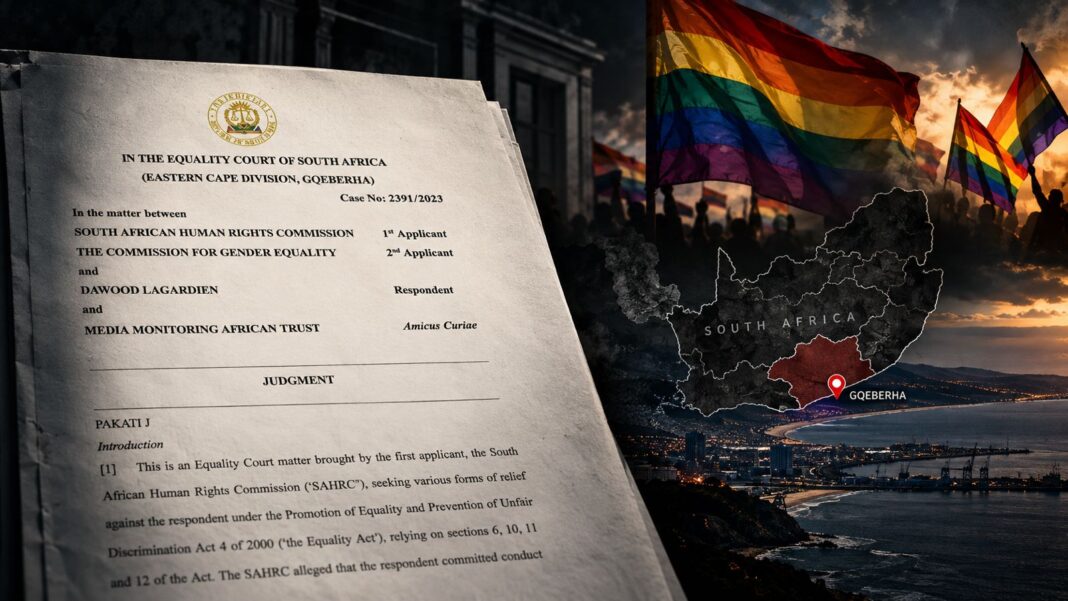

An Equality Court ruling ordering Gqeberha businessman Dawood Lagardien to publicly apologise, pay R200,000 in damages and face referral to the National Prosecuting Authority (NPA) has sparked anger among Muslims who argue that the case raises fundamental questions about religious freedom, Islamic morality and the limits of secularism.
Lagardien maintains that the dispute began when he removed two men from his business after they allegedly engaged in overt sexual conduct in front of customers, including a woman with her six-year-old child. He insists he would have objected to such behaviour regardless of whether those involved were homosexual or heterosexual.
Moulana Uwais Dockrat, Director of The Guardian Dawah Project, has sharply criticised the broader implications of the ruling.
“This judgment is a striking example of the intolerance that emerges from the modern secular-liberal state,” he told One Nation Media (ONM).
For Dockrat, the concern is not whether Muslims should be permitted to mistreat others, but whether they can uphold Islamic teachings on morality and public conduct without those convictions being marginalised in public life.
“The deeper issue is therefore not simply one businessman or one sign. It is the question of who has the authority to determine the moral boundaries of public life,” he said.
What happened inside Lagardien’s shop?
According to his affidavit, two men entered Lagardien’s business in June 2023 while other customers were present.
He alleges that the pair began kissing, fondling each other around the groin and “grinding themselves in a sexual manner” in full view of those inside.
A woman accompanied by her six-year-old child was among the customers and, according to Lagardien, reacted with shock before he approached the men and instructed them to leave.
The Equality Court judgment records Lagardien’s account of the incident, including his allegation that the men engaged in sexual behaviour in front of customers and a child.
However, he maintained that his intervention was prompted by their conduct rather than their sexual orientation.
That distinction became central to his defence.
Lagardien said he knew the men belonged to the LGBTQIA+ community when they entered his business but nevertheless permitted them inside.
“If I had intended to unfairly discriminate against members of the LGBTQIA+ community I would have not allowed them in my shop to begin with,” he stated in his affidavit.
His objection, he insisted, arose only when their behaviour became overtly sexual in front of other customers.
The distinction is significant because objections to explicit sexual conduct in a commercial establishment are not necessarily dependent on the sexual orientation of those involved.
South African law also recognises limits on sexual conduct in public spaces, although the Equality Court did not determine whether the alleged behaviour constituted public indecency. No criminal finding was made against the two men.
Lagardien’s legal counsel further argued that no affidavits from members of the LGBTQIA+ community had been submitted contradicting his account of what occurred inside the shop.
Counsel maintained that the affidavits addressing those events came from Lagardien and his daughter, accusing the applicants of having “completely sanitised the facts” surrounding the confrontation.
Lagardien also accused the applicants of “selective morality”, arguing that insufficient consideration had been given to his rights, those of his customers and the child who allegedly witnessed the incident.
Alleged threats against his family and business
According to Lagardien, the confrontation was followed by threats and intimidation. He alleges that several men entered his business the following day, threatened his daughter with violence and warned that they would burn down the shop.
Further intimidation allegedly followed, including an incident in which three men threatened to close the business while his daughter and a supplier were present.
Security officers escorted the men from the premises, and Lagardien said he subsequently increased security out of concern for his family and the surrounding community.
His daughter, Faariah Lagardien, later submitted a confirmatory affidavit endorsing the accuracy of references concerning her in her father’s statement.
Lagardien subsequently erected a controversial sign outside his business and established a WhatsApp group.
He maintained that both actions followed the earlier incidents and were intended to alert members of the Muslim community and facilitate discussions about Islamic teachings.
He also alleged that three men were captured on CCTV destroying the sign, which he chose not to replace.
However, it was these subsequent actions, rather than simply his initial decision to remove the two men, that became decisive in the Equality Court’s ruling.
Why did the court rule against Lagardien?
Judge B.M. Pakati found that the sign went beyond objecting to the conduct of two individuals and instead conveyed that LGBTQIA+ people generally were unwelcome at Lagardien’s business.
The court also considered statements circulated through the WhatsApp group and concluded that his conduct constituted hate speech, unfair discrimination and harassment under the Equality Act.
Lagardien was ordered to publicly apologise, refrain from further prohibited conduct and pay R200,000 in damages to an organisation identified by the South African Human Rights Commission.
Of that amount, R100,000 must be paid within four months.
He was also ordered to pay the Commission for Gender Equality’s legal costs, while the matter was referred to the NPA for criminal investigation.
The referral does not itself constitute a criminal conviction. The judgment is expected to be challenged on appeal.
Islamic morality versus secular liberalism
For Dockrat, the ruling raises a more fundamental question about whether secularism can genuinely remain neutral when Islamic moral teachings conflict with prevailing social values.
“Secularism presents itself as neutral towards competing religions and worldviews, but cases such as this expose the limits of that neutrality,” he told ONM.
“Muslims are increasingly told that they are free to believe what Islam teaches privately, provided those beliefs do not meaningfully challenge the moral assumptions of the dominant secular-liberal order.”
Islam is not confined to prayer, fasting or private religious observance. It establishes moral boundaries governing family life, sexuality, modesty and public behaviour.
While Islamic teachings require Muslims to uphold justice and respect the rights of others, they do not oblige believers to regard conduct prohibited by their faith as morally acceptable.
“Religious freedom then becomes freedom to practise an Islam that has first been confined, regulated and rendered compatible with prevailing liberal values,” Dockrat added.
This distinction between respecting an individual’s dignity and endorsing their conduct lies at the heart of the broader debate.
Islam prohibits injustice towards others, but Muslims maintain that respecting individual rights should not require abandoning established Islamic teachings on sexuality and morality.
“A Muslim should not be forced to surrender the Islamic position on sexuality, family and morality merely because those teachings conflict with contemporary social norms,” Dockrat said.
Criticism of the judgment among Muslims has also focused on whether sufficient consideration was given to the events preceding Lagardien’s controversial sign and WhatsApp messages.
These include the alleged sexual conduct in front of a child, his insistence that he objected to behaviour rather than identity, and the threats he claims were subsequently directed at his family and business.
Although the court ruled on the discriminatory nature of his later actions, critics argue that the wider context remains relevant to understanding how the dispute escalated.
For Dockrat, the greater danger arises when the state moves beyond preventing unlawful discrimination and begins determining which religious convictions may be expressed or acted upon in public.
“When the secular state determines which religious convictions may enter public life, which may be acted upon, and which must be silenced, secularism is not acting as a referee between worldviews; it is enforcing the supremacy of its own worldview,” he told ONM.
The case therefore raises questions extending beyond one businessman, one shop and one Equality Court ruling.
As Lagardien prepares to challenge the judgment, the wider debate concerns where South African law draws the line between protecting people from discrimination and safeguarding the public expression of religious convictions.
For Muslims following the case, the defining question is whether Islamic morality can remain a lived public conviction or whether believers will increasingly be expected to confine their faith to private life whenever its teachings conflict with the dominant secular-liberal order.