
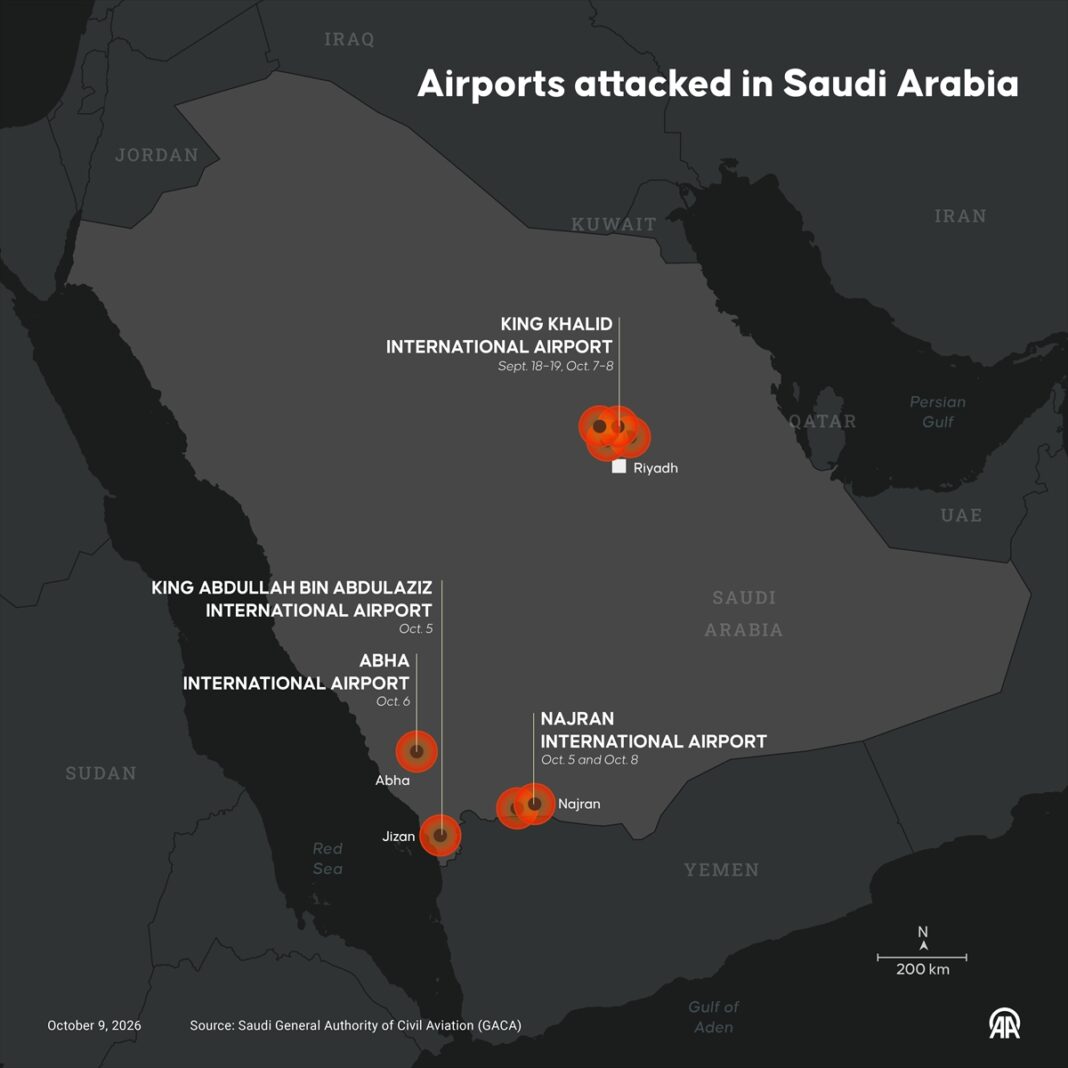

Saudi Arabia has vowed a serious response to a wave of deadly missile and drone attacks by Yemen’s Houthi movement targeting airports and energy infrastructure across the kingdom, as escalating hostilities threaten to deepen the regional conflict.
Saudi Energy Minister Prince Abdulaziz bin Salman issued the warning on Monday during the WPC Energy Congress in Riyadh, following attacks that killed at least 14 people at the capital’s King Khalid International Airport over the weekend.
“The events of recent weeks are serious. Our response must be equally serious,” he told delegates.
The warning came amid renewed explosions in Riyadh on Monday evening, with the Saudi-led military coalition announcing that it had intercepted and destroyed a ballistic missile.
The Houthis, who control large parts of northern and western Yemen, claimed responsibility for the latest attack on the airport, saying their operations were retaliation for Saudi airstrikes and restrictions imposed on areas under their control.
Deadly attacks on Saudi airports
Saturday’s missile strike on Terminal 3 at King Khalid International Airport killed 13 people, including four Saudis, two Bangladeshis and nationals from the United States, Egypt, Jordan, Syria, Palestine, Sudan and India.
The attack forced the terminal’s closure and caused widespread disruption to international flights.
On Sunday, a Pakistani resident was killed when another projectile struck Terminal 4, according to Saudi Arabia’s General Authority of Civil Aviation (GACA).
The airport has reportedly been targeted four times over the past week.
Earlier, on Thursday, three Saudi nationals, including a pilot employed by national airline Saudia, were killed in separate strikes targeting airport facilities and an aircraft on the ground.
King Fahd International Airport in the eastern city of Dammam was also targeted on Sunday evening, although Saudi authorities reported no casualties.
The Saudi-led coalition subsequently announced that its air defences had intercepted a drone over the Eastern Province and a missile launched towards the southwestern city of Khamis Mushait.
Houthi military spokesperson Yahya Saree said the group had launched missiles and drones against airports in Riyadh and Dammam, alongside two oil and gas facilities in Saudi Arabia’s Eastern Province.
He said the attacks were carried out in response to 124 Saudi airstrikes on Yemen over the preceding 24 hours.
The Houthis also renewed warnings to airlines and passengers against using Saudi airports and airspace, except for travel to and from the Islamic holy cities of Makkah and Madinah.
Saree said the movement would continue its military operations until Saudi attacks stopped and restrictions on Houthi-controlled territory were lifted.
Saudi airstrikes in Yemen
The latest Houthi attacks have coincided with intensified Saudi military operations in Yemen, where the kingdom is providing air support to forces aligned with the internationally recognised government.
On Sunday, the Houthi-run health ministry reported that a child had been killed and six other people injured when a Saudi airstrike hit a residential property in the capital, Sanaa.
The casualty figures have not been independently verified.
Saudi-led forces are conducting operations along Yemen’s Red Sea coast and other contested areas as pro-government troops attempt to regain territory seized by the Houthis.
Last month, Houthi forces launched an offensive along the southwestern Red Sea coastline, capturing positions overlooking the strategically important Bab al-Mandab Strait.
The narrow waterway connects the Red Sea to the Gulf of Aden and is a major transit route for international shipping and energy exports.
Yemen’s internationally recognised government subsequently announced a new military offensive aimed at recapturing Houthi-held territory.
Pro-government forces claimed to have regained positions around Bab al-Mandab with Saudi air support, although the Houthis denied losing control of the area.
Energy security concerns
Addressing the WPC Energy Congress, Prince Abdulaziz acknowledged the impact of the attacks on Saudi Arabia’s infrastructure and energy security.
He thanked international energy executives and policymakers for attending the conference despite heightened security concerns.
“You know this country is safe and that we hold your protection at whole heart,” he said.
The minister also warned that “energy security cannot be taken for granted”, acknowledging that recent events had tested Saudi Arabia’s infrastructure, institutions and resilience.
“We, as Saudis, are fearless, combatant and determined people,” he declared, promising that the kingdom would overcome the challenges.
The escalating conflict has raised concerns over regional energy supplies, particularly following disruptions to shipping through the Strait of Hormuz during the US-Israeli war with Iran.
Saudi Arabia has increasingly relied on Red Sea export routes, making instability around Bab al-Mandab a significant concern for global oil markets.
The latest attacks have also disrupted international aviation and heightened security concerns surrounding major economic and energy events taking place in Riyadh.
International reactions
Saturday’s deadly attack on Riyadh airport prompted international condemnation.
UN Secretary-General António Guterres said he was deeply shocked by the killings and warned that attacks targeting civilians and civilian infrastructure violated international humanitarian law.
US President Donald Trump said Washington would consider whether to join Saudi military operations against the Houthis.
The United States has reportedly been providing intelligence and targeting assistance to the Saudi-led coalition, although direct American involvement in the latest strikes has not been confirmed.
Iran, which has repeatedly denied allegations that it supplies weapons and training to the Houthis, expressed deep concern over the escalation and called for dialogue to resolve the crisis.
Yemen’s fragile ceasefire unravels
Yemen has endured more than a decade of conflict since the Houthis seized Sanaa in 2014, forcing the internationally recognised government from the capital.
In 2015, a Saudi-led military coalition intervened in support of the government, triggering years of fighting that devastated the country’s infrastructure and created a prolonged humanitarian crisis.
An informal ceasefire that had largely held for four years began unravelling in July, when the Houthis announced a maritime embargo against Saudi Arabia and resumed attacks on Saudi airports, energy installations and shipping in the Red Sea.
The movement said its operations were retaliation for Saudi restrictions on ports and airports in Houthi-controlled territory and an earlier strike on Sanaa airport.
Yemen’s government claimed responsibility for that strike, saying it was intended to prevent an unauthorised Iranian aircraft from landing.
With both sides intensifying military operations, the renewed fighting has raised fears of a wider regional confrontation, further civilian casualties and disruption to critical international energy and shipping routes.