
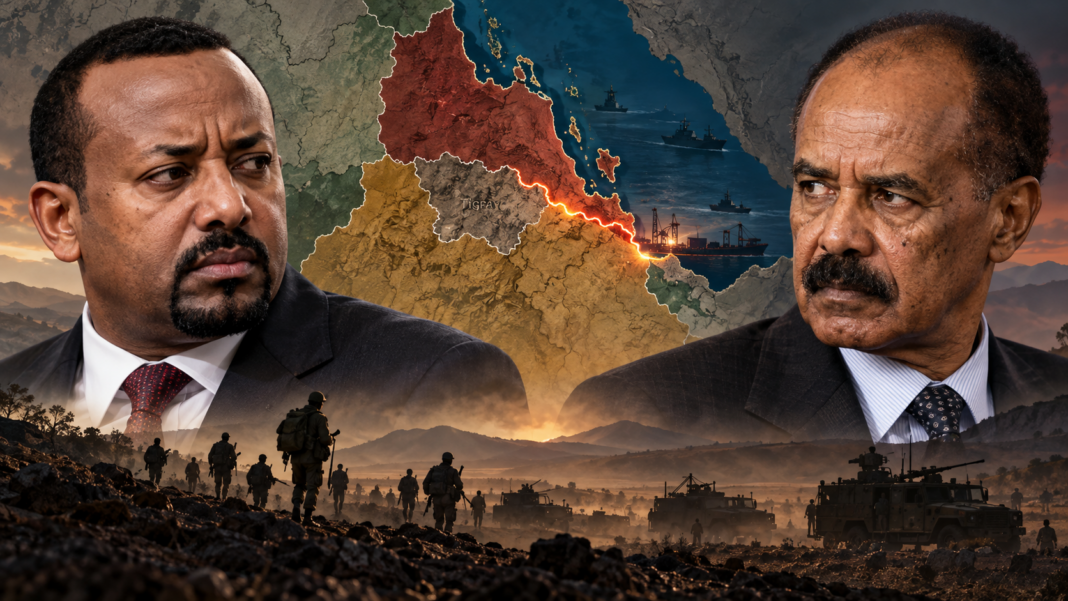

The Horn of Africa is edging dangerously close to another interstate war as Ethiopia and Eritrea trade accusations of aggression, military forces manoeuvre along their volatile northern frontier and regional rivalries threaten to draw neighbouring powers into an already combustible conflict.
Eritrea has urged the United Nations Security Council to take deterrent measures against Ethiopia, accusing Addis Ababa of effectively declaring war and warning that a military confrontation between the former allies could devastate both countries and destabilise the wider Horn of Africa.
The escalation comes amid renewed fighting in northern Ethiopia, reports of Eritrean troops crossing into Tigray, Ethiopian drone strikes and a diplomatic rupture between Addis Ababa and Asmara.
Ethiopia has also accused Eritrea, Egypt and Sudan of supporting armed groups fighting the federal government, allegations the countries have rejected. The accusations have raised fears that an Ethiopian-Eritrean confrontation could become entangled with wider disputes over the Red Sea and Nile waters.
In Johannesburg, Yohannes Habib, chairperson of the United Ethiopian Community Association in South Africa, said the local Ethiopian community “fully supported” the government of Prime Minister Abiy Ahmed.
“Economically, Ethiopia is outperforming all the other countries in the region and growing, with a population of 140 million people, more powerful. It seems this is what Eritrea and other countries are fearing and are arming and encouraging rebel groups in Tigray and elsewhere to overthrow the Ethiopian government,” Habib said.
He accused Eritrea of supporting armed groups in Tigray and Ethiopia’s Amhara, Oromia and Ogaden regions against the federal government. Eritrea denies backing forces seeking to destabilise Ethiopia.
Habib said Ethiopia was pursuing a “win-win solution” that would also address the landlocked country’s longstanding demand for access to the Red Sea.
“It’s inevitable that in the medium to long term Ethiopia will prevail,” he said.
Eritrea appeals to UN Security Council
The diplomatic confrontation reached the Security Council after Eritrean Foreign Minister Osman Saleh called on members to “forcefully condemn Ethiopia’s deplorable declaration of war against Eritrea”.
He warned that a conflict would inflict “huge devastation to the peoples of both countries and destabilize the whole region”.
Saleh also accused Addis Ababa of attempting to justify military aggression under the pretext of self-defence.
“Ethiopia’s deceitful attempts to rationalize its brazen acts of war against a sovereign UN member state in ‘self-defense’ terms are hollow in substance and constitute an insult to the intelligence of the international community,” the Eritrean letter said.
Asmara urged the Security Council to “take the requisite deterrent measures against it in accordance with Chapter VII of the UN Charter”.
Chapter VII empowers the Security Council to respond to threats to international peace and security through measures ranging from sanctions to, in certain circumstances, the authorisation of military force.
Eritrea’s appeal followed Ethiopia’s own communication to the Security Council, in which Addis Ababa invoked its right to self-defence and accused Eritrean forces of crossing into Ethiopian territory and occupying parts of northern Tigray.
Ethiopia demanded their immediate withdrawal, while Eritrea rejected the allegations and accused Addis Ababa of manufacturing a pretext for military action against its territory.
Eritrean Information Minister Yemane Gebremeskel has accused Ethiopia of pursuing “an unprovoked war of aggression” linked to its longstanding ambitions for access to the Red Sea.
Gebremeskel pointed to remarks made by Abiy in 2023 concerning Ethiopia’s maritime ambitions, arguing that Addis Ababa had effectively threatened Eritrea by pursuing “sovereign access to the sea, through negotiations if possible and by force if necessary”.
Landlocked since Eritrea gained independence in 1993, Ethiopia has repeatedly described reliable maritime access as essential to its economic and strategic future.
Eritrea, however, views suggestions that Ethiopia should obtain sovereign access through its territory, particularly through the strategic Red Sea port of Assab, as a threat to its sovereignty and territorial integrity.
Relations deteriorated dramatically on October 1 when Ethiopia ordered the closure of its embassy in Asmara and expelled 10 Eritrean diplomats, accusing Eritrea of “direct and indirect acts of hostility and belligerence”.
Eritrea responded by severing diplomatic relations with Ethiopia.
Renewed fighting threatens regional stability
The diplomatic crisis is unfolding alongside renewed fighting in northern Ethiopia, where hostilities erupted again on September 23 between the Ethiopian military and an opposition alliance that includes the Tigray People’s Liberation Front (TPLF).
The fighting threatens to unravel the Pretoria peace agreement that ended the devastating 2020–2022 Tigray war.
Ethiopia’s military leadership has accused Eritrea, Egypt and Sudan of supporting armed groups fighting Addis Ababa. Cairo, Khartoum and Asmara have rejected accusations that they are fomenting the rebellion.
Reports of direct military encounters between Ethiopian and Eritrean forces have heightened fears that the internal Ethiopian conflict could escalate into a wider regional war.
The Armed Conflict Location & Event Data Project (ACLED) reported that drones believed to have been operated by Ethiopian government forces struck Eritrean troops and military vehicles near Adigrat in northern Ethiopia.
Conflict monitors also reported Eritrean troops crossing into Tigray before withdrawing from Adigrat as Ethiopian forces and allied groups regained control of the strategically important town and nearby Idaga Hamus.
In a further development on October 13, Ethiopian troops advanced into Zalambessa, a strategically important town along the Eritrean border, according to reports from witnesses and conflict monitors. The movement has intensified concerns about a direct confrontation between the two countries.
Ethiopia and Eritrea have travelled this road before.
The neighbours fought a devastating border war from 1998 to 2000 before restoring diplomatic relations in 2018, a rapprochement that contributed to Abiy receiving the Nobel Peace Prize the following year.
Eritrean forces subsequently fought alongside Ethiopia’s federal government during the Tigray war, but relations between the former allies deteriorated sharply following the signing of the Pretoria peace agreement in 2022.
The latest confrontation is unfolding across several interconnected fault lines: Ethiopia’s internal political crisis, competing claims over Red Sea access, Eritrea’s security concerns, Sudan’s continuing instability and the longstanding dispute between Ethiopia and Egypt over Nile waters.
The stakes have risen further amid growing diplomatic coordination between regional powers concerned about Ethiopia’s maritime ambitions.
On October 4, leaders of Egypt, Eritrea, Sudan and Somalia adopted the El Alamein Joint Declaration, affirming that responsibility for Red Sea governance rests exclusively with states bordering the waterway.
UN Secretary-General António Guterres has expressed grave concern over the renewed fighting in Ethiopia’s Tigray, Afar and Amhara regions, calling for an immediate cessation of hostilities and a return to dialogue under the Pretoria agreement.
He also warned against regional interference and expressed concern over reports of Eritrean military involvement in Ethiopia.
Although Ethiopian Airlines has resumed flights to Mekelle as authorities attempt to restore some normality, the security situation remains volatile.
The UN Security Council is also expected to discuss the escalating crisis amid growing international concern about the risk of an interstate conflict.
What began as renewed fighting inside Ethiopia now threatens to become something far more dangerous: a confrontation between two heavily militarised neighbours whose conflict could draw in regional powers and further destabilise a Horn of Africa already fractured by war, political rivalries and competition over some of the world’s most strategically important waterways.