

Just as fuel supplies in Mali’s capital appeared to be stabilising after months of severe disruption, the Al-Qaeda-affiliated Group for the Support of Islam and Muslims (JNIM) has renewed attacks on one of the country’s most critical vulnerabilities: the roads carrying fuel into Bamako.
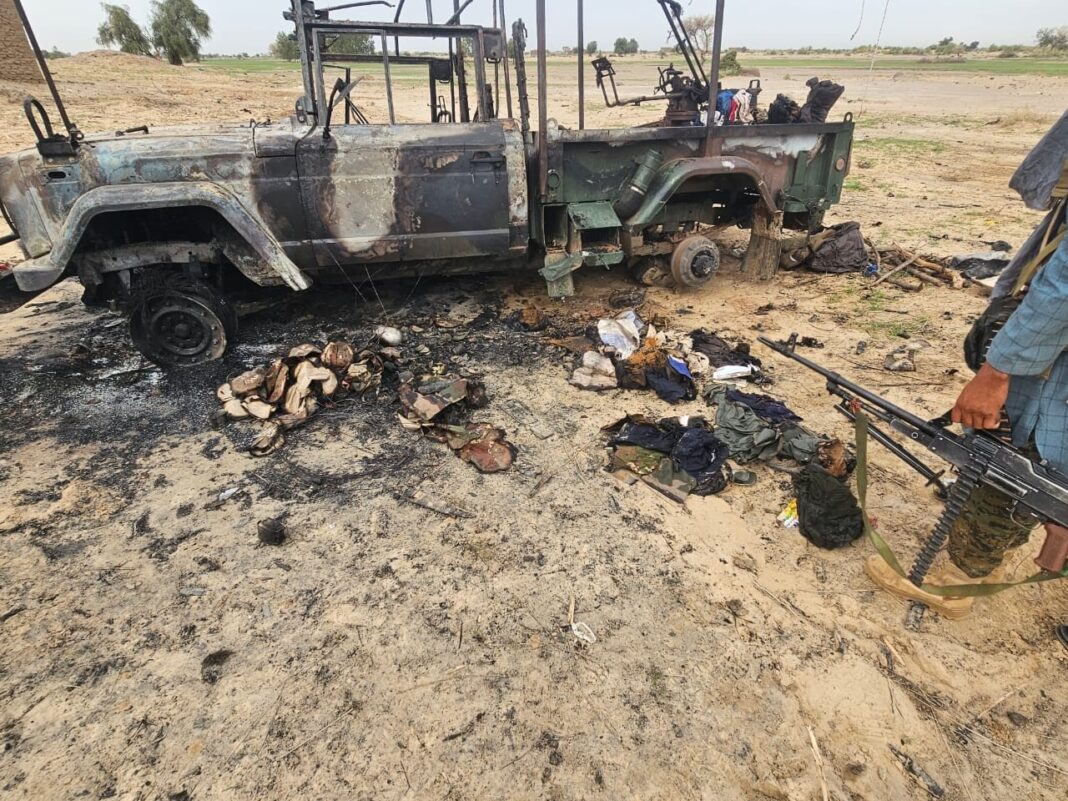
JNIM claimed responsibility for an attack this week on a convoy of fuel tankers travelling under military escort along the Ségou-Fana axis, east of the capital. Local reports said several tankers were set alight or damaged during the assault, while drivers were also reportedly caught in the violence. Malian troops protecting the convoy were targeted, with some reports indicating that Russian personnel associated with the Africa Corps were also involved in the escort.
The precise casualty toll remains unclear, and Malian authorities had not issued a detailed account of the incident at the time of writing.
The attack is significant because fuel has become one of the central fronts in JNIM’s campaign against Mali’s military-led government. Rather than concentrating exclusively on military bases and security forces, the group has increasingly targeted the infrastructure, transport corridors and commercial activity on which the state and its major cities depend.
For landlocked Mali, that vulnerability is particularly acute. Almost all petroleum products must enter the country by road, primarily through corridors linking Mali to the ports of Abidjan in Côte d’Ivoire and Dakar in Senegal.
According to FEWS NET, the two routes account for approximately 95% of Mali’s fuel supply, with around 60% arriving through Côte d’Ivoire and 35% through Senegal. Disrupting those corridors therefore gives JNIM the ability to exert significant economic pressure on Bamako without having to seize or hold the capital itself.
That strategy became increasingly apparent from September 2025, when JNIM began attempting to impose a blockade on petroleum imports entering Mali from neighbouring countries. The United Nations has described the campaign as a systematic effort to target fuel convoys, destroy tanker trucks and disrupt supplies to Bamako in order to place economic pressure on the Malian government.
Over the months that followed, tanker convoys, mining operations, factories and other economically important targets became increasingly central to the insurgency’s campaign across western and southern Mali.
The consequences were felt directly in Bamako, where repeated attacks contributed to fuel shortages, long queues at filling stations, transport disruption and pressure on electricity supplies. Open-source investigations have documented the destruction of large numbers of tankers along both the Senegal-Bamako and Côte d’Ivoire-Bamako routes.
The renewed attack therefore comes at a sensitive moment. After months of disruption, conditions in Bamako had recently begun to improve as increasingly large convoys reached the capital under military escort.
The Directorate-General for Trade, Consumer Affairs and Competition (DGCC) said more than 900 fuel tankers were received in Bamako on Sunday, 30 August, helping to restore supplies and reduce the long queues that had become a feature of daily life in the city.
But the improvement remains fragile. The military can protect individual convoys and temporarily restore supplies, but maintaining continuous access along hundreds of kilometres of road presents a far greater challenge.
Each successful attack forces the authorities to commit additional troops, vehicles and logistical resources to protecting commercial traffic, while increasing the risks faced by civilian drivers transporting fuel into the country.
The renewed activity has also revived broader concerns about JNIM’s ability to operate across areas surrounding Bamako. Reports circulating in recent days have suggested increased insurgent movement in parts of southern and central Mali, while other claims have referred to fighters seeking reinforcements from neighbouring countries.
These reports remain difficult to independently verify and should be treated cautiously.
Malian authorities have, meanwhile, intensified security operations and convoy protection as they seek to prevent the economic blockade from once again paralysing the capital. The struggle over the roads leading to Bamako has increasingly become a contest not simply over territory, but over whether the government can keep the country’s economic arteries functioning.
For JNIM, fuel convoys offer a particularly powerful target. A single attack can destroy valuable supplies, disrupt transport, increase insurance and operating costs, intimidate drivers and force the military to divert resources away from other fronts.
Repeated attacks can have consequences extending far beyond the battlefield, affecting electricity generation, businesses, public transport and household livelihoods.
This makes the battle over Mali’s highways increasingly important to the wider conflict. JNIM does not need to enter Bamako to exert pressure on the capital. By threatening the roads that feed it, the group can challenge the state’s ability to guarantee the basic movement of fuel and goods, while demonstrating that military control of the capital does not necessarily translate into control of the country’s economic lifelines.
The arrival of hundreds of tankers in recent weeks has shown that Malian authorities remain capable of breaking through the blockade and restoring supplies. But the latest attack is a reminder that the contest is far from over.
For Bamako, the question is therefore no longer simply whether fuel can reach the capital, but whether the government can keep those routes open consistently enough to prevent economic pressure from once again becoming a weapon of war.


