
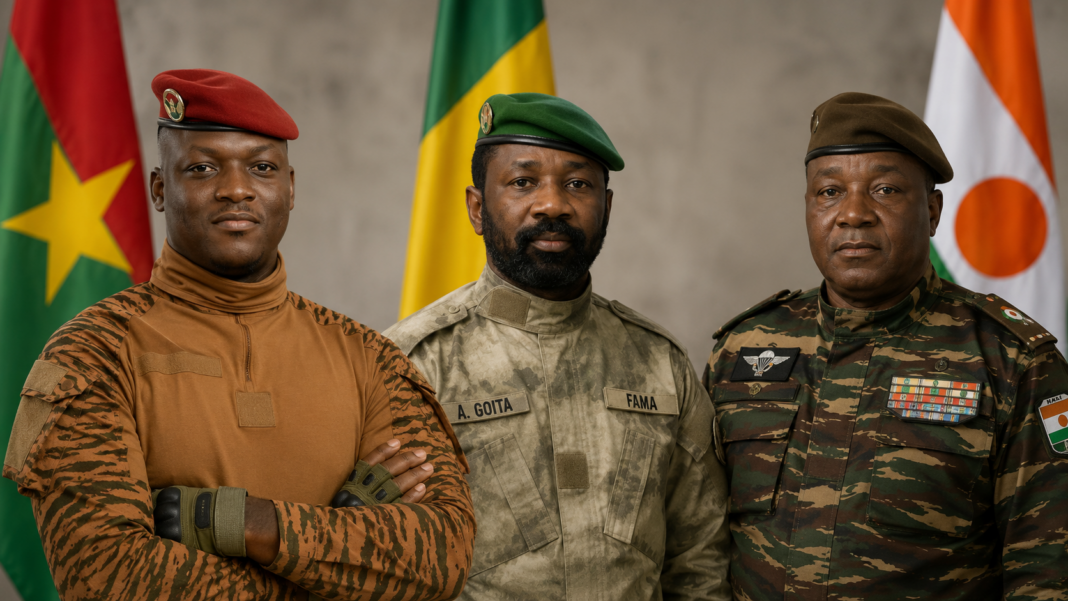

Recent statements by Niger’s President, General Abdourahamane Tiani, warning that a new offensive is being prepared against members of the Alliance of Sahel States (AES), have heightened regional tensions and renewed attention on the armed groups operating across the Sahel.
Since Mali, Burkina Faso and Niger formed the alliance, their military-led governments have made the fight against insecurity a central shared priority.
However, behind this unified security strategy lies a far more complex reality. Each country faces armed groups with distinct objectives, organisational structures and methods of operation, even as many become increasingly bold and capable of operating across borders.
Niger: Political rebellion and religious insurgency
Niger faces threats from two very different types of armed groups.
The first is the Patriotic Liberation Front (FPL), a rebel movement that emerged following the military overthrow of President Mohamed Bazoum in July 2023. Led by Mahmoud Sallah, the FPL says it is fighting to restore constitutional rule and secure Bazoum’s release.
Unlike religious insurgents, the FPL’s agenda is primarily political. The group has claimed responsibility for sabotage operations targeting strategic economic infrastructure in an effort to weaken the transitional authorities.
In late July 2026, Sallah announced an intensification of armed operations against the government led by General Tiani. Nigerien authorities have since designated the FPL a “terrorist organisation” and initiated proceedings to revoke the nationality of several of its leaders.
Alongside this political rebellion is the continuing threat posed by Daesh.
Operating mainly in the tri-border region linking Niger, Mali and Burkina Faso, Daesh pursues a transnational agenda fundamentally different from the FPL’s political objectives. It remains one of the region’s deadliest armed organisations and continues to launch attacks against security forces.
Among its most significant recent operations was an attack claimed against Niamey International Airport and Air Base 101, where members of Africa Corps, the Russian military formation supporting Nigerien and Malian forces, are based.
Niger therefore faces both an internal politico-military rebellion and a cross-border religious insurgency.
President Tiani has alleged that armed groups operating in the region are being “financed and supported by France”, an accusation repeatedly denied by Paris.
Burkina Faso: Ansarul Islam and JNIM
In Burkina Faso, one of the most influential armed movements is Ansarul Islam.
Founded in 2016 by Malam Ibrahim Dicko and now led by Zafar Dicko, the group first emerged in Soum Province before expanding across northern Burkina Faso.
Its founder maintained close ties with Amadou Koufa, leader of Katiba Macina in neighbouring Mali. Although Ansarul Islam initially operated independently, it was later integrated into the Group for the Support of Islam and Muslims, known as JNIM or GSIM, Al-Qaeda’s affiliate in the Sahel.
Operations conducted under the Ansarul Islam banner now form part of JNIM’s broader military campaign targeting Burkina Faso’s security forces, government officials and public infrastructure.
Its integration into JNIM illustrates how larger insurgent organisations have absorbed smaller local factions into wider command and operational structures.
Mali: Multiple insurgencies with different objectives
Mali has the most complex armed landscape within the AES.
The country’s largest religious insurgent group is JNIM, led by Iyad Ag Ghali, which seeks to establish governance based on its interpretation of Sharia across the Sahel.
Also opposing the Malian state is the Azawad Liberation Front (FLA), a coalition formed in late 2024 that brings together several predominantly Tuareg separatist movements.
Unlike JNIM, the FLA pursues a nationalist objective, advocating self-determination and, ultimately, independence for Mali’s northern regions.
Despite their fundamentally different political and ideological goals, JNIM and the FLA have reportedly cooperated tactically against a common enemy: the Malian Armed Forces and their Russian allies.
This cooperation has enabled coordinated operations, including clashes in late April 2026 and attacks reported along the Anéfis-Gao corridor in July 2026.
Analysts describe the relationship as a tactical arrangement rather than an ideological partnership.
Colonel Mohamed Issa, a senior FLA officer, said cooperation with JNIM had enabled the groups to divide operational responsibilities and combine their expertise in attacks against military bases and supply convoys.
JNIM’s expanding regional influence
Beyond individual national conflicts, JNIM has emerged as the dominant insurgent group across much of the Sahel.
Through its decentralised structure and network of katibas, the group operates across Mali, Burkina Faso and western Niger. Many security analysts regard it as the “most influential jihadist force operating within the AES”.
In Mali, JNIM concentrates much of its military capability. In Burkina Faso, it coordinates or influences affiliated organisations, including Ansarul Islam. In Niger, it regularly conducts operations in border regions, while at times competing with Daesh for territory and influence.
A regional conflict with multiple fronts
Officials from Russia’s Africa Corps deployed in Mali have described the conflict facing the AES as “a second front after Ukraine”, involving religious insurgencies, rebel movements and what they claim are French and Ukrainian agents operating in the Sahel.
President Tiani’s latest warnings come as armed groups demonstrate greater adaptability, operational coordination and cross-border mobility.
While the Alliance of Sahel States continues to promote a unified regional security strategy, the threats facing Mali, Burkina Faso and Niger remain distinct, reflecting the complex and rapidly evolving landscape of armed conflict across the Sahel.