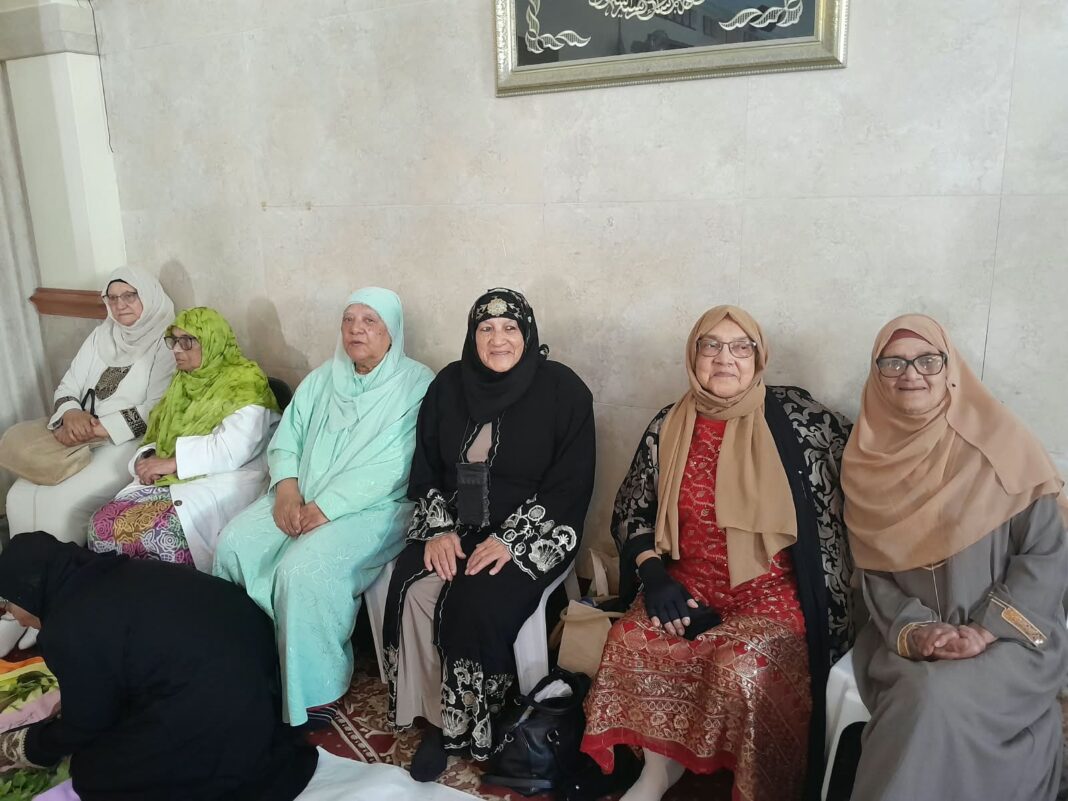

A 91-year-old Cape Muslim woman, Shahieda Sanders, returned last week to the neighbourhood from which she and her family were forcibly removed under apartheid’s Group Areas Act more than half a century ago.
The gathering took place at the Mohamadeyah Mosque on Harvey Road in Harfield Village, in Cape Town’s southern suburbs, which was declared a whites-only residential area in 1969.
Once home to a substantial Cape Malay community living among its distinctive Victorian cottages, Harfield Village was transformed by forced removals, with many Muslim families displaced to the Cape Flats.
For Shahieda’s daughter, Soraya Sanders, who accompanied her mother, the occasion carried significance far beyond the religious celebration.
After being forcibly removed from Harfield Village, the family was relocated to an apartment in Lavender Hill on the Cape Flats.
“This was my home for many years and today I am again getting to see all my people — they are like family to me,” Soraya said.
The Harvey Road mosque itself has a history stretching back more than a century.
According to congregants, the land was initially acquired by the Muslim community before financial difficulties forced its sale. It was later repurchased, and the mosque formally opened in 1915.
Former Harfield Village resident Salie Green, 74, recalled how the mosque once served a thriving Muslim community before apartheid uprooted its residents.
“The mosque was completed and opened its doors in 1915 and was very well attended by all Muslims of Harfield Village until we were forcibly removed,” he said.
Green, a former resident of 2nd Avenue, said the forced removals had devastating consequences for local families.
“It was very disturbing what took place here when the Group Areas Act came into force. It angered all of our people. Some resisted and others complied,” he said.
“The stress created sickness amongst our people, some of whom survived and others did not. The way people were forced out of their homes resulted in many resisting and, in some of those cases, there was brutality. It was bad.”
Another former resident, 78-year-old Sallega Mustapha, attended the gathering with her sisters and extended family.
“We grew up here and many of the ladies present lived in Harfield before being relocated to different areas on the Cape Flats,” she said.
“It was so sad when we had to leave Harfield and it was difficult to adapt to new areas, transporting our children to schools here from the Cape Flats. We had to leave our mosque behind. The relocation was challenging and we were not happy that we had been divided.”
Mustapha is the granddaughter of one of the mosque’s earliest imams, Armien Mustapha, who led the community for 54 years until his death in 1962.
Her family’s history in Harfield Village stretches back five generations. They were forcibly relocated in 1972, and she now lives in Penlyn Estate.
Mustapha is also a member of the Newlands/Claremont Heritage, Environmental Justice and Restitution Society and is preparing for September’s Heritage Day commemorations, which will include a “Walk of Remembrance” involving families displaced under the Group Areas Act.
Despite the dramatic decline in Harfield Village’s Muslim population following the forced removals, the Mohamadeyah Mosque continues to operate.
Imam Sheikh Fadiel Eman said it is now largely attended by people working in the area and the relatively small number of Muslims who have since returned.
“Old residents from before the eviction still attend the mosque during ‘Big Nights’, Ramadan and Eid,” he said.
The mosque also runs afternoon madrassa classes and youth programmes, while supporting outreach initiatives including stationery and sanitary-product drives for disadvantaged schools, Ramadan food parcels and financial assistance for other mosques where possible.
Sheikh Eman said one of the mosque’s main challenges today is the shortage of parking around the century-old building.
“The masjid was built over 100 years ago in one of the more populated ‘coloured’ areas in the Cape and very few people could afford a car, so parking wasn’t really a consideration when it was built,” he said.
He added that the mosque continues to maintain respectful relations with its non-Muslim neighbours.
“Because Muslims are a minority in the area, we only sound the athaan over the loudspeakers on a Friday for the Jumu’ah congregation,” he said.
More than half a century after apartheid uprooted Harfield Village’s Muslim community, the Mohamadeyah Mosque remains standing — not merely as a place of worship, but as a living reminder of a community that was displaced but never entirely erased.