
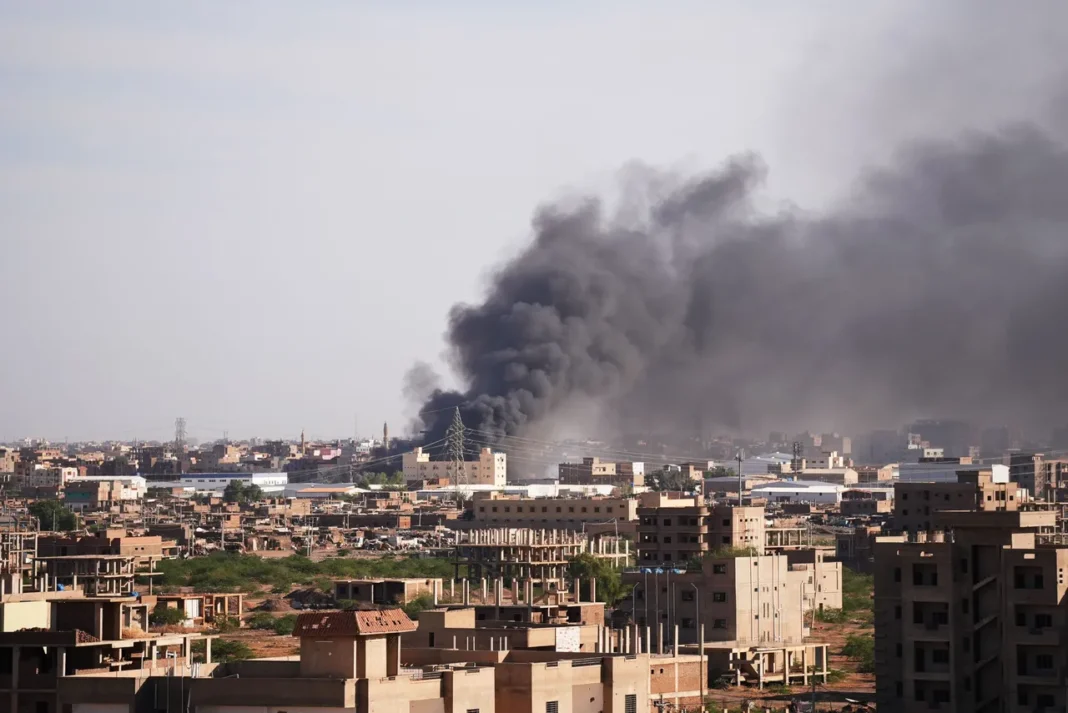

Sudan’s military-led authorities have lifted the state of emergency and curfew in Khartoum, marking another step towards restoring normal life to a capital devastated by years of war, looting and repeated attacks on critical infrastructure.
The decision comes around 18 months after the Sudanese Armed Forces (SAF) recaptured Khartoum from the Rapid Support Forces (RSF), the paramilitary force whose war against the state has torn Sudan apart since April 2023.
More than two million people have reportedly returned to the capital after millions were forced to flee during the fighting, but what they have returned to is a city deeply scarred by war.
Homes and businesses have been looted, public infrastructure has been badly damaged and large parts of Khartoum continue to suffer prolonged electricity blackouts.
Sudanese officials have accused the RSF of deliberately targeting the electricity network with drones, alongside widespread theft of cables, fuel and other essential equipment. The RSF denies deliberately attacking the grid.
The disruption has made rebuilding ordinary life extraordinarily difficult. Power shortages have prevented businesses from operating consistently and compounded an already severe economic crisis. Recent reporting from army-controlled areas has documented workers unable to complete basic jobs because electricity disappears for hours or entire days.
Khartoum International Airport has partially reopened, businesses are being encouraged to return and Sudanese authorities want foreign diplomatic missions to resume operations.
Security restrictions, however, have not disappeared entirely.
Authorities continue to conduct patrols and security operations across greater Khartoum amid concerns over RSF cells, criminal networks and weapons left behind following the fighting. Residents travelling at night may still be required to carry identification.
But while Khartoum attempts to rebuild, Sudan’s war is increasingly exposing a much wider regional struggle — and renewed scrutiny is falling on the foreign networks accused of sustaining the RSF.
The UAE shadow over Sudan’s war
For years, Sudanese authorities have accused the United Arab Emirates of arming and financing the RSF, allegations Abu Dhabi has repeatedly denied.
Those denials have become increasingly difficult to separate from a growing body of investigations documenting sophisticated weapons routes, mercenary networks and logistics operations linking the RSF to neighbouring states and entities based in the UAE.
Human Rights Watch reported in May that Colombian fighters recruited through a UAE-based private security company were deployed to fight alongside the RSF. Its investigation also documented testimony and previous UN findings concerning routes through Chad used to move military supplies towards RSF-controlled territory.
In July, UN experts examining aircraft previously identified in a Reuters investigation concluded that planes were used to transport weapons, drones and mercenaries for the RSF. The investigation also linked Colombian mercenaries fighting alongside the paramilitary force to UAE-based Global Security Services Group.
The UAE continues to reject accusations that it arms the RSF.
But the scale of the evidence has ensured that Abu Dhabi’s role remains one of the central controversies surrounding the Sudan war.
Sudanese officials have accused the UAE of exploiting supply routes through Chad, Libya and elsewhere to keep the RSF supplied even as the paramilitary force has faced allegations of atrocities across Darfur and other parts of the country.
The allegations are particularly serious because the conflict is no longer confined neatly within Sudan’s borders.
Tensions erupt with Chad
Chad recently accused Sudanese forces of striking a military convoy more than 100km inside Chadian territory in the eastern Ennedi-Est region.
Khartoum rejected the accusation and said Sudan’s military remains committed to respecting neighbouring states while defending the country against threats to its sovereignty.
The confrontation cannot be separated from Sudan’s longstanding accusation that Chadian territory has been used as a logistical corridor for RSF supplies originating from the UAE.
Human Rights Watch has documented the significance of Amdjarass airport in eastern Chad, citing previous UN findings that weapons arriving there were transported towards the Sudanese border for the RSF. The organisation also cited reporting that the facility had expanded substantially during the war.
Both Chad and the UAE deny facilitating weapons transfers to the RSF.
Yet the dispute illustrates precisely how the militarisation of Sudan by outside powers threatens to drag neighbouring countries deeper into the conflict.
The African Union and the United States have warned against any expansion of fighting across Sudan’s borders following the reported strikes inside Chad.
Washington pushes nationwide arms embargo
The United States has meanwhile proposed expanding the existing UN arms embargo on Darfur to cover the entirety of Sudan, including drones and related technology.
The current UN sanctions regime restricts the supply of weapons to actors operating in Darfur.
Washington argues that outside military and financial support is prolonging the conflict and risks drawing regional states further into the war. Its proposal would broaden the embargo nationwide and explicitly include unmanned aerial vehicles.
Sudan has opposed the proposal, arguing that it would effectively place the country’s recognised armed forces on the same footing as the RSF and restrict the army’s ability to fight an armed rebellion.
That objection strikes at the heart of the political dispute surrounding international responses to Sudan.
The SAF is Sudan’s national military, while the RSF is a paramilitary force that turned its weapons against the state and established control over large areas of the country.
Treating both simply as interchangeable “warring parties” risks obscuring the origins and structure of the conflict — while giving insufficient attention to the foreign supply networks that have enabled the RSF to sustain a devastating war.
Khartoum may now be emerging from curfews and emergency rule, but Sudan’s recovery remains hostage to a conflict whose lifelines stretch well beyond its borders.
And at the centre of the controversy sits the UAE: a wealthy regional power that insists it is not arming the RSF, even as investigations continue to expose routes, mercenaries and military supply chains that repeatedly lead back towards Emirati-linked networks.
For Sudan, rebuilding Khartoum is therefore only part of the struggle.
Ending the war will also require confronting the foreign machinery that has helped keep it alive.