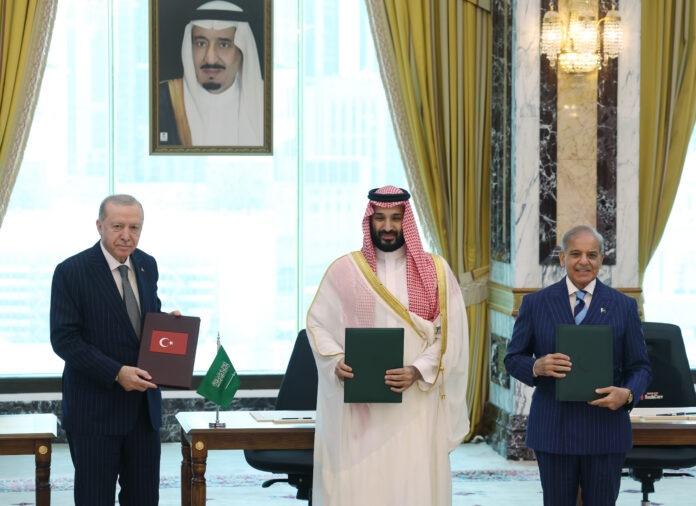

One Nation Media editor Dilly Hussain reflects on the significance of the new trilateral defence pact between Saudi Arabia, Türkiye and Pakistan, asking whether it could become the foundation of a more independent Muslim security architecture — or ultimately remain another alliance driven by nation-state interests and the rapidly changing geopolitics of the Middle East.
The intentions of the rulers aside — and they may have absolutely nothing to do with pursuing a pan-Islamic regional project — I pray that goodness comes from the Mecca Joint Defence Agreement signed by Saudi Arabia, Türkiye and Pakistan on Friday, 7 August.
My cautious optimism should not be mistaken for an endorsement of Recep Tayyip Erdoğan, Mohammed bin Salman or Shehbaz Sharif, their governments or regimes. Nor should an agreement between three major Muslim-majority states automatically be interpreted as evidence of an emerging Islamic geopolitical consciousness.
The pact was very likely conceived through the narrower prism of nation-state interests, regional security calculations and political expediency. There is little reason to assume its architects suddenly possess some grand civilisational vision. Indeed, recent events point towards a more straightforward explanation.
The ongoing US-Iran-Israel war has brutally exposed vulnerabilities in the Gulf security architecture. States that have spent decades relying heavily on American military protection have been reminded that hosting US military infrastructure can itself make them potential targets when Washington enters conflicts elsewhere in the region. For Saudi Arabia in particular, whether long-term dependence on the American security umbrella remains sustainable has become increasingly difficult to ignore.
Türkiye brings considerable military capacity, a rapidly developing indigenous defence industry and strategic weight across several theatres. Pakistan has around 660,000 active military personnel and, crucially, nuclear weapons. Against that backdrop, closer military cooperation between Riyadh, Ankara and Islamabad is hardly surprising.
The pact will be judged when it is tested
The real test is whether its central promise — that “an attack on one will be regarded as an attack on all three” — survives contact with the messy realities of regional geopolitics.
Consider Iran or the Houthis. What happens if Tehran or Sanaa attacks what it describes as American military assets hosted in the Gulf, but those strikes hit Saudi territory, damage civilian infrastructure or kill Saudi citizens? Would Pakistan and Türkiye consider Saudi Arabia to have come under an attack requiring meaningful support, particularly if doing so risked drawing them into direct confrontation with Iran?
Then there is Israel and Syria. Türkiye has substantial strategic, military and political interests immediately across its southern border. If further Israeli military operations inside Syria significantly undermine Turkish strategic interests, threaten Turkish personnel or directly interfere with Ankara’s security operations, at what point does that become an attack on Türkiye for the purposes of the agreement — and what would Saudi Arabia and Pakistan actually be prepared to do?
Pakistan presents perhaps the clearest test. If India launches military operations against Pakistan — across the internationally recognised border, in another confrontation involving Kashmir or elsewhere — would Saudi Arabia and Türkiye translate their commitment into meaningful military, diplomatic or economic action against India?
These are not peripheral questions. They go to the heart of whether this pact represents the beginnings of a genuine collective security architecture or another carefully worded agreement whose obligations become negotiable once serious political and economic interests are at stake.
The test becomes even harder if the arrangement deepens and expands. India, China, Russia and the US are nuclear powers with enormous military and economic weight and varying degrees of influence across the Muslim world. Any serious collective security architecture would eventually have to answer a fundamental question: is its guarantee genuinely universal regardless of the aggressor, or does “an attack on one is an attack on all” apply only when confronting states its members can politically afford to confront?
Collective defence means little if its application depends entirely on who the attacker happens to be. The independence and credibility of this pact will therefore be determined not by communiqués and signing ceremonies, but when honouring its commitments carries a genuine military, economic or geopolitical cost.
What does this pact mean for Palestine?
More than 73,000 Palestinians have officially been reported killed in Gaza since October 2023, with further victims believed to remain beneath the rubble. Independent research published in The Lancet Global Health suggests the true toll was already substantially higher much earlier in the war, estimating approximately 75,200 violent deaths between 7 October 2023 and 5 January 2025 alone.
Then there is the occupied West Bank, where Palestinians continue to face Israeli military raids, displacement, settlement expansion and settler violence.
And above all stands Masjid al-Aqsa. If Islam’s third holiest mosque can remain under occupation, repeatedly subjected to incursions and surrounded by an increasingly entrenched occupation, Muslims are entitled to ask what constitutes a security threat worthy of collective action.
If Palestine can be occupied, bombarded and systematically devastated for nearly three years without provoking any meaningful collective military response from the most powerful Muslim states, what exactly is being collectively defended?
Borders, governments, military installations, energy infrastructure and shipping lanes are all legitimate interests for nation-states to protect. But protecting those interests should not automatically be confused with constructing an Islamic security order.
Palestine may therefore provide the clearest test of whether this pact represents anything remotely civilisational or remains, at its core, a conventional arrangement between three nation-states pursuing their respective national interests. If its commitments extend to attacks on Saudi, Turkish or Pakistani territory but end where Israeli occupation and aggression against Palestinians begin, then we should describe the pact for what it is rather than what we might wish it to become: a strategic alliance between states. Nothing more, at least for now.
From dependency to strategic autonomy
For decades, much of the security architecture of the Arab and wider Muslim world has depended heavily on foreign powers.
The US remains the dominant external military actor across much of the Arab region, maintaining bases, defence agreements, weapons relationships and extensive military infrastructure from Bahrain and Qatar to Kuwait, the UAE and Saudi Arabia. Recent conflicts have raised serious questions about how reliable and unconditional American protection actually is for Washington’s Arab partners, particularly when compared with the depth of its security commitment to Israel.
The present regional war has sharpened that contradiction. American military infrastructure intended to protect Gulf states can simultaneously expose those states to retaliation when Washington uses regional bases and assets in its own military confrontations.
That creates an obvious strategic dilemma. A state cannot claim full strategic autonomy while remaining overwhelmingly dependent for its security on a foreign power whose military decisions it does not control.
But Washington is not the only external power upon which Muslim-majority states have relied. Several developed substantial military relationships with the Soviet Union during the Cold War, some of which continued with Russia after its collapse. China has become increasingly important in recent decades, particularly for Pakistan, supplying 80% of its major arms imports between 2021 and 2025.
The lesson cannot therefore be to exchange dependence on Washington for dependence on Beijing or Moscow. Replacing one dependency with another is not strategic autonomy.
The objective should be for Muslim-majority states to become less reliant on any foreign great power for their security, military modernisation and technological capabilities. At a minimum, defence relationships should be sufficiently diversified that no single external power possesses an effective veto over national security. The greater ambition, however, must be indigenous capability.
Modernising and strengthening Muslim armies
Modern warfare is transforming rapidly. Artificial intelligence, autonomous systems, drones, electronic warfare, cyber capabilities and precision weapons are changing what states can achieve and lowering some of the traditional barriers to advanced military capability.
Türkiye’s development of its domestic defence industry — most visibly through the success of the Bayraktar drone programme — demonstrates what sustained investment in indigenous military technology can produce. Iran’s development of the Shahed family of unmanned aerial vehicles, irrespective of one’s assessment of Tehran and its policies, similarly demonstrates how a state operating under considerable external constraints can develop relatively inexpensive capabilities that alter military calculations far beyond its borders.
Pakistan, Türkiye, Saudi Arabia and other Muslim-majority states collectively possess enormous reserves of capital, industrial capacity, scientific expertise, human resources and strategic geography — alongside Pakistan’s nuclear capability. The question is whether those strengths can increasingly be pooled rather than outsourced.
Joint research and development, technology transfer, interoperable defence industries, indigenous weapons production, shared training and expertise in AI, drones, cyber warfare and other emerging technologies could make collective security between Muslim states materially meaningful rather than merely rhetorical.
Even if one accepts the present reality of the secular nation-state — a political formation that I believe is fundamentally problematic from an Islamic worldview — a pragmatic question remains: is greater military autonomy and cooperation among Muslim-majority states preferable to permanent and disproportionate dependence on foreign powers?
I believe the answer is unquestionably yes. The objective should not be anti-Americanism for its own sake. It should be autonomy.
Revivalist aspirations in a multipolar world
An increasingly multipolar world, despite all its contradictions and dangers, may give Muslim nations greater space to pursue independent political, economic and civilisational aspirations rather than remaining permanently locked into the strategic architecture of a single dominant superpower, namely the US.
More Muslim states should ultimately join independent collective security arrangements, reduce their dependence on foreign military protection and invest seriously in their own defence industries, technology and human capital. Ultimately, they should work towards ending the permanent presence of foreign military bases on their soil. I do not believe there can be meaningful strategic autonomy across the Muslim world while foreign powers retain the ability to project military force from Muslim countries themselves.
But autonomy must mean more than replacing foreign protection with stronger national armies. If Muslim states become militarily independent only to defend the borders, regimes and economic interests of the existing nation-state order while remaining incapable or unwilling to protect Palestine, Masjid al-Aqsa and oppressed Muslim populations beyond those borders, then very little of civilisational significance has actually changed.
None of this means that Erdoğan, Mohammed bin Salman or Shehbaz Sharif intended anything resembling a pan-Islamic project when they signed this agreement. On the available evidence, the more persuasive interpretation is that the pact responds principally to changing strategic realities: vulnerabilities exposed by the US-Iran-Israel war, uncertainty over continued reliance on American protection, shifting regional power balances and the growing desire for greater military autonomy.
That alone makes the agreement significant. But significance should not be confused with civilisational purpose. Whether it develops into something more meaningful will depend not on the Muslim identity of its member states or the rhetoric surrounding it, but on what those states are ultimately prepared to defend.
Perhaps it will amount to very little. Geopolitical pressures, competing national interests and foreign influence may prevent it from becoming anything more than another transactional defence agreement. It may successfully provide Saudi Arabia, Türkiye and Pakistan with greater strategic leverage and security while remaining entirely within the logic of the secular nation-state system and the broader US-led regional order.
Or perhaps, over time, it could evolve into a genuinely independent collective security architecture encompassing more of the Muslim world. If that day ever comes, however, its credibility will not be established merely by declaring that an attack on Riyadh, Ankara or Islamabad is an attack on all three.
The far harder question will be whether Palestinian and Kashmiri blood matters as much as the sovereignty of states; whether the occupation of Masjid al-Aqsa is regarded as an Islamic obligation to address rather than merely a diplomatic issue; and whether Muslim collective security extends to protecting the Ummah when doing so carries a serious geopolitical cost.
Until those questions are answered, we should welcome greater independence from foreign military domination without romanticising what this pact presently represents.
Strategic autonomy would be progress. A genuinely Islamic security order would require considerably more.
And Allah (SWT) knows best.