

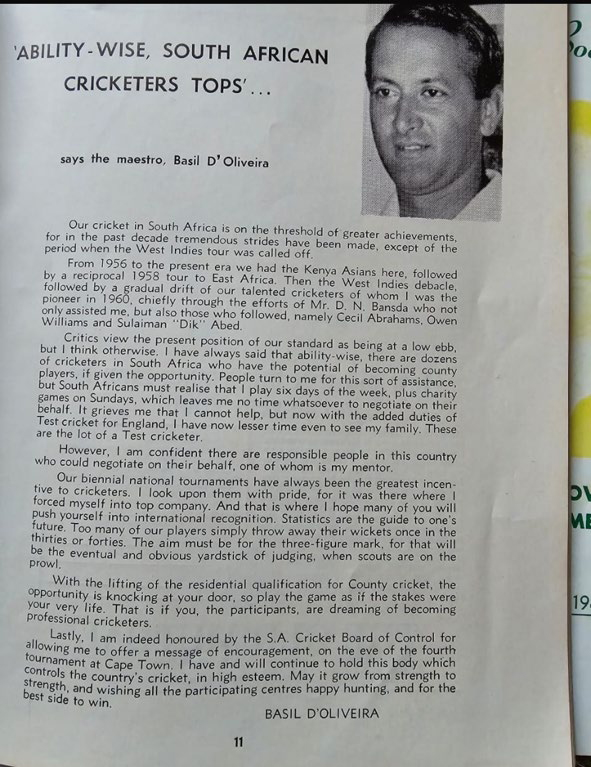
Few episodes exposed the cruelty — and the cowardice — of apartheid sport quite like the Basil D’Oliveira saga. D’Oliveira, a supremely talented cricketer from Cape Town, had been forced to flee South Africa’s racist cricket structures to pursue his career in England. Then came the ultimate “googly” the apartheid regime could neither play nor duck: in 1968, he was selected to tour South Africa with England — against the country of his birth. What followed was a political crisis disguised as a selection debate. In this exclusive excerpt from Dougie Oakes’ “Biography of Hassan Howa – No Normal Sport”, the inside story is recounted — of how one man’s bat threatened to bring down an entire ideology:
It was a time pockmarked by the scandalous conduct of cricket officials in South Africa and England and by the shameless threats of the South African Prime Minister, BJ Vorster. But in the months of 1968 that were filled with key moments leading up to what would become known as the ‘D’Oliveira Affair’, the most disgraceful performer in a long cast of disgraceful performers was Arthur Heder Coy, the secretary of the white South African Cricket Association (SACA).
Coy had fought in the Second World War on the side of the Allies against Nazi Germany. By contrast, Vorster’s heart was in what the German Führer Adolf Hitler stood for. But this didn’t matter to either man. In South African racist jargon, D’Oliveira was classified as ‘coloured’.
To them, and most of white South Africa, all their efforts were aimed at stopping the former Capetonian, Basil D’Oliveira, from being selected for an MCC side scheduled to tour South Africa in 1968/69. The fact that he had been forced to declare his allegiance to another country did not matter to Vorster and, for that matter, Coy: In their eyes, a coloured person would always be a coloured person. And in South Africa, white sport meant exactly that – sport played only by white persons, with and against other white persons.
Coy did not openly say that he was strongly and rigidly opposed to ‘mixed-race’ sport. He did not need to. His actions, typified by his preparedness to act as Vorster’s messenger between South Africa and the Long Room of Lords, the MCC’s meeting venue, where all types of intrigue were planned and secrets whispered, showed exactly where he stood.
He was prepared to do Vorster’s bidding to a degree that beggared belief, using his contacts in the MCC, calling in favours to enable him to know exactly what their officials were discussing about D’Oliveira in their supposedly confidential meetings, whispering darkly to the British that D’Oliveira’s selection would spell the end of the 1968/69 tour by the MCC to South Africa, and making sure that Vorster was always kept in the loop.
The South African Prime Minister, who, bizarrely, saw MCC officials as ‘pawns of the left-wing’ governing Labour Party in the United Kingdom, was in his element as officials in both South Africa and London fell over their feet to lessen his concerns. The tiny number who did not support apartheid were too spineless to disagree with him over his vow to the world that South Africans would not play mixed sport in the Republic. ‘We are not prepared to negotiate, and we are not prepared to make concessions,’ he thundered.100
Coy probably said a long, silent ‘Hurrah’ – and other South African Cricket Association officials backed him too, while a strong core of Britons felt the same way.
Despite the sordid developments, every article or book written about D’Oliveira in the context of that sad time was clear: he was one of the ‘nicest’ people in cricket – ‘an all-round good guy’ and one of the few people to emerge from the ‘D’Oliveira Affair’ with his credibility intact.
100 ‘Sport: PM opens the door’, Rand Daily Mail, 12 April 1967.
How to destroy a dream
D’Oliveira’s demeanour was characteristic of a member of the coloured community growing up in the 1930s, ’40s, or ’50s in South Africa. It was, in many ways, the age of stoicism in the face of a catalogue of laws and regulations enforcing segregation and, later, apartheid.
A story he related in two books, The D’Oliveira Affair and Time to Declare, was typical of his forgiving and politically naive nature. It happened on a boat trip from Southampton to Cape Town, with his wife, Naomi, and sons, Damian and Shaun, in 1966.
‘We had been at sea four or five days when a white South African couple, who had been to England for their honeymoon, enquired if I was Basil D’Oliveira,’ he wrote. ‘They did not want to talk about cricket but felt they had to say something about apartheid. They had… been impressed with the way Damian and Shaun had behaved, and they showed a genuine warmth towards us as a family.
‘The husband said, “I want to tell you I am a Nationalist, and I have always supported the government’s policy of segregation. After seeing you and your wife with your children, I am now going home wondering if… we are right.”
‘I told him that, mistaken though I believed the policy to be, I could accept that the Government sincerely believed that their way was the only means of establishing and maintaining a lawful and regulated society. And I had to add: “For us, the important thing about meeting you is that, without taking issue with you, but just being around, we have set you thinking again about the problem. There is a whole nation like us; some much nicer, better in many ways, and more educated than I will ever be.”’
This was typical D’Oliveira: his experience at sea confirmed (in his eyes) the correctness of his role – as a bridge builder – from his new home while watching events play out in his old home. It turned him into someone willing to accept the most patronising remarks aimed at him with a smile. Even so, in those difficult days, the behaviour of some of the top officials of the MCC and their ragtag South African hangers-on was unconscionable. However, as Howa and other critics often pointed out, D’Oliveira was treated the way he allowed others to treat him.
***
Although he was a victim of a disgraceful campaign to keep him out of the MCC team for its South African visit, D’Oliveira did not realise the extent to which he was regarded as necessary collateral damage in a much bigger battle, involving English aristocrats, businesspeople, and professional players who claimed to be against apartheid but insisted on competing in sport with those whose lives were built around this very policy.
D’Oliveira believed in the power of faith and the decency of humankind. His vision as a cricketer was built on simple black-andwhite cricketing terms: if he performed well for the national side, he would realise a boyhood dream of playing test cricket, even if not for the country of his birth.
This was his motivation.
But it was a naïve belief, and one which history proved to be wrong.
In simple terms, D’Oliveira was swindled by brazen hypocrites.
People, many of whom he thought were his friends, were prepared – blithely – to sacrifice his hopes and dreams on the altar of their hypocrisy. And for what? To keep alive a South African tradition of ‘whites-only’ cricket.
In South Africa, the Prime Minister, BJ Vorster, had a security file on him when he was selected to play test cricket. After the scandal, when the archives were opened to the public, they contained just a few press cuttings, with nothing to show why anyone – except Vorster – would have thought he would be a security risk.
Still, Vorster was relentless. With the faithful Coy, he spent excessive time plotting how to keep the South African-born player out of the side. D’Oliveira became his obsession. Vorster’s actions ranged from warnings sent via Coy to carefully identified decision-makers in the MCC that selecting D’Oliveira would doom the tour… to bribes… to ridiculously suggesting to D’Oliveira that he should make himself unavailable for the MCC but available for South Africa… and to spying on selectors. It was a rollercoaster ride for the Vorster and Coy combination, with the mood in Coy’s report-backs to his Prime Minister swinging from glee to dismay.
Coy did not act without the backing of the South African Cricket Association; on several occasions, he flew to the United Kingdom with the SACA president, Jack Cheetham. Reports in that period indicated that Cheetham was as conniving as Coy. But the actions of some members of the MCC – and they were probably just the tip of an iceberg of skullduggery – were as shameful.
These included Alec Douglas-Home, a former Conservative Party Prime Minister, shadow Foreign Minister, and a member of the MCC, who, during a visit to South Africa, was told to ask Vorster if D’Oliveira would be welcomed in the country if selected.
The request dripped with cowardice, but Douglas-Home’s actions were even worse. When he met Vorster, he did not even ask the Prime Minister.
On returning to the United Kingdom, no one questioned why he did not carry out his MCC brief. Worse, they allowed themselves to be fobbed off with advice rather than to wait and see. He reasoned that there was no guarantee that D’Oliveira would even be chosen for the side – in other words, Douglas-Home wanted to let sleeping dogs lie.
Another MCC member invited for a consultation with Vorster was Charles Lyttelton (or to give him his aristocratic name, Lord Cobham), who was told, deliberately bluntly, ‘Choose D’Oliveira and the tour is off.’ Alarmed, he went to the Long Room at Lords and, as Vorster hoped, passed on his warning to the MCC secretary, Billy Griffith, its treasurer, Gubby Allen, and its president, Arthur Gilligan. They knew that if they had notified other MCC committee members, as they should have, the tour would have been cancelled. And so, they kept it secret, while plans were hatched to ensure that D’Oliveira would not be chosen.
Coy was happy to agree to this, but not Vorster: the South African Prime Minister still did not trust the ‘leftist control’ that the governing Labour Party had over the cricket body. He needed to see something concrete put forward to keep D’Oliveira out of the touring team.
According to Rich Evans, writing for the Wisden publication, The Nightwatchman, Coy told Cheetham that Cobham, who had considerable business interests in South Africa, would ‘do almost anything to see that the tour is on’ and would ‘talk to O [code for D’Oliveira] with ideas that would suit us’. Coy, trying to give the impression that he had more influence than he really had, suggested that ‘BG [Billy Griffith] is very much for us – is influential outside the meeting but hamstrung inside.’ Cheetham believed the MCC would not have the nerve to omit D’Oliveira, prompting Coy to suggest to Vorster: ‘In view of this, the ‘non-availability’ of this person seems more important than ever.’
The next ploy, devised in South Africa, had the South African Prime Minister’s fingerprints all over it: a bribe.
A new ploy – And a lifeline
The offer came from Tienie Oosthuizen, a South African, who was the London-based marketing director of Carreras, a tobacco company that was part of the Rothmans group in the UK. This group was acquired by the South African Afrikaner industrialist Anton Rupert’s Rembrandt Group in 1958.
At a meeting he called with D’Oliveira, Oosthuizen said an organisation with which he and Rembrandt also had ties, the South African Sports Foundation, needed a coach for coloured cricketers. It was an opportunity too good to ignore – more than £4,000 a year, all expenses paid, a car, a house, and other benefits. With D’Oliveira well into his thirties, it would have set him and his family up for life.
But there was just one snag… According to Oosthuizen, the Foundation required an answer before the announcement of the MCC team to tour South Africa. And although his chances of selection appeared slim, D’Oliveira still hoped he would be part of that team.
What happened next resembled a cat-and-mouse game, with D’Oliveira trying to play for time but not being particularly good at it. Oosthuizen, the marketing expert and a master of negotiation, insisted that the post had to be taken up almost immediately. He set a deadline of 14 August 1968. The MCC team was due to be announced around 28 August.
D’Oliveira would have to make himself unavailable.
A psychological game centred on incessant telephone calls followed. Oosthuizen kept reminding D’Oliveira how good the offer was, and he called on him to apply his mind and give his answer urgently. But then, as so often happened in D’Oliveira’s life, fate stepped in.
Cometh the hour…
The England opening batter, Roger Prideaux, withdrew with bronchitis from the side for the Ashes-deciding fifth test against Australia at The Oval on 22 August. The England captain, Colin Cowdrey, decided to shift Colin Milburn up the order to open the batting and bring an allrounder into the middle order, but his first two choices – Tom Cartwright and Barry Knight – were both unfit. So, in came D’Oliveira.
It would prove a memorable game for the former South African, and he slept with difficulty the night before the first day. But the next morning, the opening day of the test, when he phoned his wife, Naomi, he was filled with sunny optimism. ‘Send the kids out, pull up a chair in front of the television, and watch. I am going to be there all day,’ he told her.
And he was true to his word. He went into bat with 30 minutes left on the first day and strolled to 23 by the close of play. The next day, he played one of test cricket’s greatest ‘under-pressure’ innings, punctuated by great strokes and with some wonderful secret on-the-field comments by the umpire, Charlie Elliott. When he played a few streaky shots early on, Elliott warned him to ‘Get your head down’. When D’Oliveira reached 50, Elliott whispered, ‘Well played. My God, you’re going to cause some problems.’ His 100 was greeted with an Elliot comment, ‘Oh Christ, you’ve set the cat among the pigeons now.’
When he was ninth out for 158 runs, it seemed he had sealed his place in the team to go to South Africa. The coaching offer from Tienie Oosthuizen was quietly forgotten, and Oosthuizen returned to South Africa shortly afterwards. But D’Oliveira and all who had rooted for him over many years were in for a rude shock.
‘Torn apart’
On the day the MCC team to tour South Africa was announced, 28 August 1968, D’Oliveira was playing a home match for Worcestershire against Sussex. He ensured he was in the pavilion to hear the team announcement on the 6.30 pm radio news. He was full of confidence.
In his book Time to Declare, D’Oliveira wrote: ‘I kept waiting to hear my name in the list of players. But it wasn’t there. I was dumbstruck. You could have heard a pin drop in that room; I don’t know how long I stood there, but the first thing I recall was Tom Graveney swearing bitterly.
‘Tom saw the state I was in, and he took me to the physio’s room, where I broke down and sobbed like a baby. Then, I was permitted to get away early.
‘As I stepped outside the pavilion, I saw my son, Damian: “Never mind, Dad,” he shouted, “you’re still the greatest!”
‘But I didn’t feel it. I was like a zombie. My stomach had been kicked out of me. I remember thinking, “You just can’t beat the white South Africans.” I wasn’t bitter. My mood was simply one of resignation.’101
In South Africa, Vorster’s newly appointed Minister of Police, Lourens Muller, did not even try to hide his feelings of triumph as he addressed a gathering of National Party faithful in Potchefstroom, in the then province of Western Transvaal. Stopping in mid-speech, he announced that D’Oliveira had not been selected.
His audience burst out into a prolonged round of cheering, which, according to the Progressive Party MP, Helen Suzman, could be heard ‘halfway around the world’.
‘It was not only in the field of sport that Muller demonstrated his astounding insensitivity,’ Suzman wrote in her book, In No Uncertain Terms. ‘There was a horrifying incident where a number of people had been arrested and then transported in a police van in which there was no ventilation. It was a very hot day, and when the van finally arrived at its destination, several people inside were found to be dead. I asked Muller whether the government would consider making an ex gratia payment to the dependents of the victims. He replied, “The South African Police cannot adopt the attitude of Father Christmas.”’
***
Coy, too, was overjoyed at D’Oliveira’s omission. Shortly after the news became known, he sent a letter from himself and the SACA to Vorster, saying,
I did so appreciate your telephone call to me on the evening of the 28th of August, when our respective problems were resolved. Your courtesy, frankness, and trust with which you received me on behalf of the SACA were also very much appreciated, and we do indeed appreciate your help and guidance in the matter, which was so important to our country in many respects.
The privilege of lunching with you and Mrs Vorster… when you were occupied with other matters was a privilege and experience I shall always treasure.
Once again, many thanks and appreciation.
I remain yours respectfully.
Arthur H. Coy.
***
In the United Kingdom, there were no congratulations, backslapping or wild cheering – just shock and anger, and comments from several sources that there could be no plausible explanation for D’Oliveira’s non-selection. The MCC and its selectors, backed by some outsiders and some media members, insisted that the decision to omit someone on the back of an innings of 158 had been made purely for cricket reasons. But every time they made this claim, tempers became frayed. Many answers were demanded for many questions, but for a long time, there seemed to be no answers, except for suggestions that there had been a conspiracy at the highest levels of the MCC.
The United Kingdom’s The Guardian newspaper led the charge against MCC officials who claimed that D’Oliveira had been left out of the side for cricket reasons. ‘Anyone who swallows that would believe the moon is a currant bun,’ it said.
The great cricket commentator, John Arlott, who had played such a big part in helping D’Oliveira get to the United Kingdom to play cricket, said, ‘No one of open mind will believe he was left out for valid cricketing reasons.’ In a scathing letter to The Guardian, Arlott accused the MCC selectors of bowing to political pressure from the South African government. He wrote that the exclusion of D’Oliveira from the team was a ‘betrayal of cricket and cricketers’ and a ‘surrender to the racialism of South Africa’. He accused the selectors of having been ‘influenced by considerations other than cricket’ and of ‘sacrificing a man of integrity and ability’, and he threatened to resign from the MCC if the tour went ahead.
Mike Brearley, who toured South Africa in 1964-65 and hated what he saw, supported isolation for the Springbok cricket team and seconded a motion from the former England batsman David Sheppard (later the Bishop of Liverpool), calling for the scrapping of all cricket ties between England and South Africa until there was ‘actual progress towards nonracialism in the sport’. The Anti-Apartheid Movement sent three telegrams in response to D’Oliveira’s non-selection. The first was sent to the MCC, protesting at his omission, and demanding that the tour be cancelled. The second asked the British Prime Minister, Harold Wilson, to ensure racial discrimination was not involved in the makeup of representative teams. Where this was the case, such tours needed to be cancelled immediately. The third demanded the resignation of the Conservative Party politician, Alec Douglas-Home, from the MCC and the withdrawal from the team of all the selected players to show their refusal to be part of a ‘racialist’ team.
D’Oliveira maintained a dignified silence and, instead, considered an offer from the News of the World newspaper to cover the tour for them.
As he weighed up the offer, he was reminded that there were no media facilities at any of South Africa’s cricket stadiums for black reporters, and Vorster warned that he would not take kindly to newspapers which tried to make political capital out of cricketing matters.
A lifeline
For a while, it seemed that D’Oliveira would be as unwelcome in South Africa as a journalist as he was unwelcome as a cricketer. However, his zigzag journey was far from over, as an allrounder named Tom Cartwright stepped into the controversy.
Described by those who knew him as ‘an old-fashioned socialist, a rarity in the professional game’, Cartwright had grown up in a miner’s cottage near the central England town of Coventry. He liked to travel on the colliers’ bus and, during his early years as a player, worked during the winter months on the assembly line in the car industry. He said: ‘In times of redundancy, I stood with my dad in the dole queue, eight-deep on the pavement.’
In short, Tom Cartwright hated injustice.
Then, as the debate in the United Kingdom raged over D’Oliveira’s omission, he withdrew from the side, citing injury. He had previously gone to South Africa with the MCC in 1964–65 and was appalled by what he saw. Afterwards, many who knew him questioned whether his injury was genuine. He insisted afterwards that it was. But he also said, ‘A part of me wanted to be shot of it. It would have been the easiest thing in the world to go to South Africa – that’s what everyone seemed to want me to do. But did I… wish to be part of all these things?’
He said his family hoped he would stay at home.
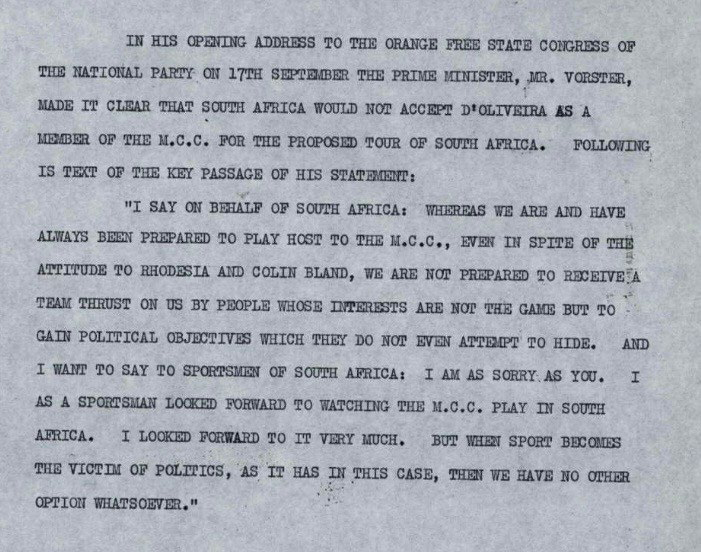
When the news broke that D’Oliveira had been chosen in the injured Cartwright’s place, Vorster was attending the Orange Free State Congress of the National Party. He was furious. Oblivious to the irony in his words, he said, ‘We are not prepared to accept a team thrust upon us by people whose interests are not the game but to gain certain political objectives which they do not even attempt to hide. The team as constituted now is not the team of the MCC but the team of the AntiApartheid Movement, the team of SANROC, and the team of Bishop [Ambrose] Reeves.’
Again, National Party supporters, together with white cricket officials and white South Africans in every part of the country, either nodded or roared their approval. Shortly afterwards, the tour was called off, and South Africa and England would not meet again in cricket for almost three decades.
***
Meanwhile, in a time of introspection in the United Kingdom, the spotlight fell on the political leanings and behaviour of members of the MCC in the original decision not to choose D’Oliveira.
Newspapers debated over who was racist and who was not, who carried stories about what happened in MCC meetings to South Africans before the selection of the team, and who supported maintaining ties with white South African cricket despite claiming to be against apartheid.
The MCC secretary, Billy Griffith, was touted by some as a South stating that Griffith had been one of the first people to speak to him about the evils of apartheid. Griffith, he said, had related a story about asking a ‘senior and respected figure in South African cricket whether some good black players were coming forward’. The reply had been, ‘Man, they’re savages.’
But some members of the MCC were decidedly right-wing.
The British right
The MCC president, Arthur Gilligan, for instance, was a man with a dangerous political background. He was a member of the British Fascist Party. When he went to Australia in 1924−25 with the MCC team, he was closely watched by the Australian Secret Service. But he believed strongly in what he stood for, proudly authoring an article for the bulletin of the British Fascists, entitled ‘The Spirit of Fascism and Cricket’. He described it as ‘a splendid example of fascism in action’ and why sports and politics should not mix.
The separation of sports and politics was a drum that right-wingers beat time without end.
Alec Bedser, one of the selectors who would find himself caught up in the furore over D’Oliveira’s original omission from the side, was another member of the MCC with right-wing views.
In his book, Basil D’Oliveira: Cricket and Conspiracy: The Untold Story, Peter Oborne described Bedser as having ‘trenchant’ conservative views and detailed how he was a founder member of the Freedom Association, set up in part with the help of South African money.
Other members of the MCC selection committee may have had rightwing views too, or, at the very least, were taken in by the arguments of Coy and another frequent visitor to Lords, Jack Cheetham. One of the selection committee members, Peter May, a former England captain, was the son-in-law of Harold Gilligan, who was also an MCC member and a brother of Arthur Gilligan. He let slip where he stood by responding angrily to the criticisms of the tour by Sheppard, his erstwhile friend and teammate.
Tension over South Africa was palpable. There was a clear divide between conservatives and a more liberal faction of MCC members, and it became starker still when the MCC decided to invite a Springbok cricket team to the UK in 1970, when the wound of the South African government’s rejection of D’Oliveira’s selection still festered.
As a new debate raged over the proposed 1970 tour, a group of British right-wing moguls set up a fund to raise money to pay for the security costs of the tour, stating they wanted to defend the right to maintain sporting ties with South Africa.
Among the members of this group was Lord Hartley Shawcross, a former member of the Labour Party and the UK’s attorney general who later became the president of the MCC. He argued that politics and sport should not ‘mix’ and that sporting contact could help improve South Africa’s situation.
He accused the anti-apartheid protesters of being a ‘small minority of hooligans and extremists’ who were ‘trying to impose their views on the majority of the British people’.
Another ‘Lord’ who argued against mixing politics and sports was Charles Lyttelton (Lord Cobham), who criticised the Labour government for forcing the MCC to call off the 1970 tour.
Then there was (Sir) Max Aitken, the owner of two major UK newspaper outlets, the Daily Express and the Sunday Express, who, like the others, also supported the proposed Springbok cricket tour. He used the Express newspapers to promote the ‘Save the Tour’ fund, boosting it with a donation of £10,000 (an amount matched by Shawcross).
(Sir) James Goldsmith, the billionaire financier and business owner, was also a staunch critic of the Anti-Apartheid Movement. He donated £5,000 to the fund and, in the case of the rugby Springboks, offered to cover the legal costs of any players arrested or injured during its tour.
These billionaires, the political and economic elite of the United Kingdom, had strong ties with and business interests in South Africa and were opposed to the sanctions and boycotts that anti-apartheid activists advocated, claiming that sporting contact would instead foster goodwill and dialogue between the two countries.
Messages from South Africa
In South Africa, Vorster’s decision to bar D’Oliveira was widely welcomed across the political divide by white South Africans.
Even though white cricketers and cricket supporters missed out on an MCC tour of South Africa in 1968 and a Springbok tour of the United Kingdom in 1970, they rallied behind Vorster. Ernie McKay, president of the Western Province Cricket Union, said, ‘I am disappointed, but I support Mr Vorster on this. I am sure [he] acted in the best interests of [white] South Africa.’105 He said most [white] South Africans agreed with him.
Many other examples of support for the Prime Minister stood out.
One instance involved Donald Woods, the editor of East London’s Daily Despatch newspaper. In 1968, shortly before Vorster decided to bar D’Oliveira, Woods urged Springbok cricketers to speak out in favour of non-racial cricket at a public banquet in the Eastern Cape. But this did not go down well with his audience.
He was shouted down by many whom he had hoped to persuade.
Even before he had completed his speech, several of the cricketers walked out, with some shouting, ‘Don’t drag politics into sport’, as they left.
Woods retorted that politicians had already dragged politics into sport and that if the cricketers did not support merit selection, it would weaken their position and result in South Africa’s isolation from international sport.
After his speech, Woods was approached by the Springbok cricket captain, Trevor Goddard, who later became a born-again Christian.
Goddard told Woods, ‘I agree with a lot of what you said, but we cannot speak out. We are in a difficult position.’
He could not – or perhaps would not – explain what was difficult about calling for equality for all cricketers in South Africa. Aware of this, Woods challenged him.
‘No’, he replied, ‘you are not in a difficult position. You are in a very safe position. You are national heroes. You will not be thrown into jail if you speak up.’
Goddard, like almost every other white cricketer, preferred the soft option of appeasing the party of apartheid. White cricketers salved their consciences by suggesting, without an iota of proof, that their black counterparts were not good enough to play test cricket.
Wilfred Isaacs, a leading white cricketing benefactor, said Vorster’s decision had been used to achieve a victory by ‘certain elements’ who wanted to use sport to further their political ends. ‘[These people] have exacted a terrible toll at the expense of sportsmen of all races,’ Isaacs claimed. ‘They have no interest in sport and sooner or later, more people overseas will wake up to them.’
Alan Melville, a former Springbok captain, accused British sportspeople of protecting themselves against ‘South Africa’s political enemies’. 106
‘Mr Vorster had no option but to act the way he did,’ Melville said in an interview with the UK-based Daily Telegraph.
Wally Hammond, the president of the white South African Cricket Association, said Vorster’s decision was beyond the control of the SACA. He said Vorster had acted in terms of his declared policy regarding sporting tours to South Africa. ‘We have understood the position for some time,’ said Hammond. ‘If the Opposition [the United Party] think they can satisfy these people with half-hearted gestures and big plans, they are making a big mistake.’
Die Vaderland, a South African newspaper and a National Party mouthpiece, urged South Africans not to become despondent over South Africa’s future sporting ties with the outside world. It also backed Vorster’s stance that the MCC team, which included D’Oliveira, had been an attempt to push politics into sport, ignoring that politics and sport were a combination used by white South Africa all the time. The newspaper said Vorster, by his actions, had done nothing more than issue a warning to South Africa’s sporting partners that ‘we would not accept a team forced on us by people whose interest was not sport’.
It added that ‘political vandalism’ affected almost all [overseas] sport.
Vorster said, ‘South Africa has always been willing to play host to the MCC,’ but ‘we are not prepared to receive a team thrust on us by people whose interests are not the game but political objectives that they do not even attempt to hide.
‘When sport becomes the victim of politics… we have no other option whatsoever.’
The Post newspaper of Natal, which had a predominantly Indian readership, criticised the ‘silent compliance’ of white sportsmen and the organisations to which they belonged. In an editorial comment, it said, ‘South Africa’s chances are not helped by the deafening silence of white sportsmen, who should say clearly that while they have to [obey] the laws of the land, they are against these laws.
‘South Africa is condemned by its own mouth – a tight-lipped mouth that it seems only opens to condemn other nations for bringing politics into sport and never raises a voice against the cause of the trouble.’
***
Many black cricket fans were disappointed not to be able to watch D’Oliveira returning to play test cricket in South Africa, and black administrators and sports activists held ambivalent views about the controversy.
Basil’s father, Lewis D’Oliveira, suggested that coloured cricket fans would have boycotted the test at Newlands between the Springboks and the MCC.
Some administrators, pressed by the overseas media, said what they were expected to say: they expressed bitter disappointment that apartheid had prevented D’Oliveira from playing the game he loved in front of people who loved him, in the country of his birth.
However, deep down, activists such as Howa and Dennis Brutus believed D’Oliveira should have withdrawn from the MCC side if the National Party government had not stopped him. But they knew this would not have happened.
Playing cricket against South Africa in South Africa was what D’Oliveira had dreamed of the moment he was first selected for England.
Howa and Brutus knew, even then, that much more was needed to bring about an equal society in South Africa than just the concession of a single black face playing in an otherwise white team against all-white opponents, and where black spectators were allowed to watch from a separate, caged section in an otherwise whites-only stadium.
In the months and years following the ‘D’Oliveira Affair’, the man at the centre of the furore and the anti-apartheid sports activists in South Africa grew further and further apart.
As the intensity of the fight against apartheid sport shifted from the United Kingdom, Australia, and New Zealand to South Africa, D’Oliveira insisted that the best way to defeat apartheid sport was through building bridges.107
It became his obsession.
This led to people like Howa stating loudly and, sometimes angrily, that it was ample proof that D’Oliveira was out of touch – and that he had sold out the people who had rooted for him over so many years.
Boos and applause at William Herbert
It was D’Oliveira’s involvement in a rugby issue involving the South African Coloured Rugby Federation that raised a storm of protest in South Africa and put paid to another attempt to get him to play on the formerly white cricket grounds throughout South Africa, at Newlands, The Wanderers, St George’s Park and Kingsmead.
The matter centred on a decision by a group of clubs to break away from the South African Coloured Rugby Football Board (which was renamed the South African Rugby Union in 1966), to form the South African Rugby Federation (SARF) on 2 February 1959. Cuthbert Loriston, its president, used his connections in the apartheid government’s Department of Coloured Affairs to get the new body recognised as ‘the only coloured body controlling rugby throughout the Union of South Africa for non-whites.’108
In 1978, the SARF and the ‘African’ South African Rugby Association joined the white South African Rugby Board (SARB), but as separate entities. But even before this, under pressure from its traditional overseas opponents to tackle the problem of apartheid, the SARB had organised a tour to the United Kingdom by the SARF in 1971. Anti-apartheid sports activists in South Africa criticised this development, while white sports lovers and administrators saw it as a praiseworthy attempt to create opportunities for coloured rugby players.
The tour offered a frightening glimpse of how the apartheid government and white rugby authorities sought to control the off-thefield activities of the coloured rugby tourists to the finest detail. Before they left, each player had to sign a code of conduct, of which one of the terms was an instruction forbidding any contact with anti-apartheid groups.
On their return to South Africa, after the tour, the team was instructed to attend a ‘debriefing session’ with the South African Security Police.
A major off-the-field difficulty for the team was the players’ inability – most were rural-based – to speak English. According to a teammate, Errol Tobias, who later became a ‘Springbok’, struggled most in this respect.
***
During the tour, D’Oliveira had assumed his role of bridge-builder and had sent the team a telegram, welcoming them to the United Kingdom and wishing them well. An angry Howa,110 keenly aware of the limitations of D’Oliveira’s political acumen, cleverly sparked a public clamour of criticism against D’Oliveira for expressing solidarity with an ‘ethnic’ rugby side – and then challenged him to a debate on the matter in a hall at the William Herbert sports grounds in Wynberg, near Cape Town, in 1972.
In the debate, Howa said he had a big problem with the definition of ‘mixed’ sport.111 ‘The word “multiracial” is something of a swear word to me. If you select a multiracial cricket side, you must be certain that the side contains players of all races, meaning that merit is automatically discarded.
‘We stand for a non-racial side where the best 11 players are selected on their cricket ability alone.
‘One point I would like to make clear is that if the 11 best players all are white, we won’t care a damn.’
To his credit, D’Oliveira, who was in South Africa, agreed to step into a ‘lion’s den’ atmosphere to state his case. It was the type of confrontation that Howa relished. He was prepared to confront a man whose views he openly did not respect and whom many Capetonians believed had become a flawed hero. Nevertheless, D’Oliveira was given a respectable hearing – even when he again stated, ‘I see myself as a bridge builder.’ But his support of a ‘step by step’ approach was met by a rueful comment of ‘sop by sop’ from one member of the audience.
D’Oliveira said his life had always revolved around cricket, and it would always be like that. And then, to applause, he added, ‘I’m against segregation. I’m against apartheid. I’m against the indignities we suffer. But I claim the right, on my record, to do what I think I can do in my small way for all of us, as a cricketer. Even in the big furore in England over the past four years, I’ve always said I am a bridge builder. Until I am proved wrong, I will continue striving to be a bridge builder. Take me off the cricket field, and I’m hopeless. I’m brainless.
‘I can’t even discuss politics.’ He said he admired Howa – and he said he had never before seen as strong a front in favour of Howa’s all-or- nothing stance as at the William Herbert Hall. Howa, aware of the wide support he had in the venue and dismissive of D’Oliveira’s attitude of knowing nothing about politics, decided to be generous to the former England player, stating he preferred to find common ground with the man he had differed with strongly in the past.
But he had good reason for taking this stance: the debate was only hours after the announcement that a much-discussed tour by an international side led by the former MCC captain, Colin Cowdrey, that would have included D’Oliveira, had been called off. To this end, Howa and D’Oliveira said they hoped to issue a joint statement on the eve of D’Oliveira’s return to England. The consensus was that the two had shown in the debate that they were moving closer together. With many battles ahead, Howa had decided that D’Oliveira could be a useful ally.
The cancellation of the Cowdrey tour confirmed that Howa was correct in campaigning so single-mindedly for South Africa’s isolation from world cricket and for the sometimes open contempt he had for the views of white – even Opposition – newspapers. They were as critical of Howa as the white South African Cricket Association and the National Party government were of him.
Some compromises they called on Howa to make bordered on the ridiculous. The Joburg-based, mass-circulation newspaper, Sunday Times, said: One can only admire the stand Mr Howa has taken throughout his career in non-racial cricket. In the Cowdrey tour discussions, he again refused to deviate from his ‘cricket-on-merit’ principles.
On this point, he was reported to have said that he holds all the trumps and, in the end, cannot lose. He’s right. One day, South African cricket, like other sports, will be nonracial, but in the meantime, it would have been wiser if he had played these trumps with more tact and less aggression.
Would he not have achieved more for the game he loves if he had stooped to compromise? If, for instance, he had accepted the Cowdrey tour, even though it did not fulfil all the non-racial requirements that his principles demand?
Tentative steps towards non-racialism have been taken by South African tennis, golf, and athletics. In tennis, the South African Lawn Tennis Union has gone so far as to accept the absurdity, forced on it by Government edict, of holding secret mixed trials. By doing this, it has made itself the laughing stock of international tennis, but it is convinced that what it has done will, in the end, benefit South African tennis in general.
Couldn’t Mr Howa have persuaded the Cricket Board of Control to do something similar?
World cricket might have laughed and jeered at it for accepting that a multiracial touring team should be restricted to playing against segregated white and non-white teams.
But it would have been an important breakthrough against racial prejudice. In the long run, it might… have brought nearer the Board’s main objective – non-racial cricket.
In playing his powerful hand, Mr Howa should in future be careful he does not trump his own ace.
The Sunday Express took a similar tack: There can be little doubt that Mr Howa’s hardline attitude doomed the tour. Mr Howa is not interested in the kind of compromise that this tour would have represented. He wants non-racial cricket… in South Africa now, without any pauses for breath on the way. His attitude may be logical, but logic is often fatal in politics, and he will get little sympathy from most white cricketers, who, illogically, but sensibly, regarded this visit by Cowdrey’s mixed team as a step in the right direction.
Ironically, when D’Oliveira died on 19 November 2011, the South African and Australian teams wore black armbands as they stood in a minute’s silence to honour his memory on the third day of their second test match in Johannesburg. The man denied recognition in life by the country of his birth was finally commemorated in death by the very institution that had rejected him.


