
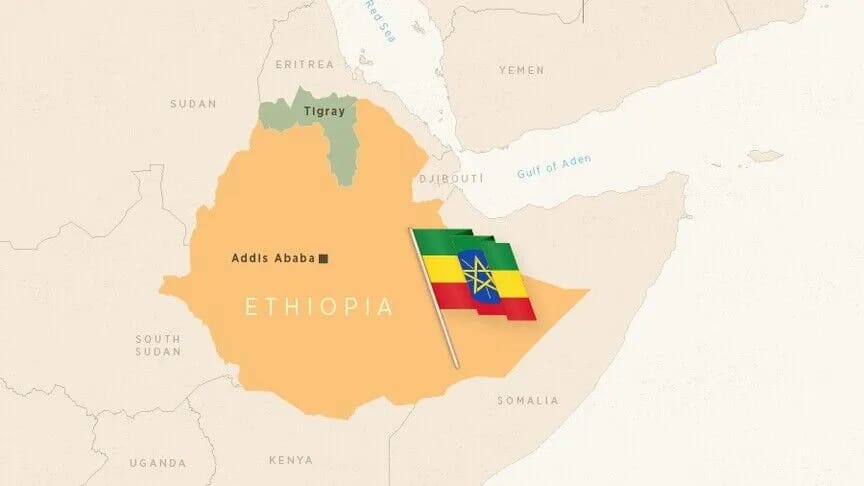

A long-simmering conflict in northern Ethiopia has erupted into open warfare, with Tigrayan forces seizing airports in Mekelle, Axum and Shire and fighting federal troops in neighbouring Afar and Amhara.
The latest escalation comes just days after seven armed and opposition groups formed an alliance seeking to remove Prime Minister Abiy Ahmed’s government, raising fears that Ethiopia could be drawn back into a major conflict less than four years after the Pretoria peace agreement ended the country’s devastating Tigray war.
Tigrayan forces seized control of three airports from federal police on Wednesday, 23 September, according to AFP, while fighting was reported in neighbouring regions. On Thursday, a senior Tigray People’s Liberation Front (TPLF) official described the conflict with the federal government as a state of “full-blown war”.
Ethiopian Airlines suspended flights to Mekelle, Axum and Shire on Wednesday, citing the security situation in Tigray. Reuters initially independently confirmed the seizure of Mekelle Airport, while reporting that the situation at Axum and Shire remained unclear at the time.
The suspension threatens to further isolate communities still recovering from the devastating 2020–2022 Tigray war, during which hundreds of thousands of people were killed and millions were displaced.
It also places renewed pressure on the African Union-brokered Pretoria peace agreement, signed in November 2022, which ended the main phase of the conflict and paved the way for the gradual restoration of essential services, including commercial flights.
Fighting has also spread beyond Tigray.
Humanitarian and security sources told AFP that clashes between Tigrayan and federal forces had erupted around Abala and Erebti in Afar, while fighting was also reported in Amhara.
The escalation follows the announcement on Sunday, 20 September, that seven Ethiopian armed and opposition groups, including former battlefield adversaries, had formed the Ethiopian Peoples’ Forces Alliance for Survival.
The coalition says it intends to remove Abiy Ahmed’s Prosperity Party-led government and establish what it describes as an inclusive transitional administration.
Its members accuse the federal government of centralising power, marginalising regional communities and failing to address Ethiopia’s security and political crises. The government, meanwhile, says it has pursued a national dialogue process aimed at addressing longstanding political divisions.
The alliance brings together the Tigray People’s Liberation Front (TPLF), Amhara Fano National Movement, Oromo Liberation Army (OLA), Ogaden National Liberation Front (ONLF), Afar National Unity Revolutionary Front, Benishangul Peoples’ Liberation Movement and Gumuz Peoples’ Democratic Movement.
Its formation marks a significant shift in Ethiopia’s armed opposition because several of its members previously fought on opposing sides.
The TPLF and Amhara Fano forces, for example, were adversaries during the Tigray war. Their decision to join the same coalition illustrates Ethiopia’s rapidly changing political and military alliances, although substantial territorial and political differences remain between some of the groups.
Humanitarian fears
The humanitarian consequences of renewed large-scale fighting remain a major concern.
UNICEF says Ethiopia entered 2026 facing a deepening humanitarian crisis driven by conflict, climate shocks and public health emergencies, with fighting in Amhara, Oromia and Tigray among the principal drivers of humanitarian need.
More than 1.9 million people were internally displaced across Ethiopia, while hundreds of thousands remained in overcrowded displacement camps with limited access to essential services. UNICEF has also warned that basic services across parts of Tigray remain severely disrupted.
Further instability risks disrupting communities already attempting to rebuild their lives, restore livelihoods and regain access to education, healthcare and humanitarian assistance.
Muslim communities and regional sovereignty
The inclusion of the Ogaden National Liberation Front extends the alliance into Ethiopia’s predominantly Muslim Somali Region, adding another dimension to the country’s complex political landscape.
The region has longstanding political disputes concerning representation, regional autonomy and relations with the federal government.
However, the ONLF’s participation in the coalition should not be taken to mean that Ethiopia’s wider Somali Muslim population supports the alliance.
For Ethiopia’s Muslim communities, the unfolding crisis raises wider concerns over the protection of life, religious and cultural identity, community dignity and the ability of different populations to participate meaningfully in shaping the country’s future.
Those concerns extend beyond the immediate struggle for political power in Addis Ababa to the preservation of communities, livelihoods and institutions already battered by years of conflict and instability.
The implications also stretch beyond Ethiopia’s borders.
The Ethiopian government has accused neighbouring Eritrea of financially supporting members of the new anti-government alliance. Eritrea has repeatedly denied allegations that it backs Ethiopian armed groups, leaving the claims disputed.
Renewed war in northern Ethiopia could therefore threaten not only the fragile Pretoria settlement but stability across the wider Horn of Africa.
For Ethiopia’s Muslim and Christian communities alike, the accelerating conflict raises a question beyond the immediate contest for political power: whether the country’s unresolved grievances can be addressed without exposing another generation to war, displacement and the destruction of institutions essential to community life.


