
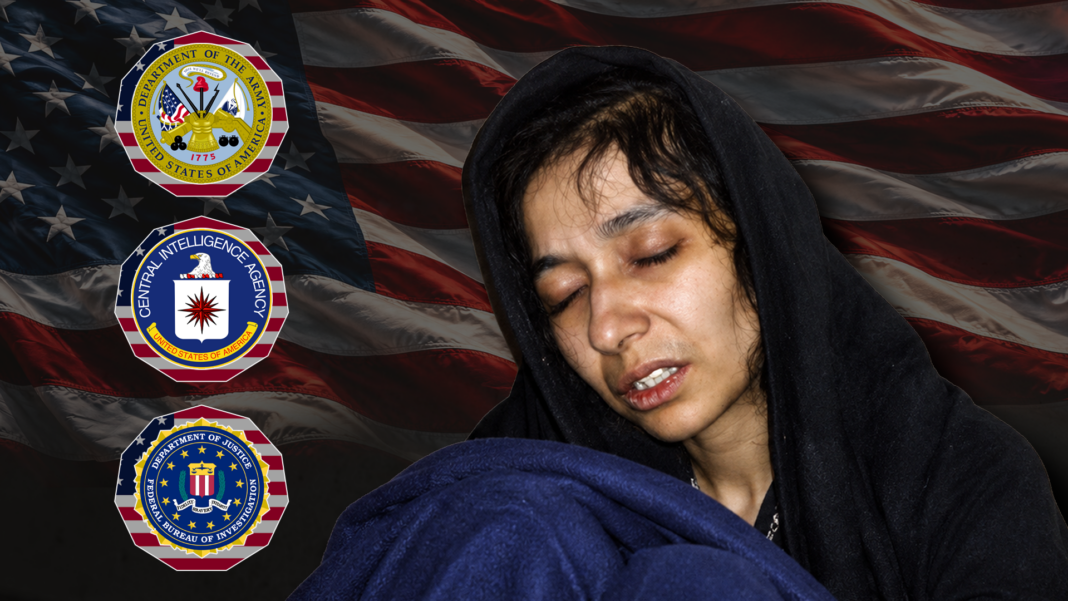

When Dr Aafia Siddiqui resurfaced in Afghanistan in July 2008, five years after mysteriously disappearing from Pakistan with her three young children, she was a shadow of the brilliant MIT-educated neuroscientist who had once excelled at America’s most prestigious academic institutions. Within 24 hours of her detention, she would be shot by US military personnel, setting in motion a controversial criminal prosecution that culminated in an 86-year prison sentence and transformed her into an enduring symbol of the human cost of America’s War on Terror.
On 17 July 2008, a gaunt and disoriented Siddiqui was detained by Afghan police in Ghazni. Her disappearance from Karachi in March 2003, alongside her three young children, had remained shrouded in mystery. An 11-year-old boy detained alongside her would later be identified as her eldest son, Ahmed.
She was wounded the following day during a confrontation with American personnel inside an Afghan police compound. What happened there would become the centrepiece of a disputed American criminal trial, transforming a mother separated from her children into an international cause célèbre.
The Ghazni compound incident: A forensic paradox
According to the original criminal complaint filed by the US Department of Justice, Siddiqui was being held behind a curtain inside an Afghan police compound on 18 July 2008 when American military and FBI personnel arrived to question her.
US officials alleged that she seized an unsecured M4 rifle belonging to an American officer and fired at the team while shouting anti-American slogans. A US warrant officer responded by firing his sidearm, striking Siddiqui in the torso.
When the case reached a New York federal court in 2010, the defence challenged the prosecution’s account, highlighting significant questions surrounding the forensic evidence.
No American personnel were struck by gunfire. The defence pointed to the absence of identifiable fingerprints linking Siddiqui to the rifle and the lack of recovered ballistic evidence conclusively establishing that the weapon had been fired.
An FBI firearms expert acknowledged that the physical evidence could not establish with certainty whether the rifle had been discharged. The prosecution, however, relied on eyewitness testimony from American personnel.
Siddiqui denied firing the rifle. She testified that she had looked out from behind the curtain, fearing a return to secret detention, before being shot.
The competing accounts raised a fundamental question: how could an alleged exchange of gunfire produce so little physical evidence that shots had been fired from the M4 rifle?
The trial of a symbol, not a terrorist
When Siddiqui stood trial in Manhattan, the courtroom became a focal point for controversies surrounding the War on Terror.
Despite sensationalist media headlines branding her “Lady al-Qaeda”, she was not charged with membership of al-Qaeda or involvement in the September 11 attacks.
Instead, the US government prosecuted her on seven counts relating to the attempted murder and assault of American personnel in Afghanistan, including a firearms offence.
The human toll of her missing years hung heavily over the proceedings.
Siddiqui frequently interrupted the trial, making allegations about secret detention facilities and the mistreatment of her children. Her lawyers raised concerns about her psychological condition and fitness to stand trial, although the court ultimately ruled her competent.
In February 2010, a jury convicted her on all seven counts. On 23 September 2010, US District Judge Richard Berman sentenced her to 86 years in prison.
The severity of the sentence, imposed on a woman who had killed no one, wounded no one with gunfire and was herself the only person shot during the confrontation, generated outrage among supporters and intensified demands for her release.
Her conviction was subsequently upheld on appeal.
For campaigners, the trial raised serious questions about whether the American justice system had adequately considered her disappearance, psychological condition and the wider political climate surrounding her prosecution.
The missing children and the human cost
Beyond the legal proceedings lies a humanitarian tragedy that continues to fuel international concern: the fate of Siddiqui’s three children.
According to her family, when she disappeared in March 2003, her children were approximately six years, five years and six months old.
During her five-year absence, reports emerged from former detainees and human rights campaigners about a female prisoner allegedly held at the US-run Bagram Air Base in Afghanistan, known as the “Ghost of Bagram” or “Prisoner 650”.
Former detainees described hearing a woman’s screams, while advocacy organisations, including CAGE, raised concerns that the unidentified prisoner might have been Siddiqui.
Her family maintained that she had endured secret detention, isolation and psychological abuse while separated from her children. American authorities denied holding her during the missing years.
In 2008, her eldest son, Ahmed, was reunited with relatives in Pakistan after being detained alongside his mother in Ghazni.
Human Rights Watch had called for his release from Afghan intelligence custody, raising concerns about the detention and treatment of an 11-year-old child.
In April 2010, her daughter, Mariam, was reunited with relatives in Karachi after reportedly being brought to the family’s home by unidentified individuals. The circumstances surrounding her disappearance and return remain disputed.
Her youngest son, Suleman, who was just six months old in 2003, remains missing. Family members fear he died during the events surrounding the disappearance, although his fate has never been independently established.
For the family, Siddiqui’s imprisonment represents only one part of a tragedy involving years of separation, uncertainty and a child who has never returned.
A global movement: Protests, campaigns and political leverage
For nearly two decades, the campaign for Siddiqui’s release has united supporters across Pakistan and the wider Muslim world.
Led by her sister, Dr Fowzia Siddiqui, and supported by organisations including CAGE and the Aafia Foundation, the “Free Aafia” movement has transcended political and religious divides.
Pakistani cities have repeatedly witnessed demonstrations demanding her release. Her image has appeared on protest banners and billboards, representing what many Pakistanis regard as a national humiliation and a failure by successive governments to protect one of their citizens.
Successive Pakistani governments, including those led by Nawaz Sharif and Imran Khan, have faced pressure to pursue her repatriation through diplomatic engagement with Washington.
Her symbolic status has also been exploited by armed extremists, including during the January 2022 synagogue hostage crisis in Colleyville, Texas, when a gunman demanded her release.
Such incidents have complicated the wider campaign for justice. However, demands by militants for Siddiqui’s release do not establish her involvement in their activities.
The inmate at Carswell
Dr Aafia Siddiqui remains imprisoned at the Federal Medical Center (FMC) Carswell in Fort Worth, Texas, a facility providing specialised medical and mental health services to female prisoners.
To the US legal system, she is federal inmate number 76494-054, convicted of attempting to kill American personnel in Afghanistan.
To her family and supporters, she represents the profound injustices associated with the War on Terror — an era marked by extraordinary rendition, secret detention, torture and the erosion of fundamental legal protections.
The allegations surrounding her missing years remain unresolved, while the fate of her youngest son remains unknown.
Beyond the intelligence reports, courtroom proceedings and political controversy stands a family that has endured more than two decades of separation and unanswered questions.
A mother remains imprisoned. Two children were reunited with their family after years apart. A third has never returned.
And the neuroscientist who once pursued a future in education and humanitarian service now faces the prospect of spending the remainder of her life behind American prison walls.


