
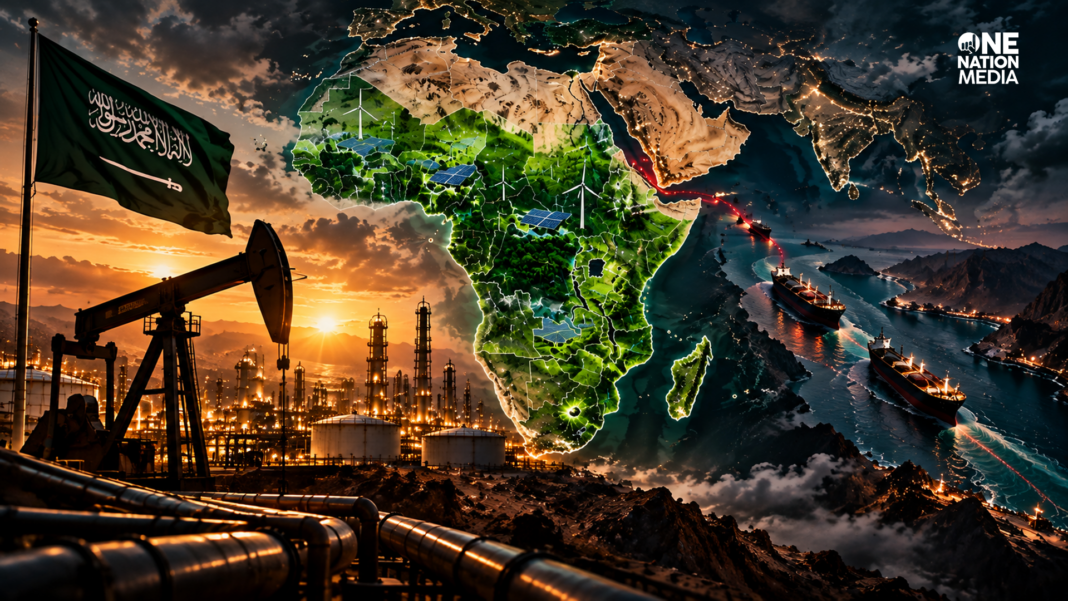

Najm al-Din examines how the Saudi-Houthi confrontation and disruption across Hormuz and Bab al-Mandeb are deepening the global energy crisis, while accelerating Africa’s push towards a greener but potentially more exploitative economic order.
The recent conflict between the Houthis and Saudi Arabia has reached a critical flashpoint, severely compounding the global energy crisis.
When traffic through the Strait of Hormuz collapsed earlier this year due to the Iran war, international energy transit shifted towards the Red Sea and the Bab al-Mandeb.
Flow through this alternative chokepoint surged considerably, forcing Saudi Arabia to rely on the East-West Pipeline to pump crude from its eastern fields across the kingdom to the Red Sea port of Yanbu, bypassing the Persian Gulf and Hormuz entirely.
However, drone attacks by Iran-aligned Iraqi insurgents on the East-West Pipeline, coupled with a Houthi blockade of Saudi Red Sea ports, have effectively handed the Houthis significant leverage over the 20-mile-wide waterway.
Combined with prolonged disruptions along the Persian Gulf route, two critical arteries of global energy trade are now significantly paralysed.
Economic shock
Spurred by hostilities in the Middle East, Brent crude topped $105 a barrel, cutting global supply by 4% and deepening the energy crisis.
With repairs projected to take months and tankers forced to detour around the Cape of Good Hope — drastically increasing shipping times, insurance premiums and freight costs — this dual-chokepoint energy bottleneck has driven Saudi Arabia’s crude oil output to its lowest levels in more than three decades, forcing the kingdom to cancel its monthly crude allocations to European refiners.
Because both energy chokepoints also control the transit of essential non-energy goods such as fertiliser, aluminium and sulphur, a wider commodity crisis now threatens global agricultural yields and manufacturing sectors.
These pressures have intensified a historic supply shock, fuelling severe global inflation, prompting sovereign debt sell-offs and driving up geopolitical risk premiums as estimates of inventory depletion accelerate.
Africa
The OECD has already lowered its baseline global growth forecast, while economists warn that failing to normalise Gulf exports could trigger severe recessions, widespread unemployment, capital flight and reduced investment.
This will disproportionately affect low-income African economies, where food and energy consume the largest share of household budgets. As a result, these geopolitical shocks are transmitting faster and more deeply into Africa than in previous crises, fundamentally reshaping the continent’s socio-economic and political landscape.
In South Sudan, fuel dependency has contributed to severe blackouts and power rationing in Juba, while Somalia is reeling from blocked aid deliveries and soaring food costs.
Zimbabwe has imposed mandatory fuel rationing and transport restrictions amid hyperinflation, while landlocked Ethiopia’s total dependence on imports leaves its agricultural sector exceptionally vulnerable to shortages of Gulf-supplied urea and ammonia, threatening a major hunger crisis.
Meanwhile, as ships bypass the Red Sea in favour of the Cape route, Cairo is losing billions in foreign currency because of its reliance on Suez Canal transit fees.
Close to 30 African currencies have sharply depreciated against the US dollar, inflating external debt-servicing costs.
As food inflation escalates across the continent, mounting cost-of-living pressures and energy crises are taking a heavy toll on household budgets and national grids, contributing to widespread food insecurity and population displacement.
The social and political consequences of the recent Middle East upheavals are also reverberating across the continent. Fighting in Yemen has displaced more than 100,000 people domestically, forcing thousands of refugees across the Red Sea into East African countries such as Djibouti and placing further strain on local humanitarian resources.
This has heightened fears of military spillover and proxy wars in the Horn of Africa, where the Houthis now occupy armed positions directly across from the African shoreline.
Because sudden rises in bread and fuel prices often fuel civic unrest, the combination of rationing, blackouts and inflation is likely to intensify domestic instability and anti-government protests in several African countries.
The green pivot
While the global energy crisis is destabilising African economies, it is also acting as a powerful catalyst for accelerating Africa’s shift towards the Net Zero agenda and the United Nations Sustainable Development Goals (SDGs) — a 17-goal blueprint aimed at creating a more equitable and sustainable world through social inclusion, economic growth and environmental protection.
Although severe fossil-fuel disruptions and high energy prices are creating short-term economic strain, they are also reinforcing the case for long-term green transitions across African markets in several structural ways.
First, international price shocks are making fossil fuels increasingly economically untenable. For net-importing African economies, this vulnerability is a stark market signal to reduce fossil-fuel dependence and leapfrog traditional energy pathways by anchoring energy security to local generation.
To hedge against Middle Eastern volatility, African nations are increasingly turning towards domestic clean-energy resources, with the continent holding roughly 60% of the world’s best solar resources alongside vast hydro, wind and geothermal potential.
The economic shock is therefore transforming green energy from an environmental choice into a national-security imperative, with decentralised renewables offering the potential to expand off-grid power without relying on vulnerable fossil-fuel infrastructure.
Furthermore, as Saudi Arabia diversifies its fiscal model away from vulnerable oil corridors under its Vision 2030 framework — with its Gulf neighbours following suit — Africa is well placed to attract Gulf capital.
Gulf states are currently investing more than $100 billion in clean-energy and infrastructure projects across the continent. By positioning themselves as partners in Africa’s green transition, Saudi and Emirati investors are helping bridge the major funding gaps required to build climate-resilient agriculture, local solar grids and green hydrogen plants.
Additionally, as the global race to secure supply chains for renewable technologies accelerates, demand for Africa’s abundant energy-transition minerals — including lithium, cobalt, copper and manganese — is set to rise sharply.
This demand can be leveraged through strategic resource management that ties the continent’s renewable capacity and green-industrialisation projects directly to local processing and manufacturing, ensuring that the global Net Zero agenda also creates jobs and sovereign wealth within Africa.
Ultimately, the convergence of the global energy crisis and geopolitical pressures is accelerating the adoption of low-emission development strategies across Africa, turning net-zero roadmaps into bankable projects through greater market integration.
It is also encouraging innovative funding mechanisms such as Debt-for-Climate swaps and a proposed global shipping carbon tax, which aims to unlock billions annually for African green-port electrification.
Risks
While the global rush for clean energy presents opportunities, Africa’s transformation into the next frontier for international finance also warrants caution.
There is a growing risk that foreign corporations will exploit this shift, leaving African nations with the environmental and economic fallout.
If multinationals extract Africa’s critical minerals for processing abroad, export hydrogen and electricity to the Global North and then sell finished products back to African markets at a premium, local economies will once again be deprived of the manufacturing wealth generated from their own resources.
This risks repeating a familiar historical pattern of extraction without meaningful local value addition.
Moreover, African nations risk falling into predatory debt traps if concessional grants are replaced by climate loans and green bonds.
Because African countries often face high interest rates due to perceived risk, these financing arrangements can deepen financial dependence. Creditors may then use loan conditions to demand policy concessions, structural adjustments or tax exemptions, worsening sovereign debt pressures while reducing governments’ ability to regulate their own energy sectors and prioritise domestic needs such as education and healthcare.
Crucially, as large corporations acquire vast tracts of African land for reforestation and conservation projects, there is also a risk that African carbon sinks will be exploited to generate offsets that allow foreign companies to greenwash their environmental records.
Wealthier nations can continue polluting domestically while effectively locking up African land — sometimes displacing local and indigenous communities from ancestral resources — to feed speculative carbon markets.
The result could leave residents trapped in low-wage, extractive labour while transforming ecosystems from common heritage into speculative financial assets.
Conclusion
As private-sector clean-energy investment expands and African governments increasingly align their national development agendas with Agenda 2030, populations must ask whether adopting the UN SDGs will genuinely unlock inclusive economic growth or whether the forces shaping the continent’s green transition will simply replicate past extractive colonial models.
Simply put, whose prosperity is being prioritised, and at what cost?
As the combination of a Middle Eastern energy squeeze and international net-zero mandates forces a profound structural reordering across Africa, this shift will only deliver meaningful benefits if the green transition develops into a genuine blueprint for economic security and self-sufficiency.
African nations must be positioned as partners and producers in a new global value chain, rather than mere consumers of imported solar panels, wind turbines and hydrogen infrastructure.
Otherwise, a Green World Order risks repeating the same cycles of exploitation seen for centuries — this time under the benevolent guise of “sustainability”, with corporate extraction repackaged as environmental salvation.