
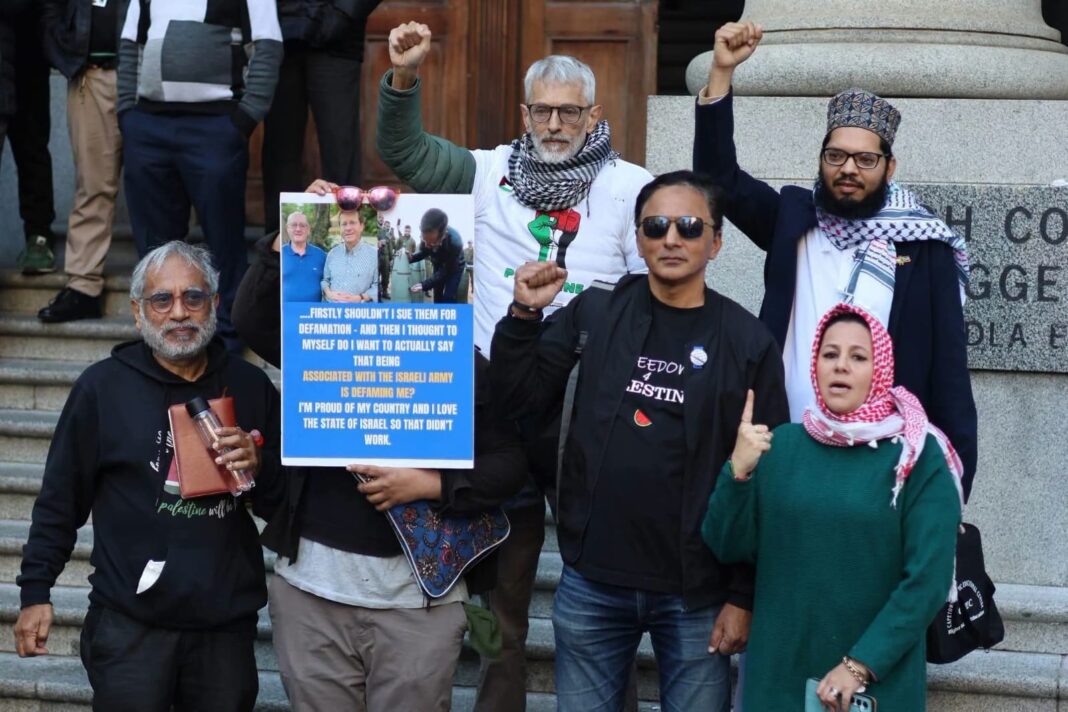

The Palestine Solidarity Campaign (PSC) has returned to Cape Union Mart stores despite a Western Cape High Court judgment restricting what activists can say about the retailer and its chairperson, Philip Krawitz.
The judgment, handed down on 4 September, interdicted activists from claiming that Cape Union Mart is funding genocide or military conflict in Gaza, or that Krawitz is funding genocide, the Israeli army or the conflict. They were also barred from claiming that the applicants were killing children or complicit in the killing of children.
But the ruling did not prohibit Palestine solidarity protests or the boycott of Cape Union Mart.
Importantly, the court documents make clear that the case was not about preventing criticism of Israel or restricting public opposition to what is happening in Gaza. In paragraph 12 of the judgment, the court states that no relief was sought to prevent activists from assembling peacefully in public places or boycotting Cape Union Mart.
The ruling therefore places restrictions on specific statements about the company and Krawitz while leaving the wider Palestine solidarity campaign — including peaceful protests and consumer boycott action — intact.
Within a day, PSC activists returned to stores at Canal Walk and the V&A Waterfront, signalling that the campaign was far from over. PSC coordinator Usuf Chikte said the organisation would study the judgment and consider its legal options, including a possible appeal.
The Cape Town Ulama Board (CTUB) has meanwhile expressed its “full, unequivocal solidarity” with the PSC, Shaykh Sayed Ridhwaan Mohamed and the other activists cited in the case.
The Board said the demonstrations were rooted in the documented devastation and loss of civilian life in Gaza, describing speaking out against “international injustice, occupation, and war” as a sacred duty of conscience and faith.
It also voiced concern over what it described as an increasing tendency by well-resourced corporate entities to use the courts against grassroots activism, peaceful assembly and consumer boycotts.
For Palestine supporters, however, the case raises a wider concern: is legal action increasingly becoming a means of constraining South Africans who speak out against Israel and Zionism?
A growing legal battle
The Cape Union Mart case comes amid other legal disputes involving pro-Palestinian voices.
Nabeweya Lukie, an employee of the Muslim Judicial Council of South Africa, is facing an Equality Court case brought by the Cape South African Jewish Board of Deputies over posts published on her personal Facebook account between 2023 and 2025.
The Cape SAJBD alleges that some of Lukie’s statements about Jews, Zionists and Israel constitute hate speech. Lukie disputes the allegations. The case remains before the court.
Another case involves Megan Choritz, a Jewish South African and outspoken anti-Zionist activist who is facing a R500,000 defamation claim from University of Cape Town academic Adam Mendelsohn over statements she made about him.
Speaking to One Nation Media, Choritz described what she sees as a deliberate attempt by South African Zionists to portray themselves as victims while attention remains focused on Israel’s actions in Palestine.
“There is often a manufacturing of victimhood, a manufacturing of incidents in order to declare the Jewish Zionist community victims of something or another, instead of actually understanding that their support of the state of Israel is violent,” she told ONM.
Choritz confirmed that Mendelsohn is suing her for defamation, adding that she and her legal team were in the process of filing her plea.
While Palestine suffers
These legal battles are unfolding as Palestinians continue to endure the devastating consequences of Israel’s war in Gaza. Thousands of Palestinians have been killed, families displaced and civilian infrastructure destroyed, while questions of accountability remain at the centre of international debate.
For South African Palestine activists, speaking out is therefore not simply about a political disagreement. It is about opposing what they regard as an ongoing system of occupation, dispossession and violence against Palestinians.
South Africa’s own history of apartheid and struggle against racial oppression has made solidarity with Palestine particularly powerful in the country.
The Cape Union Mart judgment may place limits on specific allegations, but it has not stopped the boycott or the protests.
Activists including Lukie and Choritz are also continuing to challenge what they regard as attempts to police or restrict their speech.
The question now is whether these legal battles will ultimately protect legitimate rights or create a chilling effect on South Africans campaigning for Palestine.
Because if solidarity can be taken to court, how much room remains for dissent?


