
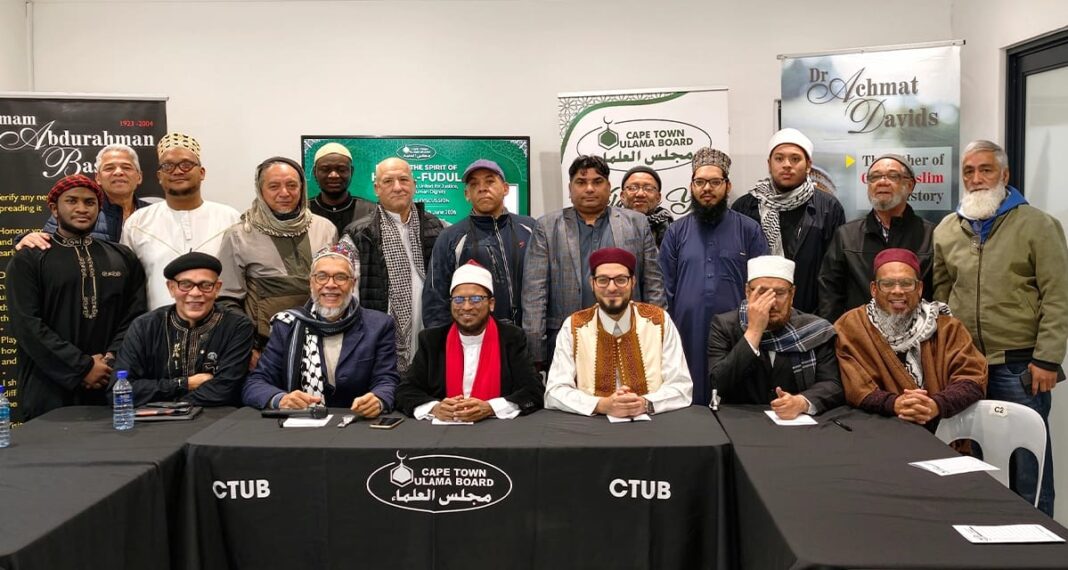

A Cape Town initiative is placing Muslim youth at the forefront of efforts to combat gangsterism, crime and extortion, with organisers stressing that proactive community involvement is essential to protecting vulnerable neighbourhoods before criminal networks take hold.
The CTUB Community Guardianship Desk, launched by the Cape Town Ulama Board (CTUB) in April 2026, combines community safety, youth empowerment and advocacy through partnerships with law enforcement agencies and civic organisations.
Sayed Ridhwaan, a CTUB executive member and project lead for the Community Guardianship Desk, described it as “a flagship safety, youth empowerment and advocacy initiative launched by the CTUB”.
He said the initiative “bridges professional law enforcement expertise with moral leadership” through four key pillars: principled advocacy and accountability, proactive youth empowerment, civic infrastructure and collaboration, and the intersection of law and conscience.
The initiative was established following a high-level crime response summit convened by CTUB. According to Ridhwaan, it was founded under the leadership of CTUB President Mufti Sayed Haroon Al Azhari and is managed by retired police commander Colonel Dawood Laing alongside himself.
“It was started to move community safety from a reactive stance to a proactive, intelligence-driven front that holds authorities accountable while protecting neighbourhoods,” he said.
The project was developed in response to escalating gang violence, extortion and drug-related crime affecting communities across the Cape Flats.
Ridhwaan said the urgency of early intervention was reflected in the words of Sufi scholar Shaykh Mukhtar Ad-Dusooqi:
“Spit on a small flame and you’ll extinguish it, but once it engulfs your whole community, no effort will be enough to undo the damage it leaves behind.”
Youth at the centre of community safety
Ridhwaan said young people are central to the initiative’s long-term strategy.
“Youth are the operational core of the project,” he said. “Rather than allowing young people to fall victim to gang recruitment, the Desk engages hundreds of youth in mentorship, civic duties and safety awareness, offering them purpose, protection and positive alternatives.”
Volunteers participate in high-visibility street patrols, youth mentorship workshops and administrative advocacy. They are also encouraged to join local neighbourhood watches and Community Policing Forums (CPFs) to strengthen existing community safety structures.
The Desk also assists crime victims who encounter procedural obstacles when attempting to open criminal cases.
Regular patrols, youth development programmes and advocacy meetings are currently taking place in the Grassy Park and Eagle Park communities.
Supporting victims and holding authorities accountable
Among the initiative’s early successes, Ridhwaan highlighted its intervention in the Langa madrasa extortion case in June.
“When an extortionist threatened a Langa educational centre that feeds local children, and police turned the official away twice, Colonel Dawood Laing, Shaykh Sayed Ridhwaan and MP Imraan Moosa personally accompanied the official to Athlone SAPS,” he said.
“They firmly demanded that a criminal case be opened immediately and transferred directly to the SAPS Specialised Extortion Unit.”
Ridhwaan described gang violence and organised crime as “an existential threat to families, small businesses and places of worship”.
He argued that “broad, expensive interventions such as deploying SANDF soldiers without arrest powers, at a cost of more than R830 million, fail to solve the crisis”.
“Effective change requires intelligence-driven policing, procedural integrity and active community participation,” he added.
The Community Guardianship Desk works alongside SAPS, Community Policing Forums, registered neighbourhood watches and municipal law enforcement agencies.
It also facilitates interfaith roundtable discussions involving Muslim, Christian and other faith leaders, civic organisations and Members of Parliament to strengthen coordinated responses to crime.
A call to Muslim youth
Ridhwaan said many of the initiative’s volunteers are motivated by “religious duty, a commitment to protecting their families, and the empowering realisation that civil society can reclaim its streets when backed by proper legal knowledge and moral guidance”.
He urged more young Muslims to become actively involved in protecting their communities.
“Be proactive before it is too late,” he said. “Step forward, join your local neighbourhood watch or CPF, and align with structured platforms such as the Guardianship Desk to protect your neighbourhoods from extortion and violence.”
Ridhwaan added that the initiative is grounded in Islamic principles that prohibit “injustice, extortion and spreading corruption”, or fasad fil-ard.
He stressed that “protecting human life, defending vulnerable community institutions and removing harm from public spaces are sacred religious obligations”.
Ridhwaan also appealed for stronger cooperation between civic and religious institutions and encouraged the public to support the CTUB Community Guardianship Desk through donations of safety equipment, funding for youth programmes and other operational resources.