


Death in the family comes with a price tag. From hiring mourners to cry and purchasing expensive coffins to extravagant funerals that leave families in debt, mourning the dead can come at a significant cost. A boat tragedy in Bayelsa, Nigeria, which claimed 24 lives as mourners travelled to a burial, has also highlighted the dangers associated with funeral obligations.
Death is supposed to bring families and communities together in moments of grief, reflection and remembrance. But in some sections of Nigerian society, the rituals surrounding death have increasingly become expensive social performances, creating opportunities for financial exploitation, deception and commercial interests to thrive at the expense of bereaved families.
From individuals hired to cry at funerals to extravagant burial ceremonies that leave families in debt, the question is becoming unavoidable: is mourning still about honouring the dead, or has it evolved into a business?
A tragic incident in Nigeria’s southern Bayelsa State has brought another dimension to this debate.
24 dead on the way to a burial
On Friday, 20 November 2026, a boat conveying mourners to a burial ceremony capsized in the waterways of Southern Ijaw Local Government Area, leaving at least 24 people dead and another 24 rescued. Search-and-rescue operations were continuing as authorities worked to establish the total number of passengers and missing persons.
The vessel was travelling from Ayama to Ukubie when it reportedly developed a mechanical problem and overturned near the river junction between the Oweikorogha and Otuan communities. Preliminary accounts pointed to overcrowding, the absence of a passenger manifest and inadequate use of life jackets. Some passengers had also reportedly expressed concerns about the number of people aboard before the boat departed.
Governor Douye Diri ordered an investigation into the incident.
Beyond the immediate questions of maritime safety and accountability, the tragedy raises a difficult question: how far should people go to demonstrate their respect for the dead, particularly when funeral obligations expose the living to danger?
When grief becomes a profession
In Nigeria, professional mourning has become an unusual occupation in some communities. Individuals and groups are reportedly hired to cry, wail, sing sorrowful songs and create an atmosphere of grief during burial ceremonies.
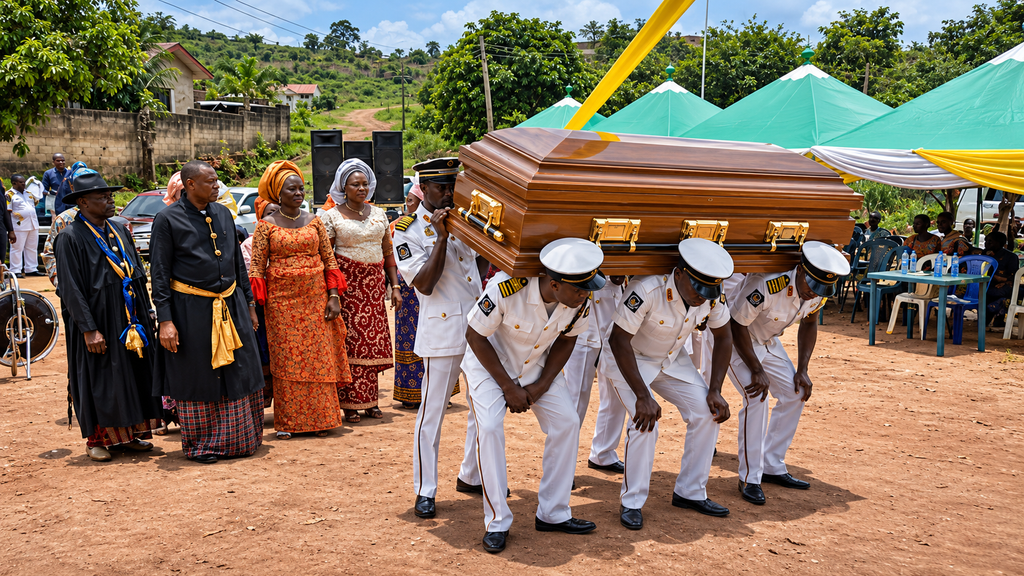
A 2022 report by The Cable documented the practice, with some professional mourners reportedly earning between ₦3,000 and ₦5,000 daily, depending on their arrangements.
While such services may provide an income for those involved, they also raise questions about the authenticity of public expressions of grief. There is a fundamental difference between someone mourning a person they genuinely loved and another being paid to manufacture sorrow for an audience.
The practice becomes particularly questionable when families feel pressured to hire mourners because they fear that a quiet funeral might be interpreted as a sign that the deceased was not sufficiently loved or respected.
In such circumstances, grief becomes a performance, measured by the number of people crying, the volume of lamentation and the scale of the ceremony.
But genuine sorrow cannot be purchased, and the number of hired mourners cannot determine the worth of a human life.
The financial exploitation of bereavement
The commercialisation of death goes beyond professional mourners. Across different religious and cultural communities, some families face enormous financial expectations when organising funerals.
Expensive coffins, elaborate decorations, costly burial clothing, lavish receptions, entertainment and multiple ceremonies can turn what should be a period of mourning into a financial struggle. Some families borrow money, sell property or exhaust their savings to satisfy expectations from relatives, community members and religious associates.
More troubling are dishonest service providers who inflate quotations, demand unnecessary payments or take advantage of families who are emotionally vulnerable and may have little capacity to question expenses. Funeral fundraising can also become problematic when contributions supposedly intended to support bereaved families are misappropriated or transformed into compulsory financial demands.
Not every expensive funeral is fraudulent, and funeral service providers operate legitimate businesses. The concern arises when deception, coercion and unnecessary expenditure replace transparency and compassion.
The Nigerian Baptist Convention has also cautioned against extravagant burials, expensive coffins, unnecessary delays and turning funeral ceremonies into money-making ventures. Its recommendations discourage churches from imposing unnecessary financial demands on grieving families.
This suggests that the problem is not exclusive to any particular religion but reflects a wider challenge of religious accountability.
Islam’s approach: Simplicity, dignity and prompt burial
Islam provides a different perspective on death, emphasising simplicity, dignity, communal responsibility and remembrance of Allah rather than public display.
Mallam Adam Shaaban, Assistant Imam of Pambara Central Mosque in Bwari Area Council, Abuja, said Islam teaches that death is inevitable and that every soul will eventually return to Allah. He explained that the religion emphasises simplicity, dignity and compassion in handling the deceased, with burial regarded as a collective obligation of the Muslim community, known as Fard Kifayah.
Shaaban said Islamic teachings also encourage Muslims to hasten funeral arrangements and avoid unnecessary delays, in accordance with the guidance of Prophet Muhammad (peace be upon him). Rather than placing additional financial demands on grieving families, he explained, Islamic teachings encourage relatives, neighbours and members of the community to support them with food and practical assistance.
He added that funeral processions should be conducted solemnly, with prayers seeking Allah’s forgiveness and mercy for the deceased, while avoiding excessive lamentation and extravagant ceremonies.
For Shaaban, the circumstances surrounding death should remind people of life’s uncertainty and strengthen their compassion towards those experiencing loss. Funeral arrangements, he stressed, should not become occasions for unnecessary display, controversy or hardship, but should reflect dignity, restraint and collective support.
In Islamic teaching, death is a reminder of human mortality, not an opportunity to demonstrate wealth or compete over social status.
A deceased Muslim has rights that the living community must fulfil. These include washing the body, shrouding it, performing the Salat al-Janazah (funeral prayer) and arranging burial. These duties are generally classified as Fard Kifayah, a collective obligation discharged when sufficient members of the Muslim community fulfil them.
The body is washed respectfully, covered in a simple shroud and prepared for burial. The funeral prayer is an act of supplication, asking Allah to forgive the deceased and grant them mercy.
Islam also encourages prompt burial. The Prophet Muhammad (peace be upon him) instructed Muslims to hasten funeral rites, a teaching recorded in Sahih al-Bukhari. The emphasis is therefore on fulfilling religious responsibilities rather than organising elaborate ceremonies, displaying expensive burial materials or delaying burial unnecessarily.
Importantly, Islam does not prohibit grief. Crying and feeling sadness after losing a loved one are natural human responses. However, excessive lamentation and practices that contradict Islamic teachings are discouraged.
The religion also encourages communities to support bereaved families, including providing food and assistance rather than imposing additional financial burdens on them.
A challenge that crosses religious boundaries
Islamic teachings on burial do not mean Muslim communities are immune to extravagance or exploitation. Expensive ceremonies, competitive hospitality and unnecessary financial demands also occur in some Muslim communities, despite the religion’s emphasis on moderation.
Christian, Muslim and traditional religious institutions therefore share a responsibility to confront practices that turn bereavement into an opportunity for profit. Consumer protection agencies and law enforcement authorities also have a role in addressing fraudulent funeral services, particularly where families are deliberately misled or financially exploited.
Ultimately, the Bayelsa tragedy reminds communities that honouring the dead should never come at the expense of the living. No burial ceremony should require people to risk their lives in overcrowded boats or unsafe vehicles simply to demonstrate loyalty to someone who has died.
The dead deserve dignity, but those left behind deserve compassion, protection and financial consideration.
Perhaps the greatest respect a community can show the deceased is not through expensive ceremonies, hired tears or extravagant displays, but through sincere prayers, genuine remembrance and support for the bereaved.
Death should unite people in compassion, not create another opportunity for exploitation.