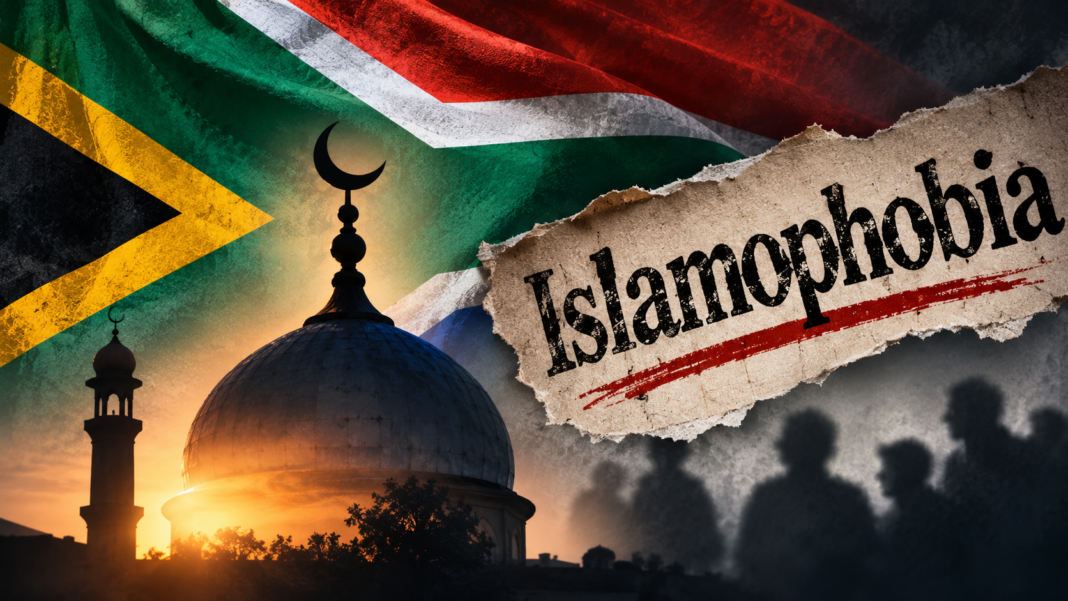

South African Muslims have been urged to unite, mobilise and confront the growing threat of Islamophobia, amid warnings that organised anti-Muslim hatred and far-right influence could undermine religious freedoms and social cohesion in the country.
“It was a matter of time before this engineered anti-Muslim hate landed on our shores.”
These were the words of community activist Khalid Vawda at the United Ulama Council of South Africa (UUCSA) national symposium, where he called on Muslims to move beyond expressions of concern and take collective responsibility for confronting the growing visibility of Islamophobia.
Addressing the gathering, themed “Who Benefits from Fear & Hate? Islamophobia, the Far Right and Foreign Influence in South Africa”, Vawda argued that the Muslim community needed to recognise the nature of the challenge, strengthen its internal unity and develop a coordinated response that extended across leadership, legal structures, research, media and community institutions.
Grounding his remarks in Islamic teachings, Vawda reminded the audience that Muslims should understand the challenges facing them as a test from Allah. Quoting the Qur’anic verse, “Do you think you will be admitted into Paradise without being tested like those before you?”, he said that while the community should pursue the best possible strategies and outcomes, the results ultimately rested with Allah.
Vawda identified three broad categories of people within South African society: those who have built meaningful relationships with the Muslim community, individuals whose attitudes are shaped by ignorance and misinformation, and those who harbour genuine hostility towards Muslims.
“There are those who have genuine hatred in their hearts. Deeply. Pretending otherwise on our part would be naive and it would be costly,” he said.
He argued that understanding the individuals and organisations involved in spreading anti-Muslim sentiment was essential to developing effective responses. Referring to what he described as a wider agenda against Islamic values and principles, Vawda urged researchers and community organisations to examine the connections between international developments and local campaigns.
He specifically called for closer examination of the International Court of Justice (ICJ), a Times of Israel article which he said called for the fragmentation of Africa and South Africa, and the interests benefiting from such developments.
Referring to a question raised earlier by Mawlana Suleiman, Vawda said: “Follow the money to see who benefits. Follow the power to see who benefits.”
However, he stressed that identifying those responsible would mean little without unity within the Muslim community itself.
“It’s essential that the Muslim community and organisations stand as a unified bloc. This is essential. It cannot be emphasised enough. Not in slogans but in action,” he said.
Acknowledging that Muslim organisations may differ in their approaches and strategies, Vawda maintained that these differences should not prevent them from supporting one another.
“Regardless of our differences in approaches and in strategy, it’s critical to have each other’s back,” he said, warning that unresolved internal divisions could leave the community increasingly fragmented.
He also cautioned against confusing peaceful conduct with passivity, urging Muslims to defend their faith with dignity and confidence rather than becoming apologetic in the face of hostility.
“What we are calling for is standing with honour and dignity, being forthright and not being apologetic for our faith,” Vawda said.
He added: “This is also so that the opposing parties very clearly understand that our kindness should not be mistaken for weakness.”
For Vawda, confronting Islamophobia cannot be the responsibility of a handful of prominent individuals or organisations. It requires participation across different sectors of the Muslim community, including leadership, legal professionals, researchers, writers and those working in technology and media.
He placed particular emphasis on the role of social media, encouraging Muslims to become more active in producing and sharing credible content rather than remaining passive consumers of online information.
“Don’t let the algorithm dictate to you what you should be watching,” he said, urging community members to contribute meaningful material, support credible news outlets and share the work of content creators addressing issues of social justice.
Vawda also called for a coordinated system to document incidents of Islamophobia, suggesting that community technology teams explore options such as dedicated applications, browser tools or reporting hotlines.
“Record every single incident,” he urged, emphasising that reporting mechanisms would only be effective if the public actively used them.
He further challenged mosque committees and religious leadership to become more involved in addressing the issue, arguing that community mobilisation should not be treated as optional.
“Our masjid committees have an obligation. It’s not a choice. They have an obligation to get on board here,” he said.
He extended the same responsibility to imams and community members who share Friday sermons and religious talks, calling for greater awareness and preparedness, particularly among women and young people.
Vawda warned against allowing the community’s most vulnerable members to remain unprepared in the face of hostility, referring to the incident involving Halima in Durban as a reminder of the need for vigilance and self-defence.
He concluded by urging Muslim organisations to think beyond immediate interventions and develop strategies that would sustain the community’s response over the next five, ten and twenty years.
“It’s about what we do and what we do now because this will shape the years and the decades to come,” he said.
A wider concern for South Africa
Vawda’s call for organised community action formed part of a broader discussion at the symposium about the social, political and economic implications of Islamophobia in South Africa.
Political analyst Dr Imraan Buccus raised concerns about what he described as a regression towards ethnic nationalism, pointing to the country’s history of xenophobic violence in 2008, 2015 and 2021.
He expressed concern about what he viewed as growing identity-based political mobilisation, highlighting developments involving March and March, the MK Party and Zulu nationalism, as well as the Patriotic Alliance and AfriForum.
Buccus warned that this form of political insularity could contribute to Muslims being increasingly regarded as outsiders rather than as an established part of South African society.
Acting Police Minister Firoz Cachalia offered a different assessment of the domestic context, cautioning against direct comparisons with European countries.
While acknowledging that South Africa was not immune to international political developments and the growing visibility of anti-Muslim sentiment, Cachalia argued that Islamophobia did not have deep, organic roots in South African society.
He pointed to the country’s established tradition of respecting religious belief, practice and diversity, maintaining that coexistence between different religious communities remained an important feature of its social fabric.
The economic implications were raised by business sector representative Ebrahim Patel, who warned that Islamophobia could also affect South Africa’s participation in the global halal economy, a multi-trillion-dollar market.
Drawing on experiences in Australia and Belgium, Patel raised concerns about the potential disruption of halal manufacturing, supply chains and international business relationships where anti-Muslim hostility affects commercial environments.
He cautioned that growing prejudice could have consequences for South Africa’s international reputation, trade relationships and investment opportunities.
Beyond condemnation
Following the symposium, UUCSA announced that it had developed a national strategy aimed at strengthening public awareness, legal protections, policy engagement and institutional accountability.
The council emphasised that Islamophobia cannot be treated as a concern affecting Muslims alone. It is a challenge to the constitutional values of equality, dignity and belonging that underpin South Africa’s shared society.
The symposium’s discussions highlighted the need for responses that extend beyond condemning individual incidents, bringing together community organisations, researchers, legal professionals, media, business and public institutions.
For Vawda, however, the starting point remains the Muslim community’s willingness to take responsibility for what happens next.
While strategies and institutional interventions are being developed, he reminded the gathering that the present moment demands action rather than prolonged internal debate.
“Now it’s our turn,” he said, reflecting on the responsibility carried by the generation that must continue the work of those who came before them.
South Africa belongs to all who live in it. Religion must never become another frontier of discrimination and exclusion.