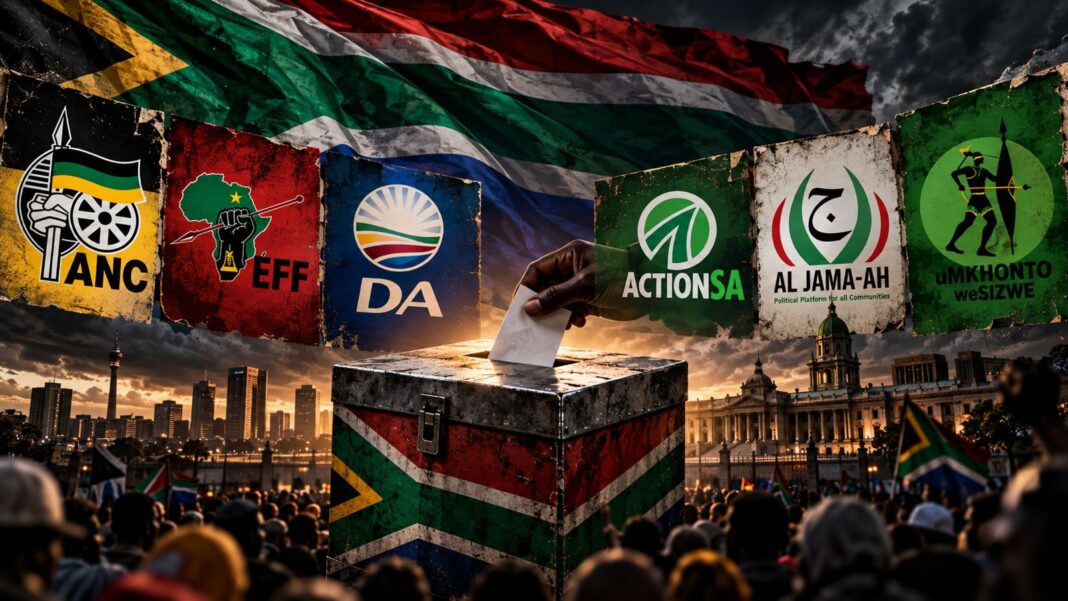

With South Africa’s local government elections scheduled for 4 November, Muslims face a fundamental question: To vote or not to vote? In the first of a series of opinion pieces examining this issue, Moulana Uwais Dockrat of the Guardian Dawa Institute challenges the dominant narrative that secularism is a neutral political framework, arguing that Muslims must recover their own intellectual foundations.
One of the most powerful assumptions of the modern age is that secularism is neutral: a political arrangement that simply creates room for people of different faiths to coexist. But that description conceals something much deeper. Secularism is not merely the absence of religion from government. It is a worldview with its own claims about truth, morality, the human being, law, authority and the purpose of life.
For Muslims, this distinction is fundamental. Islam is not a private collection of rituals confined to the masjid, the prayer mat or the month of Ramadan. Deen speaks to the whole of life. It shapes how we understand reality, how we know what is true, how we define right and wrong, how families are organised, how wealth is used, how society is governed and where ultimate authority lies.
Secular liberalism also makes claims in all of these areas. The question, therefore, is not whether Islam is a worldview while secularism is neutral. The question is which worldview is setting the terms.
That becomes clear when we examine how modern societies have come to define “religion”. Religion is commonly presented as a broad category encompassing a range of competing faith traditions: Islam, Christianity, Judaism, Hinduism, Buddhism and others. Each becomes one option among many, often reduced to personal belief or private identity. Within this framework, religion is increasingly detached from politics, economics, law and public morality.
Yet historically, religion was not always understood in this compartmentalised way. An older sense of the term carried the idea of duties and obligations owed to God. That resonates more closely with the Islamic understanding of deen: not merely a personal preference, but a divinely ordained way of life to which the believer is accountable.
The change in meaning matters because language carries assumptions. Once Muslims accept secular categories uncritically, we may find ourselves defending Islam through concepts that originate in a very different worldview.
We may defend hijab, for example, solely through the language of individual freedom. Freedom may have strategic value in a secular legal argument, but the Islamic reason for hijab begins elsewhere: obedience to Allah. When another worldview supplies our vocabulary, it can quietly begin to supply our premises as well.
This is why secularism should not be understood as a simple political mechanism. It is comprehensive. It makes claims about what exists, what counts as knowledge, where morality comes from, what human beings are, what constitutes a good life and who has the right to legislate.
In the secular paradigm, reason, empirical evidence, social consensus and human autonomy occupy the centre. In Islam, revelation provides the governing framework, with reason and evidence operating within it rather than above it.
The claim that secularism merely separates religion and state is also too simplistic. The modern state does not simply leave religion alone. It decides what counts as religion and which religious acts it will tolerate. It can classify some beliefs as private faith, others as culture, others as political claims and still others as threats to public order or constitutional values.
In this sense, religion is not always removed; it is reshaped. Prayer, fasting and personal spirituality may be accommodated, while legal, political or moral claims that conflict with the dominant constitutional order are restricted. The state thus becomes the authority that determines where religion may begin and where it must end.
South African Muslims should take this seriously. Contemporary disputes involving religious dress, corporal punishment, sexuality, education and the regulation of religious institutions all point to a broader question: if the state decides what religion may do, who is ultimately subordinate to whom?
The problem did not begin in the present. Colonialism was not merely a project of resource extraction. It was also a civilisational project.
Across Muslim lands, colonial powers dismantled, codified or subordinated existing systems of law, education, waqf and governance. The British reshaped legal systems through translation and codification; the French weakened waqf structures in places such as Algeria; and colonial administrations recast Islamic law into forms that conformed to European state structures.
Political independence did not automatically reverse this intellectual transformation. Much of the institutional architecture remained. Muslims could inherit states, institutions, legal assumptions and categories shaped by colonial modernity, only to mistake them for neutral foundations.
That is why the central challenge is not merely political participation. It is intellectual clarity. We must distinguish between living under a system and believing in it; between using its tools and adopting its worldview; between working within a system and becoming part of its conceptual architecture.
This does not require withdrawal from society. Muslims live in real states, under real laws, alongside neighbours of other faiths and none. Engagement is unavoidable. But engagement without clarity carries the danger of gradual absorption.
The first task, then, is recovery: recovering the confidence to think from within our own intellectual foundations. Correct action begins with correct conceptualisation. If the starting point is confused, every practical decision that follows risks being shaped by assumptions we have never consciously examined.
An Ummah that cannot identify the worldview surrounding it will struggle to preserve the worldview revealed to it.
Before asking how we should act within the modern order, we must first understand what that order is and remember who we are within it.
Moulana Uwais Dockrat is an Islamic scholar and public servant involved in education and da‘wah. A graduate of Darul Uloom Azaadville, he is the Managing Director of The Guardian Da‘wah Institute and founder of Markaz Manār al-Fikr, organisations dedicated to Islamic education and addressing contemporary misconceptions about Islam. He also serves as secretary of the Association of Muslim Schools (AMS) at both Gauteng and national levels.