
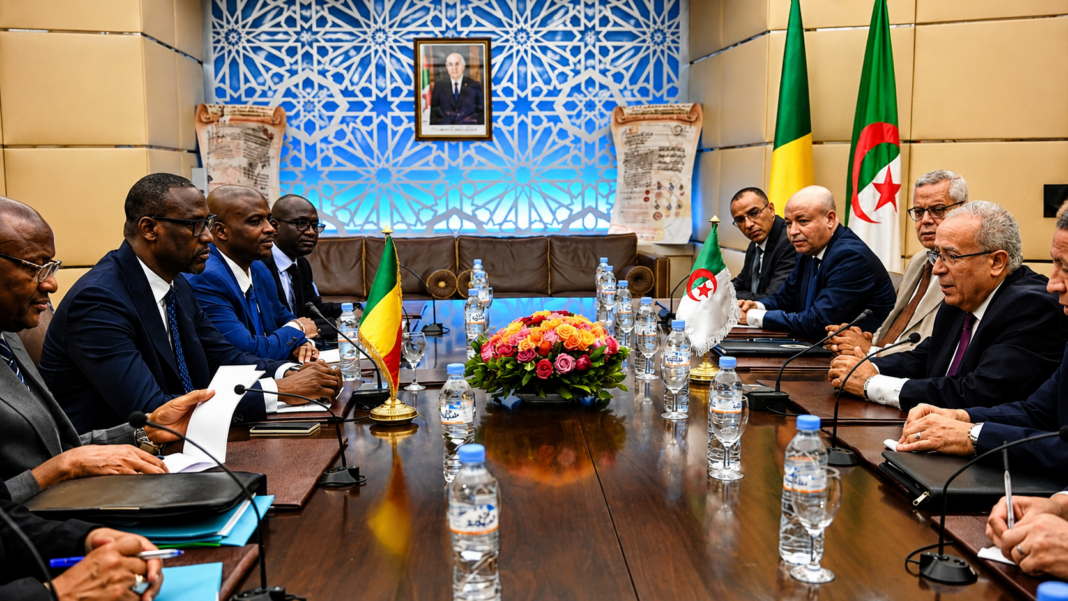

After months of tensions, Algiers and Bamako restored diplomatic relations in July 2026, opening a new chapter in efforts to address Mali’s protracted security crisis. But shifting alliances among armed groups, tentative signals towards dialogue and deep mistrust between Mali’s military authorities, the Front de Libération de l’Azawad (FLA) and Jama’at Nusrat al-Islam wal-Muslimin (JNIM) have made the path towards peace increasingly complex.
According to diplomatic sources, Algeria is quietly working on a new peace initiative involving the FLA and Mali’s military authorities, which it hopes to present to Bamako. The proposal, however, is reportedly being received cautiously by the Malian authorities.
An invitation extended to Malian Prime Minister Abdoulaye Maïga to visit Algeria could represent a first step. Observers believe Algiers wants to hear Bamako’s position directly and assess the conditions under which a renewed political process could take shape.
The initiative comes amid a conflict landscape that has changed significantly since the 2015 Algiers Accord.
In January 2024, Mali formally terminated the Algeria-brokered agreement, declaring it unworkable and expressing its determination to “nationalise” the peace process. Bamako has since favoured an inter-Malian dialogue rather than returning to a framework in which a foreign state plays a central mediating role.
That leaves Algeria facing a delicate diplomatic question: how can it help broker a settlement without appearing to undermine Mali’s insistence on sovereignty over its own peace process?
JNIM complicates the equation
Perhaps the most significant obstacle is JNIM.
The group currently maintains military cooperation with the FLA, complicating any attempt to negotiate a settlement involving only the Malian authorities and Azawad movements.
In recent weeks, some local JNIM figures, including Sheikh Jafaar Dicko and Albani Al-Ansari, have made statements indicating openness towards peace under certain conditions.
They have raised the implementation of Sharia law and called for an end to attacks by national armies, arguing that “innocent people on both sides are suffering and do not want this war”.
The statements do not amount to an announcement of formal negotiations with Bamako. They do, however, represent political signals that may prove difficult to ignore in any attempt to build a broader peace process.
On the Malian side, the ultimate decision rests with the political leadership.
Minister Delegate to the Minister of Defence Major General Oumar Diarra made that position clear: “We are under the orders of the political authorities. If the political authorities tell us to wage war, we wage war; if they tell us to make peace, we make peace.”
His remarks suggest that continued military operations do not necessarily rule out a political decision to pursue negotiations.
FLA remains sceptical
The FLA has not officially commented on the discussions between Algiers and Bamako.
However, Saïd Ben Bella, one of its leaders, believes improved relations between the two capitals could help “reduce tensions” without necessarily “bringing an end to the war” between the FLA and Bamako.
According to Ben Bella, the Malian authorities currently show no “real willingness” to pursue a “just and lasting peace”.
Other FLA officials have reportedly interpreted the invitation to Maïga as evidence that “nothing has been decided” and that discussions are taking place “in the shadows” at the FLA’s expense.
Such mistrust could present another major obstacle to any Algerian initiative, particularly if armed movements believe the framework is being shaped without their meaningful participation.
Why Algeria is pushing ahead
Algeria’s involvement in Mali’s political and security crises stretches back decades.
Since Mali gained independence, Algiers has repeatedly acted as a mediator between Bamako and armed movements in the north. Its interest is driven not only by diplomacy, but also by national security.
Algeria shares a lengthy border with Mali and has a direct interest in preventing instability across the Sahel from spilling into its territory.
The Tuareg question also extends beyond Mali, involving communities across several countries in the Sahel and Maghreb. For Algiers, containing conflict in northern Mali is therefore both a security imperative and a means of maintaining its diplomatic influence in the region.
Niger could also emerge as a factor in any new diplomatic configuration because of its relations with Algeria and its membership of the Alliance of Sahel States (AES) alongside Mali and Burkina Faso.
A difficult peace equation
Algiers’ challenge will therefore extend far beyond simply bringing Bamako and the FLA back to the negotiating table.
Any sustainable process would have to reduce violence while accommodating Mali’s insistence on the “nationalisation of the peace process”, addressing the FLA’s demands and confronting the reality of JNIM’s military and political influence on the ground.
A settlement excluding influential armed actors risks shifting the conflict rather than ending it. Yet attempting to include all the protagonists would present enormous political, ideological and security challenges of its own.
The anticipated visit by Maïga to Algeria, if it goes ahead, could provide the clearest indication yet of how far Bamako is prepared to move towards a renewed diplomatic process.
For Algeria, the task will be to convince Mali that renewed mediation does not mean resurrecting the 2015 Algiers Accord.
For Bamako, the question is whether an Algerian initiative can advance its security and political interests without compromising its control over the peace process.
For the FLA, it is whether the movement is prepared to return to negotiations under a framework fundamentally different from the one established in 2015.
And for JNIM, the critical question is whether recent signals of openness towards peace could ever translate into a genuine political process — and on what terms.
Peace in Mali may therefore no longer be a matter of negotiating solely between Bamako and Azawad insurgents.
It has become a far more complicated regional equation involving the FLA, JNIM, the AES, Algeria and the competing security interests of several states.
That is precisely what makes Algeria’s renewed diplomatic push potentially significant — and exceptionally difficult.


