
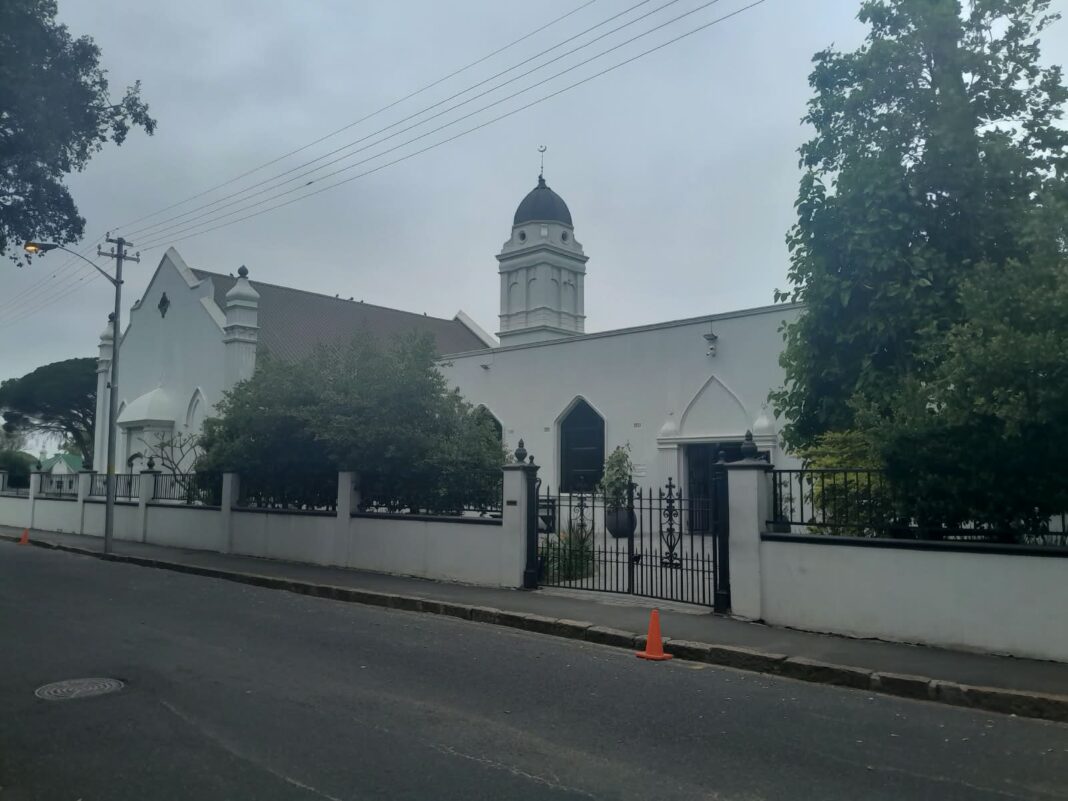

In Cape Town’s Claremont suburb stands Masjid Al-Jaamia, a heritage mosque that has been revitalised into what its leaders describe as a living, breathing sanctuary where history meets the future.
The Shah Mohamed Trust, established by philanthropist Shah Mohamed, acquired the land in 1911. Construction of the mosque was completed in 1922, with the first jamaah salah held on 12 Rabi’ al-Awwal 1341 AH — 2 November 1922.
Early leaders including Imam Magmoed Slamang, Imam Salie Ghak, Imam Hajwani and Imam Sonday anchored the community through the five daily salahs, Sunday madrassa, weekly thikr and Laylatul Bara gatherings.
Next door lies the historic maqbara, where the first recorded burial dates back to 1868, evidence of a thriving Muslim community in the area during the 1860s. Closed under colonial and apartheid-era regulations, the cemetery was eventually reopened following a seven-year campaign led by current mosque chairperson Nazeem Jamie, who has served in the role since 2011.
“After seven long years of perseverance, we successfully reopened the maqbara,” says Executive Secretary Reza Solomon. “Al-Jaamia has structurally anchored its historical footprint, transforming the site into a living monument of endurance.”
During restoration work, workers unearthed the mosque’s original front-door key. Cleaned and framed, it now hangs inside the mosque as a piece of living history.
Imam Achmat Booley — son of 94-year-old former Imam Amanulla Booley and one of four current imams — says the maqbara contains around 1,400 burial sites, which are meticulously maintained, with some families placing benches beside the graves of loved ones.
When apartheid’s Group Areas Act forcibly uprooted Muslim families from Claremont, Newlands and Harfield Village and relocated them to the Cape Flats, worshippers refused to let go of their connection to Al-Jaamia.
“Worshippers simply refused to let distance sever their connection, making the journey at great sacrifice from the segregated suburbs of Lansdowne, Surrey Estate and Sherwood Park to return to their spiritual home week after week,” Solomon says.
The mosque honours prominent figures from its history, including martyred anti-apartheid activist Imam Abdullah Haron, who served from 1955 to 1969, as well as Imam Rashad Salie, Imam Amanulla Booley, Imam Ebrahim “Sepp” Davids and his brother Imam Salliem Davids.
Today, amid Claremont’s transformation into an affluent commercial hub, Al-Jaamia continues to serve two communities: the old, multi-generational families who travel back to preserve their connection with the mosque and its heritage, and a new generation of young Muslim professionals who rely on it daily.
“Under the vision and leadership of Nazeem Jamie, Al-Jaamia has undergone a remarkable renaissance,” Solomon says. “Rather than serving as a standard place of worship, it has been revitalised into a dynamic, highly organised and premier community hub.”
Open from Fajr until 9pm, the mosque offers a packed weekly programme. This includes an afternoon madrassa from 4pm to 5pm, evening lectures with Shaykh Dilavar Baba, Tuesday Quran classes with Moulana Saalim Peck, Wednesday fiqh classes with Shaykh Shafi Salie, Thursday thikr and Raatib-ul-Hadat gatherings, and weekend Hajj and Umrah preparation.
The Al-Jaamia Ladies Forum also organises a range of activities, including Rampies cuttings, open days, markets and mini-symposiums. The mosque hall is available for nikah ceremonies, wedding receptions and other community functions.
Despite occasional challenges, including vagrancy along the mosque’s perimeter fence — an issue since addressed with the assistance of law enforcement — relations with neighbouring communities remain strong.
“On isolated occasions when external complaints were raised regarding the volume of the athaan, our long-term neighbours actively stepped forward to support and defend the mosque’s right to call to prayer,” says Imam Booley.
Funded entirely through community donations and its building fund, and managed by a portfolio-based executive committee, Al-Jaamia continues to look towards the future while honouring its past.
As Solomon puts it: “Not just as a relic of the past, but as a living, breathing sanctuary where history meets the future.”


