
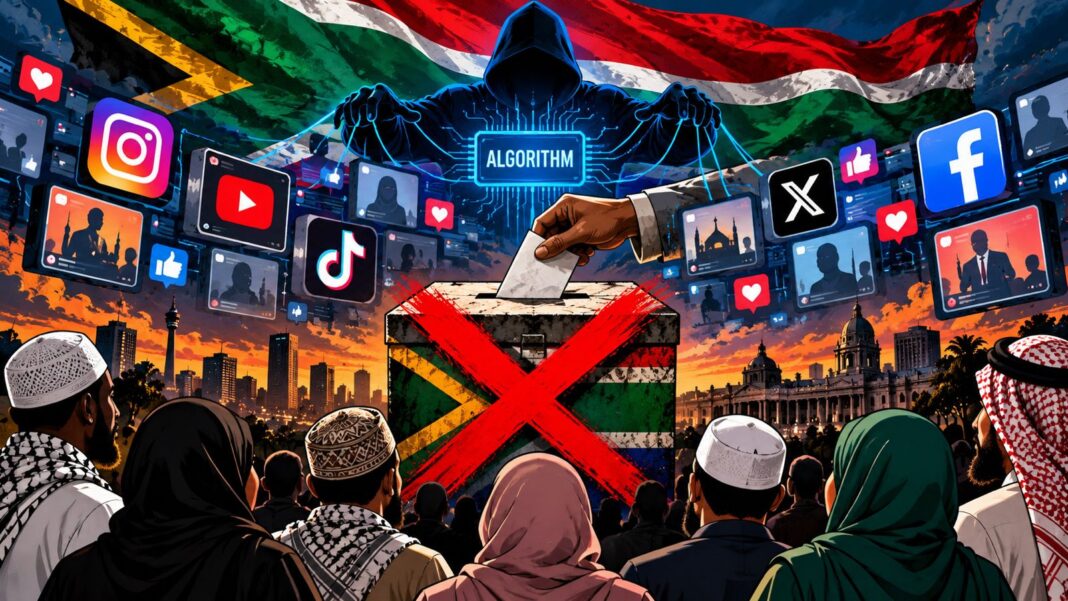

Millions of people form their views of Islam, Muslims and politics through social media. But what they see is increasingly shaped by algorithms controlled by a handful of powerful technology companies.
These algorithms influence which voices are amplified, which are suppressed and which narratives spread fastest, warns Muhammed Zia of Superwise Solution.
As South Africa prepares for its local government elections on 4 November, his warning raises a broader question: how much influence do social media platforms have over what people think, believe and ultimately vote for?
While Muslims continue to debate the compatibility of secular political systems with Islam and how they should engage with them, political messaging is already reaching them through their smartphones.
It appears in TikTok videos, WhatsApp groups, Instagram and X posts, Facebook advertisements and endorsements from celebrities and influencers.
Political parties can reach potential voters without those individuals ever attending a rally, meeting a candidate or reading a manifesto.
With elections approaching, parties are increasingly seeking support from communities across South Africa, including religious groups. Social media provides a fast, inexpensive and powerful means of reaching millions.
These platforms can explain policies, promote manifestos and mobilise voters. But they can also spread misinformation, hostility and emotionally charged narratives, including those targeting religious communities.
Zia argues that the digital environment in which this political contest unfolds is far from neutral.
“Coordinated networks of fake accounts spread anti-Muslim narratives at scale: fabricated stories, recycled hate and manufactured outrage. Researchers and watchdog groups have repeatedly documented these networks, yet many remain active for months, sometimes years,” he said.
Meanwhile, Muslim activists, journalists and ordinary users challenging such content can face removals, reduced visibility and account suspensions, he added.
For Zia, this raises serious questions about whether technology companies enforce their moderation policies fairly and consistently.
It also means that even people with little interest in politics can encounter campaign advertisements, speeches, influencer endorsements or viral allegations without actively seeking political information or verifying its accuracy.
When influence becomes personal
For younger voters, political loyalties can become deeply influenced by personalities and online trends rather than policies.
“As the youth of today, we swing with what everyone is swinging with, even if that means going against our own values. A political party with my favourite artist, influencer or motivational speaker may be the reason why I vote for that party or even be interested in what they are talking about, regardless of what their manifesto says,” one young South African said.
Yet the issues shaping everyday life in South Africa’s municipalities are often far removed from the personalities dominating social media.
Water, electricity, roads, refuse collection, housing, public infrastructure, safety and employment opportunities remain pressing concerns.
These are the realities communities face long after campaign posters disappear and viral videos lose their appeal.
Political promises must therefore be examined against actual delivery rather than online popularity.
The challenge is compounded by misleading claims, manipulated videos, coordinated online campaigns and misinformation. Recommendation algorithms can repeatedly expose users to similar content, potentially reinforcing particular political narratives and impressions.
However, Zia warns against fighting digital manipulation with more manipulation.
“Some argue we should fight fire with fire and match bot with bot. I understand the frustration behind that instinct, but it is a losing strategy. We would be playing on someone else’s field, under someone else’s rules, with someone else holding the whistle.
“Any response that depends on a platform’s goodwill can be switched off by that platform overnight. And we should never answer manipulation with manipulation. Our case is strongest when it is made honestly,” he said.
For Zia, the fundamental problem is ownership and control of the digital infrastructure itself.
“The real lesson is about ownership. In the long run, we cannot win an online battle using technology owned by others. Whoever owns the platform owns the algorithm, and whoever owns the algorithm decides whose voice is heard.
“As long as Muslim communities remain only consumers of technology, we will always be guests in someone else’s house, subject to their rules, their priorities and their blind spots,” he said.
From consumers to builders
Rather than abandoning social media, Zia believes Muslims should become more involved in developing and owning technology.
“First, we must build. Not imitations, but industry-leading platforms that compete on quality, speed, design and trust. Platforms with transparent moderation, clear rules applied consistently, and a genuine commitment to free expression for everyone, including those we disagree with.
“The talent exists. Across the Muslim world and its diaspora are engineers, designers, entrepreneurs and investors of the highest calibre. What has been missing is the will to back long-term technology ventures with the same seriousness we bring to property, trade and philanthropy,” he said.
He stressed that these platforms should not become exclusive Muslim spaces, but inclusive digital environments serving people of all faiths and backgrounds.
True influence, he argued, comes from developing technology that people trust and voluntarily choose to use.
Drawing inspiration from the intellectual legacies of Baghdad, Cordoba and Samarkand, Zia said Muslim civilisation historically influenced the world through knowledge, innovation and institutions that others valued.
He believes the same principle applies today: build something valuable, fair and trustworthy, and influence will follow.
Beyond likes and loyalty
As South Africans consider whether to vote, whom to support and what political participation means, the challenge is to distinguish genuine political substance from online popularity.
A viral clip is not a manifesto.
A celebrity endorsement is not a record of public service.
Millions of views do not make a claim true.
And an algorithm cannot determine the values someone should carry into the ballot box.
From an Islamic perspective, Zia noted, political decisions also raise questions of accountability, justice, honesty, trust and responsibility.
Social media, however, often rewards content that attracts attention, provokes emotion and spreads quickly, regardless of its accuracy or wider consequences.
For Muslim voters, the question is therefore not simply who is trending, who dominates the timeline or which political campaign generates the most excitement.
The ballot may be cast in seconds. The values behind it should not be decided by an algorithm.


