
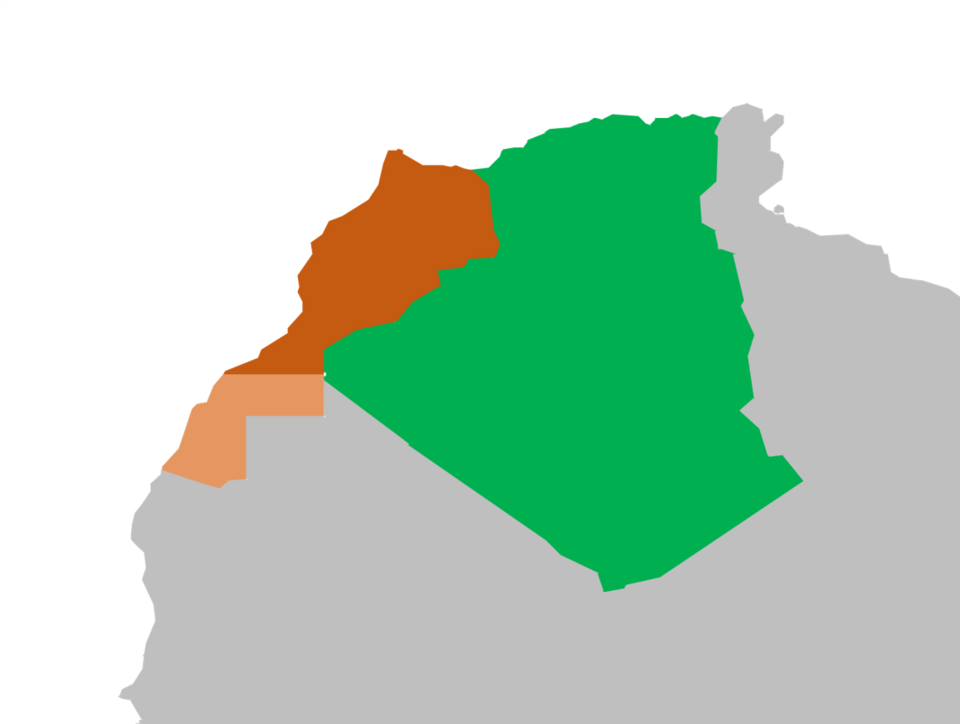

The arrest of 61 Moroccan nationals accused of plotting sabotage in Algeria has reignited tensions between two of North Africa’s most powerful countries, raising fears that their decades-long rivalry could escalate into a wider regional confrontation.
At the heart of the dispute is Western Sahara, where Morocco’s territorial claims and the Sahrawi people’s struggle for independence have fuelled one of Africa’s longest-running conflicts.
The latest developments have also brought renewed attention to South Africa and the African Union (AU), as questions over decolonisation, sovereignty and self-determination intensify.
Algerian authorities announced on October 11 that they had arrested 61 Moroccan nationals suspected of planning acts of sabotage.
According to Algeria’s General Directorate of National Security (DGSN), the suspects, including a former Moroccan soldier, entered Algeria through mountainous routes from Tunisia and formed part of what authorities described as an international Moroccan criminal network threatening national security.
Algerian authorities have not publicly disclosed evidence substantiating the alleged plot, while Morocco has not issued an official response to the arrests.
The allegations have nevertheless heightened tensions between two neighbours whose shared land border has remained closed since 1994. Algeria severed diplomatic relations with Morocco in August 2021.
The central source of hostility remains Western Sahara, a mineral-rich former Spanish colony largely controlled by Morocco since 1975 and still classified by the United Nations as a non-self-governing territory.
Rabat considers Western Sahara an integral part of Morocco, while Algeria backs the Polisario Front, which has fought for Sahrawi independence and insists that the territory’s future must be determined through self-determination.
Western Sahara and the struggle for self-determination
The dispute has become increasingly contentious as international support grows for Morocco’s autonomy proposal.
Introduced in 2007, the plan would grant Western Sahara limited self-government while keeping the territory under Moroccan sovereignty.
The United States, France, Spain and Germany are among the countries that have backed the initiative. Algeria, however, rejects any settlement that would impose Moroccan sovereignty without allowing the Sahrawi people to determine their political future.
On October 31, 2025, the UN Security Council adopted Resolution 2797, establishing Morocco’s autonomy proposal as the basis for renewed negotiations and identifying genuine autonomy as a potentially feasible outcome.
Although the resolution retains references to Sahrawi self-determination and calls for a mutually acceptable political settlement, critics argue that placing Morocco’s proposal at the centre of negotiations risks prejudging the outcome in Rabat’s favour.
Crucially, the resolution did not formally recognise Moroccan sovereignty over Western Sahara. Nevertheless, its emphasis on autonomy represents a significant diplomatic victory for Morocco and raises questions about whether independence remains a realistic outcome under the current UN-led process.
For Algeria and South Africa, the issue extends beyond diplomatic negotiations. Both countries regard the Sahrawi struggle as unfinished business in Africa’s decolonisation.
South Africa has remained one of the Polisario Front’s strongest supporters, drawing on its own history of resistance to apartheid and colonial rule.
In July 2026, President Cyril Ramaphosa reaffirmed Pretoria’s support for Sahrawi independence when he received Sahrawi Foreign Minister Mohamed Yeslem Beissat, who visited South Africa as a special envoy of Sahrawi President Brahim Ghali.
South Africa refuses to abandon the Sahrawi cause
Ramaphosa reiterated South Africa’s commitment to the Sahrawi people’s struggle for freedom and independence, reflecting Pretoria’s longstanding position that their right to self-determination must not be overridden by the interests of powerful states.
South Africa officially recognises the Sahrawi Arab Democratic Republic (SADR), maintains diplomatic relations with its representatives and has repeatedly challenged the international community’s handling of Western Sahara.
Pretoria regards the territory as Africa’s last remaining colony and has drawn parallels between the Sahrawi struggle and South Africa’s resistance to apartheid.
During previous UN Security Council debates, South African representatives criticised the marginalisation of African voices in negotiations over Western Sahara, arguing that decisions affecting the continent should not be dominated by Western powers.
Following the adoption of Resolution 2797 in October 2025, South Africa expressed disappointment that negotiations were being centred on Morocco’s autonomy proposal while insufficient attention was given to Sahrawi proposals and the right to self-determination.
The Department of International Relations and Cooperation (Dirco) has consistently defended the Sahrawi people’s internationally recognised right to determine their future, placing the issue alongside other unresolved struggles against colonial domination, including Palestine.
For Morocco, South Africa’s position remains a diplomatic obstacle to its campaign for wider international recognition of sovereignty over Western Sahara.
African Union faces a test of its principles
The African Union now faces a fundamental challenge: how to reconcile its recognition of the Sahrawi Arab Democratic Republic with an international diplomatic process increasingly centred on autonomy under Moroccan sovereignty.
The SADR joined the Organisation of African Unity (OAU), the AU’s predecessor, in February 1982. Morocco withdrew in 1984 in protest against Sahrawi membership and remained outside the continental body until January 2017.
When Morocco returned, its readmission was approved by 39 African states, despite opposition from Algeria and South Africa.
The SADR nevertheless remains a full AU member, creating an unusual situation in which Morocco and the Sahrawi Republic belong to the same continental organisation while maintaining fundamentally opposing claims over Western Sahara.
Although the AU has historically supported Sahrawi self-determination, it has increasingly deferred to the UN-led political process to avoid direct confrontation between its members.
That approach is now under renewed scrutiny.
Resolution 2797 and the approaching expiry of the United Nations Mission for the Referendum in Western Sahara (MINURSO) mandate on October 31, 2026, have intensified questions about the territory’s future and the AU’s commitment to its founding principles.
MINURSO was established in 1991 to support a ceasefire and organise a referendum on self-determination. More than three decades later, that referendum has never taken place.
Critics fear that any substantial alteration of the mission’s mandate towards an autonomy-centred settlement could further marginalise Sahrawi aspirations for independence.
Such an outcome would also expose contradictions within the AU, which would continue recognising the SADR as a member while an internationally supported process potentially entrenches Moroccan sovereignty over much of the disputed territory.
For South Africa and Algeria, the concern is that Africa’s unfinished decolonisation agenda could effectively be settled by external powers without the consent of the people whose future is at stake.
UAE and Israel deepen regional divisions
The Morocco-Algeria rivalry has increasingly extended beyond Western Sahara, drawing in regional and international powers whose strategic interests are reshaping North Africa’s alliances.
On September 10, 2026, Algeria severed diplomatic relations with the United Arab Emirates (UAE), ordering the Emirati ambassador to leave and announcing restrictions on UAE-registered aircraft entering Algerian airspace.
Algerian authorities cited what they described as provocative and hostile actions by Abu Dhabi, although their official announcement did not identify the specific incidents behind the decision.
The diplomatic rupture followed mounting tensions over regional policies, including the UAE’s support for Morocco’s position on Western Sahara and the countries’ opposing approaches towards Israel.
Morocco normalised relations with Israel in 2020 under the US-brokered Abraham Accords. Its subsequent security and military cooperation with Israel has added another dimension to Algeria’s regional security concerns.
Morocco has reportedly acquired Israeli surveillance and defence technology while strengthening military cooperation with the United States and other international partners.
A major non-NATO ally of Washington, Morocco hosts the annual African Lion military exercises and has invested heavily in modernising its armed forces, including through American F-16 fighter jets, Apache attack helicopters and unmanned aerial systems.
A military rivalry threatening regional stability
Algeria, meanwhile, remains a major purchaser of Russian military equipment and maintains longstanding defence ties with Moscow.
It has also developed important energy partnerships with European countries, including Italy and Spain, despite diplomatic tensions with Madrid following Spain’s support for Morocco’s autonomy proposal.
These competing alliances have fuelled concerns that the rivalry could escalate into a wider confrontation involving international powers with strategic interests in North Africa.
Both Algeria and Morocco have invested heavily in military modernisation while maintaining heightened security along their closed border.
The two governments have repeatedly traded accusations of espionage, interference and support for separatist movements.
Morocco accuses Algeria of backing the Polisario Front, while Algeria has accused Morocco of supporting the Movement for the Self-Determination of Kabylie (MAK), which Algiers has designated a terrorist organisation.
These accusations, combined with expanding military partnerships and the unresolved Western Sahara conflict, have created an atmosphere of deep mistrust.
For ordinary Algerians and Moroccans, the consequences extend far beyond military and diplomatic rivalry.
Families remain divided by the closed border, direct travel and economic cooperation are restricted, and opportunities for regional integration have been undermined.
The prolonged confrontation has also weakened prospects for economic cooperation across the Maghreb, depriving neighbouring populations of potential trade, investment and development opportunities.
With diplomatic relations severed, military alliances expanding and Western Sahara’s future unresolved, the risk of escalation remains.
Yet the approaching UN decision presents an even more fundamental question for Africa.
Can the African Union defend the Sahrawi people’s right to self-determination while accepting an international diplomatic process that increasingly favours Moroccan autonomy over independence?
For South Africa, Algeria and the Sahrawi people, the answer will have consequences far beyond Western Sahara.
It will test whether Africa’s commitment to decolonisation remains a guiding principle or whether the political and strategic interests of powerful states will ultimately determine the fate of one of the continent’s last unresolved struggles for independence.


