
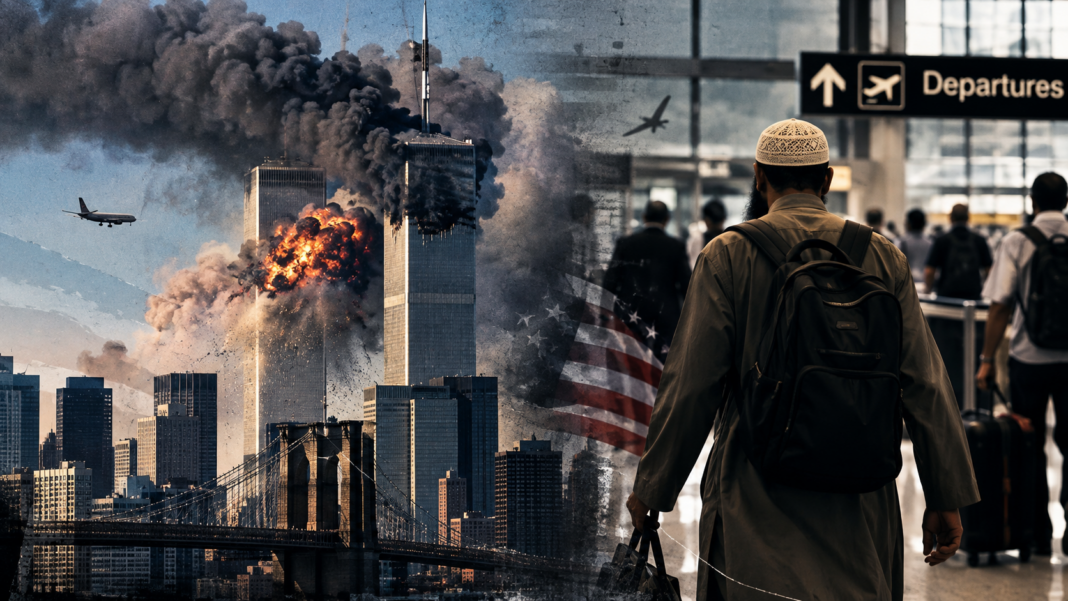

For Muslims around the world, 9/11 did not end when the towers fell. Its aftermath followed Muslims into airports, schools, workplaces, mosques and public life, turning Muslim identity into something increasingly questioned, scrutinised and, in many cases, viewed through the lens of security.
Twenty-five years later, that psychological and social legacy remains.
“The deepest psychological legacy of 9/11 is that it turned Muslim identity into a question Muslims were constantly required to answer,” Dr Jameel Asani, a University of Johannesburg researcher focused on religion and Islamic and Middle Eastern studies, told One Nation Media (ONM).
“Overnight, ordinary believers across the world found themselves explaining, apologising for, and distancing themselves from acts they had nothing to do with.”
For Asani, that burden created what he describes as a “quiet hyper-vigilance”. Muslims became increasingly conscious of how they dressed, what they named their children, which charities they supported and what they said in public.
“A whole generation of young Muslims grew up encountering their faith first as a security issue before they encountered it as a source of meaning,” he told ONM.
But the impact of 9/11 was not only psychological. It also changed how Muslim institutions were perceived and how Muslims themselves understood the political world around them.
Asani says the War on Terror “securitised Muslim institutions”, placing mosques, madrasas and Islamic charities under greater surveillance and suspicion. Drawing on his experience in the humanitarian sector, he said banking restrictions and increased scrutiny also made it harder to deliver aid to people who needed it.
Yet he stressed that Muslims did not simply retreat.
“9/11 also forced an intense internal conversation about who speaks for Islam, about authority, extremism, and ethics,” Asani said. “Islam is a living, argued-over tradition, and those arguments grew sharper and, in many places, more confident.”
That internal conversation has also included debates over how Muslims understand the events of 9/11 themselves, and what the attacks and their aftermath meant for the Ummah.
Yusuf Docrat explored this question in a lecture delivered on Qawlan Sadeeda, focusing on the theological and political implications of how Muslims interpret 9/11.
Docrat argued that Muslims should begin by placing their understanding of political events within their belief that Allah ultimately controls all matters, while Muslims remain responsible for preparing themselves and placing their trust in Him.
He also addressed the effect competing explanations of 9/11 can have on Muslim morale.
In his lecture, Docrat questioned why material he says would demonstrate Muslim responsibility for the attacks is, in his view, difficult to find online, while alternative theories surrounding the attacks remain widely available.
He referred specifically to claims surrounding alleged Mossad involvement and disputed accounts concerning evidence associated with the hijackers.
But Docrat’s broader point was less about revisiting competing explanations and more about what such narratives can do to Muslim consciousness.
“So that must be telling enough that the conspiracy theory is a conspiracy in itself that is designed to weaken the Muslims even further, not to give them any encouragement from our victories,” he said.
For Docrat, the issue is therefore tied to how Muslims understand power, defeat, resistance and their own place in a world shaped by the consequences of 9/11.
That perspective adds another layer to the psychological impact identified by Asani. While Asani describes a generation forced to encounter Islam through the language of security, Docrat focuses on how Muslims themselves have grappled with narratives about power, responsibility and whether Muslim agency was erased or diminished by the dominant post-9/11 narrative.
The consequences extended far beyond the attacks themselves.
The wars in Afghanistan and Iraq, and more recently the devastation in Gaza, have further shaped Muslim perceptions of Western governments and institutions. Asani says these conflicts have left many Muslims deeply sceptical of Western claims about human rights and the rule of law.
For Muslim communities, the post-9/11 period therefore became a complicated combination of external suspicion and internal debate.
Muslims were being asked to explain violence they had not committed while simultaneously confronting questions about political power, military intervention, extremism, resistance and the meaning of Islamic identity in a rapidly changing world.
In Southern Africa, Asani says Muslims were “spared the worst” of the securitisation experienced elsewhere, but that did not mean the region was untouched.
“In Southern Africa, we were spared the worst of that securitisation, but we imported its language,” he said.
He believes that language carries consequences beyond the community originally targeted.
“Once a society learns to see a group as a dangerous other, that lens is easily turned on new targets.”
Asani points to hostility towards African migrants in South Africa, including African Muslims, as an example of how that logic can travel.
The warning places the legacy of 9/11 within a broader question about how societies construct outsiders. Once suspicion becomes embedded in public discourse, the same language of threat can be turned on different communities at different times.
Docrat’s lecture and Asani’s analysis approach that legacy from different directions, but both point to an experience extending far beyond the events of one day.
For Asani, the central legacy is the burden of constantly having to explain Muslim identity. For Docrat, it is the struggle over how Muslims understand power, agency and the narratives constructed around them.
Remembering 9/11, then, is not simply about remembering what happened on September 11, 2001. It is also about examining what followed, and how an event that killed thousands went on to shape the consciousness, institutions and lived experiences of millions of Muslims who had no connection to the attacks.
Twenty-five years on, the shadow has not disappeared.


