
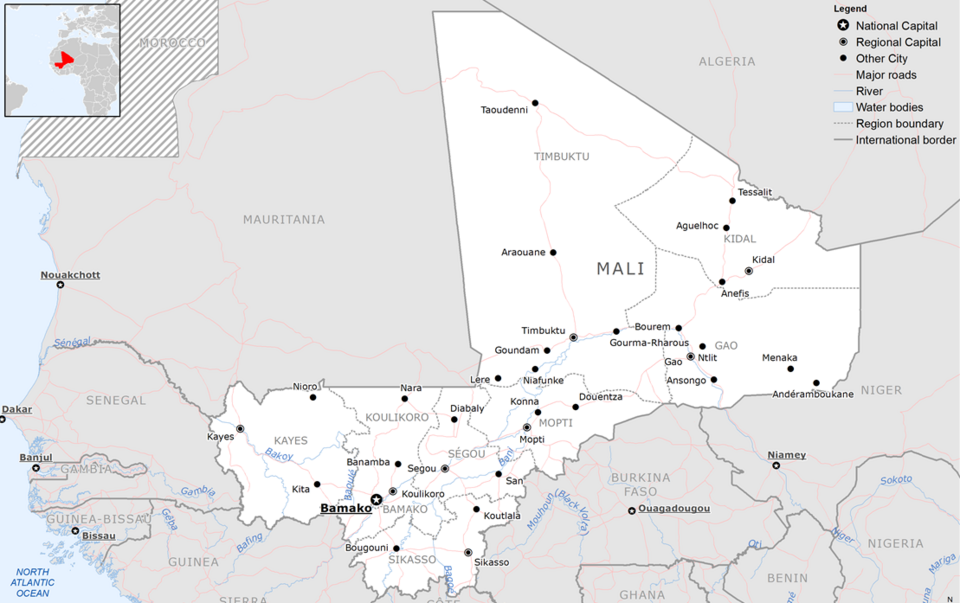

From Sudan to the Horn of Africa, the United Arab Emirates (UAE) has repeatedly faced accusations of fuelling regional instability through its alliances, military interventions and support for armed secessionist groups. Now, reports that a separatist movement in northern Mali is seeking closer ties with Abu Dhabi have raised fresh concerns about Emirati ambitions in the Sahel and their implications for regional security.
The Azawad Liberation Front (FLA), led by Alghabass Ag Intalla, is reportedly seeking to diversify its foreign backing by establishing closer ties with the UAE and forces loyal to Libyan military commander Khalifa Haftar.
According to recent reports, an FLA delegation approached Saddam Haftar, deputy commander of the Libyan National Army (LNA), in Benghazi to seek military equipment and cooperation for its continuing conflict with Mali’s military authorities.
However, it remains unclear whether these discussions have resulted in any agreement or commitment to provide weapons or funding.
The reported outreach comes as the FLA seeks to strengthen its military capabilities and reduce its dependence on traditional regional partners and mediation channels.
The UAE, a major backer of the Haftar camp in eastern Libya, wields considerable political, economic and security influence in the country. Its relationship with Haftar could potentially offer the FLA access to new sources of support and greater room for manoeuvre.
Such a development could also complicate existing regional alliances. Russia maintains a military presence in Mali in support of the authorities in Bamako, while also retaining close ties with Haftar’s forces in Libya.
Any military assistance from the Haftar camp to the FLA could therefore create tensions with Moscow, whose forces are operating alongside the Malian military against armed groups in the north.
The reported diplomatic manoeuvres also come amid persistent tensions between the FLA and neighbouring Algeria, which regards developments in northern Mali as a matter of national security.
Sahel gold in exchange for Emirati weapons?
Questions have also emerged over whether illicit gold trading networks in the Sahel could potentially facilitate weapons transfers to armed movements.
Economic analyst Dr Yves Ekoué Amaizo has suggested that the UAE possesses the financial resources and military equipment that could, in theory, be exchanged for gold illicitly mined and traded by armed groups operating across the region.
Under such a hypothetical arrangement, weapons deliveries could replace conventional financial payments.
Concerns surrounding the UAE’s role in Africa’s gold trade are not new.
A 2024 investigation by Swiss development organisation SWISSAID estimated that between $24 billion and $35 billion worth of artisanal gold is produced annually across Africa without being officially declared.
The investigation also found that at least 435 tonnes of gold were smuggled out of Africa in 2022, worth approximately $31 billion, with the UAE identified as a major destination for undeclared African gold.
Between 2012 and 2022, the UAE imported approximately 2,596 tonnes of African gold that had not been declared for export by the countries of origin, according to the study.
SWISSAID warned that the illicit gold trade could facilitate the financing of armed groups, deprive African countries of substantial public revenues and contribute to human rights abuses.
However, no evidence has been established of any gold-for-weapons arrangement between the FLA and the UAE, and the suggested connection remains speculative.
Algeria warns against foreign interference
The prospect of greater Emirati involvement in northern Mali has raised concerns in Algeria, which considers the Sahel part of its strategic security environment.
In an opinion piece published by Algerian outlet TSA, former Algerian diplomat Amar Belani warned that the potential expansion of UAE-linked networks near Algeria’s borders represented a serious cause for concern.
Belani cautioned that the FLA could be manipulated by external powers seeking to advance their own geopolitical interests at the expense of regional stability.
He also highlighted the growing political and security cooperation between the UAE, Morocco and Israel, arguing that their expanding influence in North Africa and the Sahel could undermine Algeria’s traditional regional role.
The concerns reflect wider accusations that Abu Dhabi has sought to expand its influence across Africa through financial leverage, military partnerships and support for rival political and armed factions.
UAE accused of destabilising African conflicts
The UAE’s involvement in African conflicts has attracted increasing international scrutiny, particularly over allegations that it has provided military and financial support to Sudan’s Rapid Support Forces (RSF).
The paramilitary group has been fighting the Sudanese Armed Forces since April 2023 in a devastating conflict marked by mass civilian casualties, displacement and allegations of war crimes.
Abu Dhabi has repeatedly denied providing military support to the RSF.
Nevertheless, allegations surrounding its activities in Sudan, Libya and the Horn of Africa have fuelled criticism of the Gulf state’s expanding military and political influence.
Hassen Kacimi, a specialist in geopolitics and migration, has sharply criticised the UAE’s alleged involvement in conflicts across the continent.
“This microstate has now become a threat to international peace and security,” Kacimi said, arguing that allegations surrounding its activities warrant scrutiny by international judicial bodies.
“Wherever there is disorder and chaos, wherever there are wars and conflicts, you will find traces of this criminal state, which is, of course, financing all these subversive activities,” he alleged.
His accusations reflect growing criticism of the UAE’s foreign interventions, although claims of criminal conduct require independent investigation and substantiation.
A separate analysis by the German Institute for International and Security Affairs (SWP), entitled The Destabilising Role of the United Arab Emirates in African Conflicts, examined Emirati involvement in conflicts across Ethiopia, Libya, Somalia and Sudan.
The institute described the UAE as “one of the most aggressive external actors” in these conflicts, highlighting the consequences of its interventions for regional stability.
The analysis raised concerns that external military and financial backing can embolden armed factions, prolong hostilities, entrench war economies and weaken already fragile state institutions.
Against this backdrop, the FLA’s reported efforts to establish closer relations with Abu Dhabi have renewed questions about whether the UAE could extend its influence into northern Mali.
While there is currently no established evidence of Emirati military assistance to the FLA, any such involvement could further complicate the conflict, undermine regional mediation efforts and intensify geopolitical rivalries across the Sahel.
For communities already suffering from years of conflict, displacement and insecurity, the prospect of additional foreign intervention raises the risk of further instability and prolonged violence.