
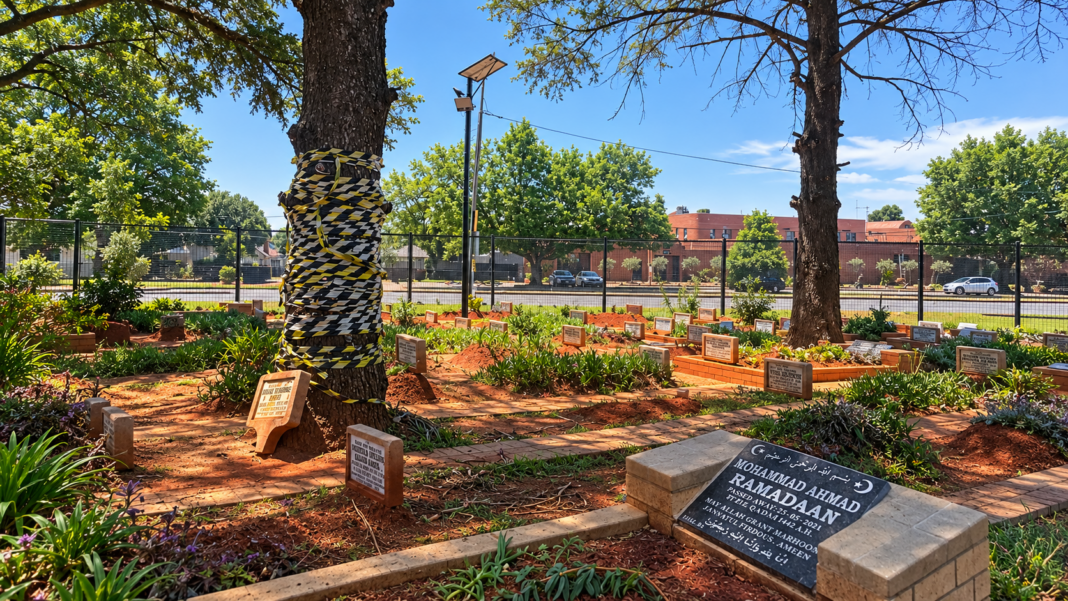

With Westpark Cemetery nearing capacity and Newclare already effectively full, Johannesburg’s Muslim community faces difficult questions about reburials, family burial rights and its collective responsibility to secure sufficient burial space for future generations.
Johannesburg’s Muslim community is confronting a growing burial crisis. With Newclare Cemetery effectively full and Westpark rapidly approaching capacity, the question is no longer simply where Muslims will bury their dead, but whether the community must fundamentally rethink how its limited burial space is managed.
According to Mohamed Laher, who oversees burials for the Fordsburg Muslim Youth Organisation (FMYO), Westpark’s remaining Muslim burial space could be exhausted by the end of January 2027. Newclare, meanwhile, has had virtually no new burial space available for years, with the few remaining unused graves largely belonging to families who secured burial rights long ago. The situation raises a difficult but increasingly unavoidable question: should existing graves remain reserved exclusively for families, or should burial space eventually become a shared resource for the wider Muslim community?
Reburials may become unavoidable
With new burial space rapidly disappearing, Laher believes reopening existing graves for additional burials will become an increasingly important solution. “Once it’s full to capacity, we’re going to be pushing reburials as much as we can,” he said. According to Laher, Muslims wishing to continue burying their deceased at Westpark and Newclare may have little choice but to consider reburials.
The practice involves reopening an existing grave and burying another deceased person above the previous burial, while maintaining the required separation between bodies. Laher said approximately 60 centimetres must separate each burial. He explained that reopening graves previously required a considerably longer waiting period, but that changes in procedures now allow graves to be reopened sooner under certain conditions.
“It used to be after 10 years you open up a grave but now the law has changed and as long as we spray a certain bacteria, after eight months we can reopen the graves,” Laher claimed.
The depth of graves also determines how many burials can be accommodated. According to Laher, graves at Westpark could potentially accommodate four or five bodies, while those at Newclare generally have sufficient depth for approximately three.
Who has the right to an existing grave?
Under FMYO’s current practice, reopening a grave generally requires permission from a family member, who signs the necessary documentation. Another relative, such as a parent, sibling or cousin, can then be buried in the same grave. However, Laher suggested that restricting reburials to family members is largely an organisational practice rather than an absolute prohibition against unrelated Muslims sharing burial space.
“Anybody can be buried in anybody’s grave,” he said, explaining that FMYO nevertheless prefers to accommodate family members together.
This distinction could become increasingly significant as burial space runs out. Some within the Muslim community have questioned whether graves should continue to be treated as permanent family preserves when other Muslims struggle to secure burial space. They argue that, provided Islamic principles, municipal regulations and the rights of those concerned are respected, consideration should be given to allowing unrelated Muslims to share existing graves.
Such an approach would require careful consultation with Islamic scholars, burial organisations, families and municipal authorities. The dignity of the deceased, the sanctity of graves and the rights of surviving relatives cannot be disregarded. Nevertheless, the broader question remains: can a community facing an acute shortage of burial land afford to treat every grave as an exclusive family resource indefinitely?
A changing approach to burial rights
Laher explained that families were previously able to reserve graves by paying the municipality for designated burial spaces. However, Westpark no longer accepts new grave reservations, and FMYO does not reserve graves at the cemetery. These changes reflect the mounting pressure on Johannesburg’s burial infrastructure.
Johannesburg City Parks and Zoo has previously acknowledged the capacity challenges at Westpark and identified the reopening of existing graves as one of the available burial options. However, reburials alone cannot resolve the long-term shortage of burial land.
Laher said efforts are underway to explore alternative burial sites, including Diepsloot, Olifantsvlei and possibly Midrand. Discussions with Johannesburg City Parks are continuing, but securing suitable land remains a lengthy process. Until additional burial space becomes available, the community may have to make greater use of existing graves.
The financial burden of burying the deceased
The growing burial crisis is not limited to land availability. It also places financial pressure on organisations responsible for ensuring Muslims receive dignified Islamic burials. According to Laher, a Muslim janazah currently costs approximately R6,500 through FMYO.
For families unable to afford these expenses, particularly vulnerable households and migrant Muslims facing financial hardship, FMYO provides burial assistance free of charge. While this ensures that financial circumstances do not prevent Muslims from receiving dignified burials, it places additional pressure on the organisation’s resources.
FMYO has consequently appealed to Johannesburg’s Muslim community for sustained financial support, including regular monthly contributions of approximately R200 through debit orders. The appeal highlights an important Islamic principle: caring for the deceased and ensuring their dignified burial is not merely a private family responsibility, but a collective obligation upon the Muslim community.
A collective responsibility that demands collective solutions
Johannesburg’s diminishing Muslim burial space presents a challenge that extends far beyond cemetery management. It raises fundamental questions about communal responsibility, the equitable use of limited resources and the obligations Muslims owe one another, even after death.
Reburials may provide immediate relief, but a sustainable solution will require cooperation between burial organisations, Islamic scholars, municipal authorities and the wider Muslim community. Preserving the dignity of the deceased must remain paramount. At the same time, the community must confront whether established practices surrounding family graves are sustainable when future generations face increasingly limited burial options.
Islam teaches that death is a certainty and that the Muslim community bears collective responsibilities towards its deceased. That obligation cannot end with ensuring today’s janazahs are performed. It must extend to securing dignified burial arrangements for those who will come after us.
As Westpark approaches capacity and Newclare remains effectively full, Johannesburg’s Muslims face a question that can no longer be postponed: will burial space continue to be managed primarily around individual family claims, or will the community develop a system that places the needs of the wider Ummah at its centre?
The answer may determine not only where future generations are buried, but how seriously the Muslim community fulfils its collective responsibility towards the deceased.


