
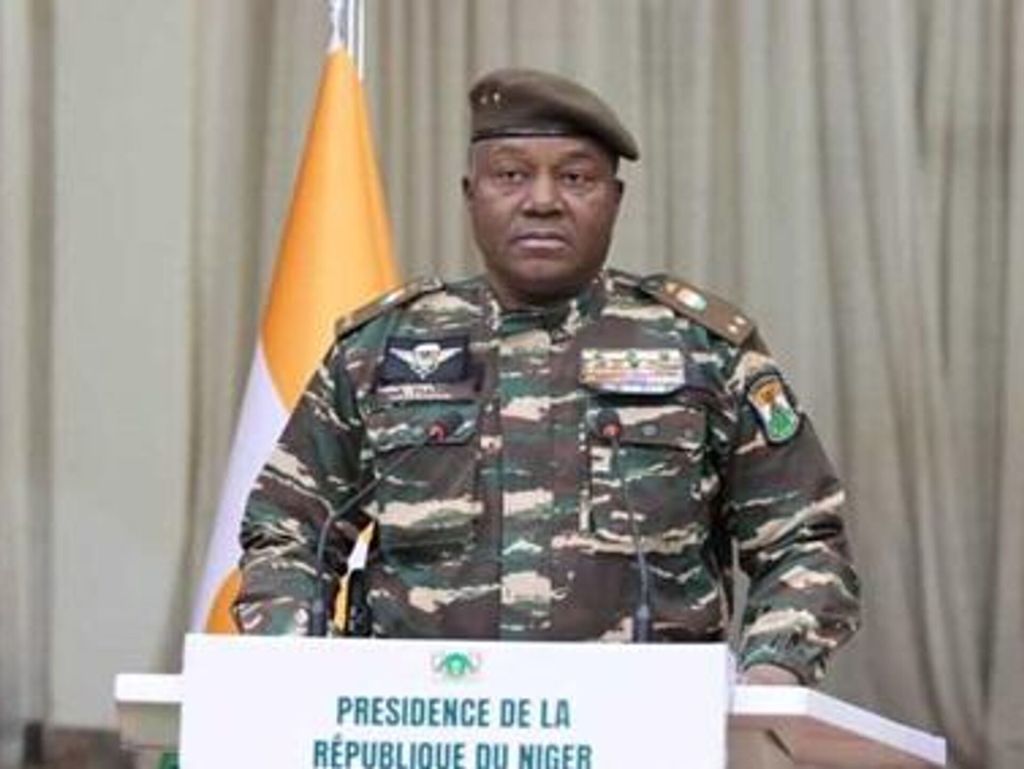

Niger’s military-led government has accused France of backing a failed mutiny that saw renegade soldiers attack key military and government sites in the capital, Niamey — allegations Paris has strongly denied.
The accusations follow some of the most serious internal unrest to confront General Abdourahamane Tiani since he came to power after the military overthrow of former President Mohamed Bazoum in July 2023.
Fighting erupted in the early hours of August 29 when mutinous soldiers targeted Base 101, a strategic military installation located within the Diori Hamani International Airport complex in Niamey.
Niger’s Defence Ministry said a group of soldiers had attempted to detain fellow troops at the base before opening fire on several “sensitive sites” across the capital. Heavy gunfire and explosions were reported around the airport and other parts of Niamey, while the state television service was temporarily disrupted.
The unrest also reached the area around Niger’s presidential palace, posing a major challenge to the military government as loyalist forces fought to regain control. State media later reported that dozens of mutineers had been killed or arrested.
Russian Africa Corps personnel stationed in Niger also intervened in support of forces loyal to the government. Russia’s ambassador subsequently confirmed the involvement of Russian personnel, further highlighting Moscow’s growing security role in Niger and across the wider Sahel.
After hours of fighting, Nigerien authorities announced that security forces had regained control of the affected sites.
Niger points finger at France
Days after suppressing the mutiny, Niger’s government publicly accused the administration of French President Emmanuel Macron of being behind the destabilisation attempt.
Following a meeting of the Council of Ministers on September 4, government spokesperson Soumana Boubacar said the authorities believed the operation had international backing.
“This operation, with its international ramifications, was instigated and sustained by a vast network of collusion headed by the French regime of Mr Macron,” Boubacar said in a government statement broadcast on national television.
He accused renegade soldiers of accepting promises from outside actors in exchange for attempting to destabilise the government, while insisting that such efforts against Niger would fail.
The government also said it had compiled substantial documentation relating to the alleged operation and reserved the right to pursue the matter before international judicial bodies. However, authorities have not publicly released evidence establishing French responsibility for the mutiny.
Nigerien officials have also accused African actors of facilitating attempts to destabilise the country. Earlier claims aired by Nigerien state television implicated several regional governments, although the government’s subsequent formal statement did not publicly identify all of them.
Niamey, meanwhile, thanked Russia, Algeria and its fellow members of the Alliance of Sahel States — Mali and Burkina Faso — for supporting Niger and its institutions during the crisis.
France rejects allegations
France has categorically denied involvement.
French Foreign Minister Jean-Noël Barrot described Niger’s accusations as “pure fantasy”, saying Paris had neither intended nor mobilised the means to organise the mutiny.
“There never was any intention, nor means that France would have mobilised,” Barrot told French broadcaster RFI, accusing Nigerien authorities of once again blaming France for events for which Paris says it bears no responsibility.
The allegations mark another deterioration in relations between Niger and its former colonial ruler.
Relations between Niamey and Paris collapsed following the July 2023 military takeover. Tiani’s government ended key defence arrangements with France and demanded the departure of French troops stationed in the country, while increasingly strengthening political and military cooperation with Russia.
Around 1,500 French troops subsequently withdrew from Niger as the new authorities sought to dismantle the security relationship that had made France one of the country’s principal Western military partners.
The shift has formed part of a wider geopolitical transformation across the Sahel. Niger, Mali and Burkina Faso — all governed by military-led administrations — have moved away from France and other Western partners while deepening cooperation with Russia and forming the Alliance of Sahel States.
A major test for Tiani
The August mutiny also exposed tensions within Niger’s own security forces at a time when the country continues to confront armed groups operating across the Sahel.
Some of the soldiers involved in the unrest reportedly came from areas heavily affected by attacks by armed groups, while reports have pointed to dissatisfaction among frontline troops over worsening insecurity and military conditions.
Tiani originally justified the 2023 overthrow of Bazoum partly on the grounds that Niger’s civilian government had failed to adequately address the country’s security crisis.
Three years later, armed violence remains one of the most serious challenges facing his government.
The mutiny therefore represented more than an isolated military rebellion. It exposed the potential for battlefield frustrations and internal divisions to threaten the cohesion of Niger’s armed forces while the government is simultaneously attempting to redefine the country’s foreign alliances and security strategy.
For Niamey, however, the official narrative increasingly places those internal threats within a wider struggle against foreign interference.
Its accusation that France helped orchestrate the August mutiny has yet to be backed by publicly available evidence, and Paris has firmly rejected it.
But the confrontation illustrates just how far relations between the two countries have deteriorated since 2023 — and how Niger’s struggle over sovereignty, security and foreign influence is increasingly becoming inseparable from the wider geopolitical contest reshaping the Sahel.