

By ONM Reporter
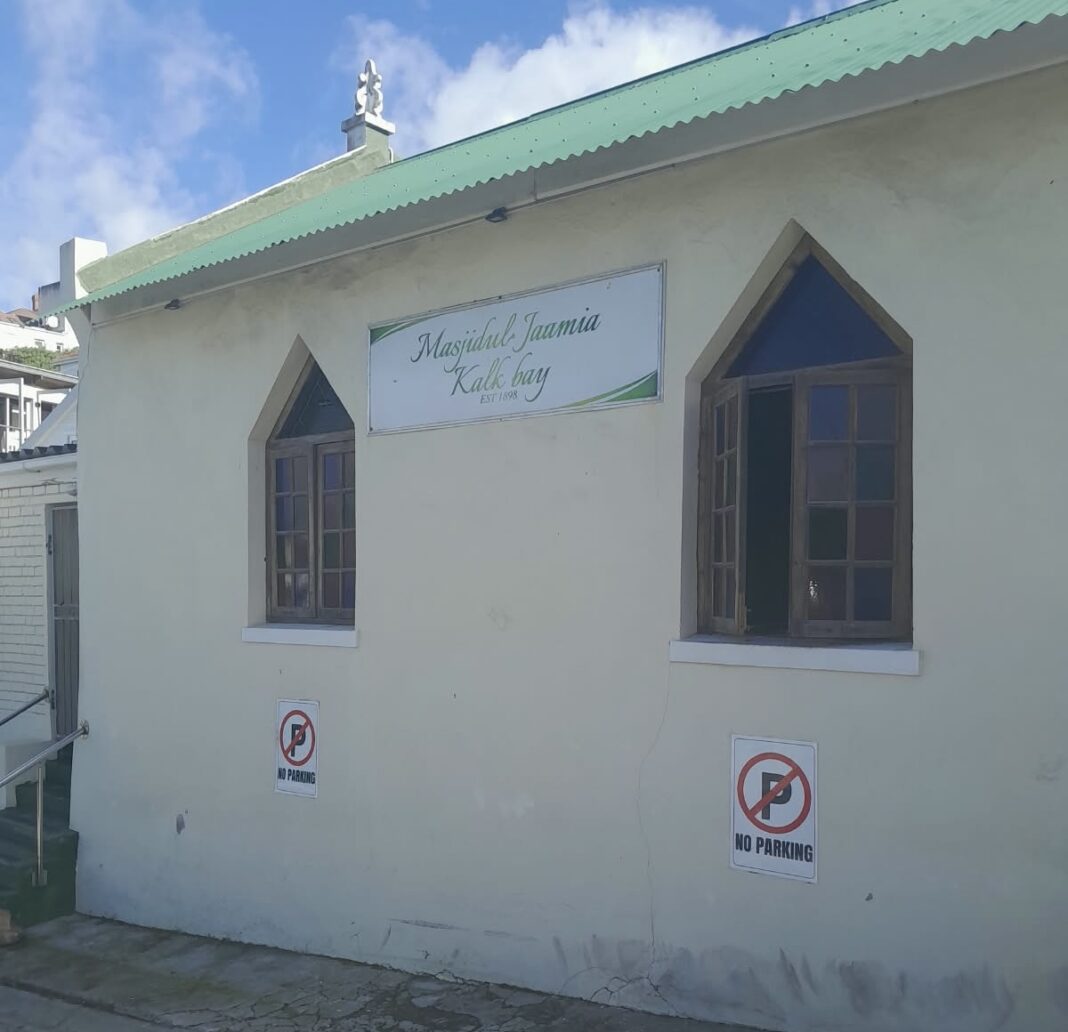
For more than a century, Masjidul Jaami has stood above Kalk Bay harbour as a surviving symbol of the Muslim fishing community uprooted by apartheid.
Kalk Bay is arguably one of South Africa’s most picturesque fishing villages.
Towering above it are the southern foothills of Table Mountain, where generations of fishermen built their homes along the slopes.
Among them, they built a mosque: Masjidul Jaami.
Today, the historic mosque on Quarterdeck Road sits in the heart of a gentrified suburb. It remains one of the few reminders that this harbour town was once home to a vibrant, mixed-race fishing community whose men would launch their boats and cast their nets into the rich waters of False Bay.
In the 1960s, Kalk Bay’s picturesque location made it an obvious target for the apartheid regime.
Under the Group Areas Act, people of colour were forcibly removed from some of Cape Town’s most desirable areas, which were reserved for whites.
Kalk Bay was not spared.
Today, Masjidul Jaami is frequented by a handful of Muslim families who still live in the area, others who travel from the Cape Flats, foreign nationals and tourists.
A waqf for £50
Former resident Roesdien Emandien, who was raised in Kalk Bay and now serves on the mosque’s executive committee, traces its beginnings back to the late 19th century.
“The ground or land was acquired in 1898, and it was bought for 50 sterling pounds by Mr Rejaldien Salie,” Emandien said.
“It was zoned as waqf, meaning it belongs to no one but Allah.”
In 1937, it was formally handed over to the Moehamadaan Faith of Kalk Bay.
Emandien, who assists with janaazahs — including the washing of bodies and booking of graves — as well as dhikrs, remains active in both the mosque and the local fishing community.
Six imams in more than a century
The community’s oral history records a line of religious leadership stretching back to the mosque’s early years.
Imams Rejaldien Salie and Hashim Fisher led the Muslims of Kalk Bay between 1898 and 1966. Imam Damoon Salie followed from 1967 to 1972, before Imam Salie Damon served for a year.
Imam Abduraghmaan Fortune served from 1975 to 2000, followed by Sheikh Abduraghmaan Gafieldien from 2000 to 2005.
Since 2006, the mosque has been led by Imam Achmat Sity, a student of Sheikh Gafieldien.
“We have great relationships with neighbours and various interfaith leaders in Kalk Bay, and we are respected,” Imam Sity said.
“We share platforms at community events, and when we have challenges, we deal with them through guidance from the Almighty, and it gets resolved.”
Classes are held on Monday, Tuesday and Wednesday evenings, alongside madrassa activities, daily prayers and Jumu’ah on Fridays.
“We have many tourists visiting from Malaysia, Indonesia and elsewhere, as they are also interested in the harbour because it’s the only harbour with wooden vessels roaming the sea, and the community lives and survives from the sea,” he said.
“Great people came along to the mosque, which was a little house, with the idea of revamping it. We can’t live in houses with bling and stylish things while the house of Allah is neglected and not looking good.
“The honour is now restored. It is welcoming and what it should be, and when we have that, we have religious tolerance.”
Beyond the mosque, Imam Sity serves as a Deputy Judge at the Sharia Court and as a counsellor dealing with marriages, marital problems, domestic abuse, addiction, family disputes and inheritance.
His office in Kalk Bay serves communities in Kalk Bay, Ocean View and Simon’s Town.
The fisherman imam
Historical material from the Amlay House Museum describes Imam Rejaldien Salie as a prominent figure in the local Muslim community and fishing industry.
A fishing boat owner, he was born in Simon’s Town in 1906 and died in 1990. He became known locally as Imam Jaltjies and played an important role in establishing Islam within the Kalk Bay community.
Sheribeen Amlay, curator of the Amlay House Apartheid and Heritage Museum, said:
“He was moestajap and gifted with extraordinary and mystical powers like his ancestor Imam Abdul Karriem Dea Malela Dea Koasa of Simon’s Town. His stories were never written down, and many legends are told about his life.”
“His kitaabs, written in Melayu, Buginese, Sanskrit and other languages, were taken to Makkah because during that time nobody could read, translate or understand what was written, and they never returned.”
Amlay said the kitaabs were handwritten manuscripts, artistically produced using unusual colours and designs.
“Imam Rejaldien and Imam Abdul Karriem performed the Ratiep with names of swords similar to each other called Vergietmynie, Nooitgeoog, Trep en Stukkies, Doel Fataar, etc,” he said.
According to those kitaabs, his ancestor Tuan Ismail Dea Malela Dea Koasa came from Gowa in Makassar, Indonesia, before travelling to Sumbawa and later being captured and sent to Simon’s Town in 1741.
Blessing of the fleet
Every November, Kalk Bay holds its annual Blessing of the Fleet at the harbour, bringing together representatives of different faiths to pray for and bless the fishing boats.
Muslim leaders and members of the local community remain a visible part of the tradition.
More than a century after Masjidul Jaami was established, Kalk Bay’s Muslim fishing heritage endures — its community diminished, but its faith still anchored to the sea.