

It has become known as the mosque that defied Apartheid. Like a sentinel perched on the slopes above Simon’s Town naval harbour stands the Nural Islam Mosque, one of Cape Town’s oldest Islamic places of worship.
It is a small, weathered building, now surrounded by private, gentrified homes occupied largely by white residents.
Once filled with congregants, today it serves only a handful of shop owners and workers who remain in the town centre. Most of its congregation was forcibly removed under Apartheid’s Group Areas Act and relocated to Ocean View, where the local mosque now serves the displaced community and its descendants.
But this small mosque carries a history far larger than its walls.
“The Nural Islam Mosque opened its doors in 1888, but Islam started in this town in 1740,” says 62-year-old Sheribeen Amlay, curator of the Amlay House Museum.
Before the mosque was built, Islam was practised in different homes known as “langaars”.
Amlay was born in Simon’s Town. His aunt, Patty Davidson [Zainub Amlay], now 91, established a heritage museum in their family home in the early 1990s after realising that the story of forced removals was not being told by those who had lived through them.

Today, Amlay House welcomes visitors, schools and tour groups, while also facilitating walking tours to karamats, Antonie’s Gat and sites connected to local family genealogies. It also hosts functions and luncheons on request.
According to Amlay, Apartheid was first discussed in the naval town of Simon’s Town in the 1950s, when the government deemed people of colour “undesirable and a risk to the navy”.
“It can be noted that 70% of the naval workforce and 80% of the residents were persons of colour who were born in Simon’s Town,” he says.
The majority were relocated to Ocean View, a dormitory suburb around 15 kilometres from the naval town, while others were sent to the Cape Flats. Many lost their jobs because there was no adequate transport back to Simon’s Town.
Islam’s roots in the area stretch back centuries, to the period when the Dutch brought political prisoners and enslaved people from the Malayan Archipelago, India and Sri Lanka to the Cape. Many were regarded as troublemakers by the colonial authorities because of their resistance to Dutch rule.
“These political prisoners and slaves were specifically brought to Simon’s Town to work on the whales, and they were fishermen,” Amlay says.
“Those that ended up in Bo-Kaap and District Six were artisans who were brought specifically to build Dutch-style houses, and they were Hafiz.”
The Muslims of Simon’s Town became pioneers of Ratiep, Moulood, Saman and numerous forms of dhikr. They were also among the first to gather over Easter weekend at the Faure Karamats, linked to the family of Sheikh Yusuf of Macassar.
As European settlement expanded, land was granted to settlers while prisoners and enslaved people were made to work for them.
The local population included Muslims and Roman Catholics, with Christianity having reached parts of the Malay Archipelago through earlier Portuguese colonisation.
“These men married locals, namely the Khoi-San, Hottentot and Strandloper, who were hunter-gatherers and farmers, giving birth to what we now know as the Cape Malay and Cape Coloured,” Amlay says.
“Today all these families are scattered all over, and we are constantly told to move on, but our history did not start when Nelson Mandela was released.”
Following the abolition of slavery in the 1800s, the Nural Islam Mosque was founded as a permanent centre of Islamic life in Simon’s Town.
Its founder, Tuan Ismail Dea Malela, regarded as the first formal leader of Islam in Simon’s Town, is buried nearby, alongside other prominent Islamic figures whose graves remain part of the town’s Muslim heritage.
Since its establishment, 13 Tuans and Imams have led the mosque and taught Islam in the community.
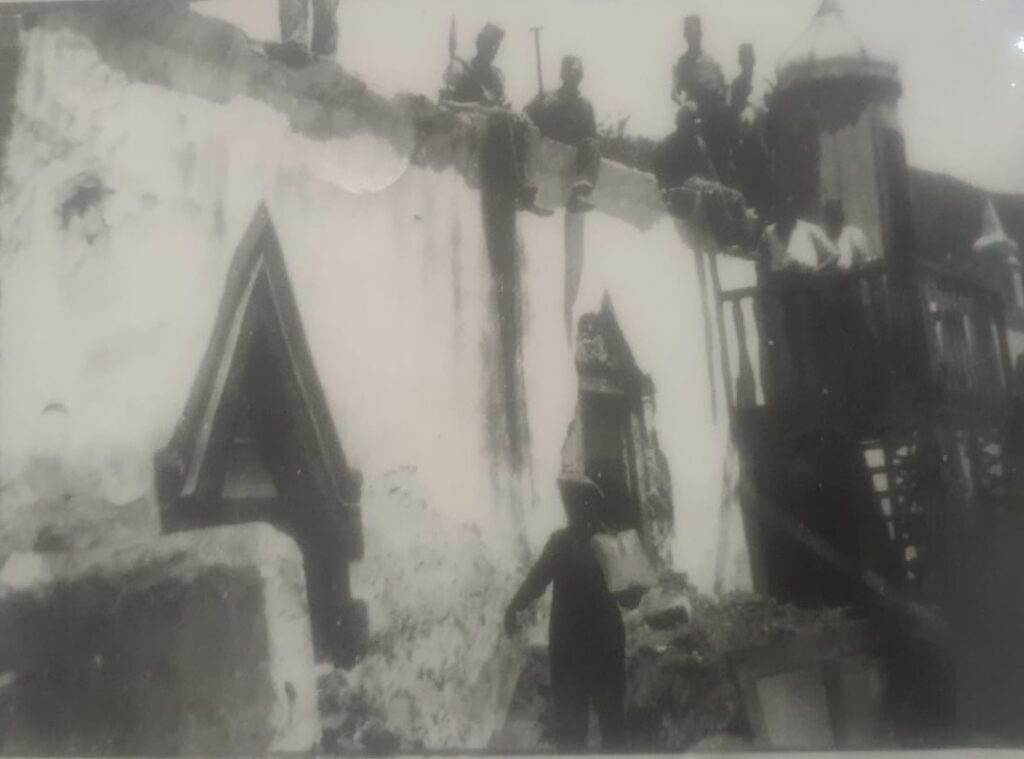
At its height, the mosque hosted all five daily prayers, madrassa classes and even served as a school.
Today, it primarily opens for Jumu’ah on Fridays and for early morning prayers.
For years, there were objections to the public call to prayer. The adhaan, broadcast through the mosque’s loudspeaker system — known locally as the Bilal — could once be heard across the valley.
Today, it remains silent to the wider public.
“The surrounding community has been respectful towards the mosque, which is situated between residences,” Amlay says.
“We do not have the Bilal going off like other mosques but hope to have it soon because there are many asking for it, even people from other countries visiting.”
The mosque still faces challenges, including maintenance, restoration and the effort to restore the public adhaan.
“We have challenges, but hopefully with the help of donations from the public, that and a few other things can get sorted to better the mosque; it will happen soon, inshallah,” Amlay says.
Simon’s Town is home to far more Islamic history than is reflected in many official accounts of the area.
For generations, its Muslim community endured colonialism, slavery, forced removal and Apartheid — yet the mosque survived.
And high on Thomas Street, the small Nural Islam Mosque still stands above the sea: a surviving monument to a community that was driven from its homes, but never erased.