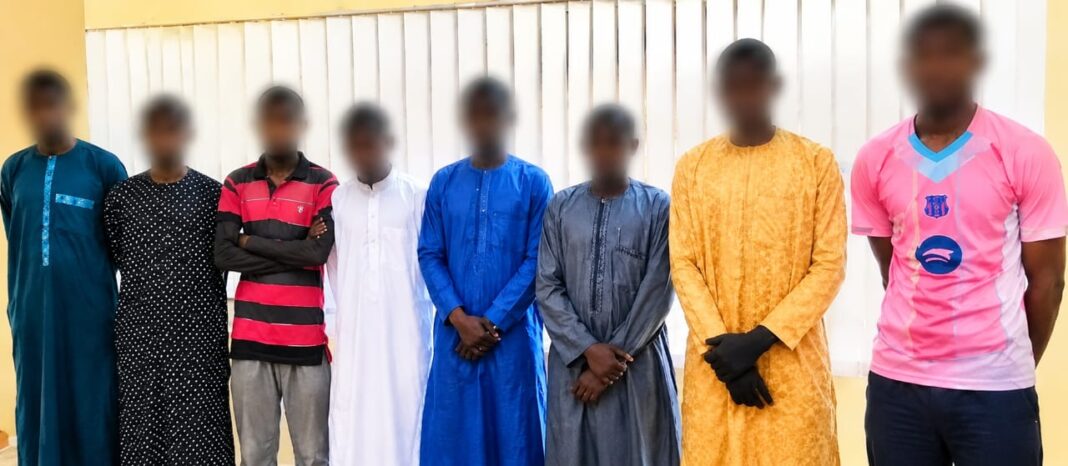

The arrest of eight people over alleged homosexual acts in Nigeria’s Jigawa State has renewed attention on the country’s religious, cultural and legal position on homosexuality, which stands in stark contrast to prevailing attitudes in much of the West.
The arrests by the state’s Hisbah Corps in Kazaure Local Government Area followed a complaint by a 22-year-old man who accused nine individuals of engaging in sexual activities with him on different occasions.
According to Hisbah authorities, the complainant, from the Kanti area of Kazaure, alleged that he later tested positive for HIV, which he attributed to the encounters. However, the circumstances surrounding the alleged transmission have not been independently established, and it remains unclear whether the encounters were consensual.
Hisbah spokesperson Dauda Muhammad Hadejia confirmed that eight suspects had been arrested, while efforts were ongoing to locate the ninth. He said the suspects reportedly admitted to the alleged activities during preliminary investigations and that the case would be taken to court.
The case has brought renewed attention to Nigeria’s wider position on homosexuality, which is reflected in its religious teachings, cultural traditions, national legislation and prevailing public opinion.
Islamic teachings on marriage and sexuality
The Qur’an and Sunnah prohibit homosexual acts and establish marriage between a man and a woman as the foundation of family life and a source of companionship, affection and mutual responsibility.
Ustaz Sagir AbdulRazaq, Chief Imam of Kurmin-Mashi Central Mosque in Kaduna State, said Islamic teachings define marriage as a sacred union between a man and a woman, established on love, mercy and shared responsibilities.
He pointed to Surah Ar-Rum, verse 21, where Allah describes the creation of spouses as one of His signs and explains that He has placed affection and mercy between them.
He also cited the account of Prophet Lut (Lot), particularly Surah Al-A’raf, verses 80–81, in which homosexual acts are condemned.
The prohibition of homosexual acts is unanimously recognised by the classical schools of Islamic jurisprudence.
Nigeria’s legal framework and public opinion
Nigeria’s position on homosexuality is also reflected in its legal framework. The Same-Sex Marriage (Prohibition) Act, signed into law in 2014, prohibits same-sex marriages and civil unions, prescribing 14 years’ imprisonment for those convicted of entering such unions. It also criminalises certain forms of participation in and support for same-sex organisations, while homosexual acts are prohibited under separate criminal laws.
In northern Nigeria, the influence of Islamic teachings is particularly visible through Hisbah bodies, which operate in states that have adopted Sharia-based legal systems. Their activities include addressing conduct prohibited under Sharia.
Nigeria’s rejection of same-sex marriage enjoys overwhelming public support across its two largest religious communities. A 2023 survey by the US-based Pew Research Center found that 97% of Nigerian adults opposed the legalisation of same-sex marriage, including 98% of Muslims and 97% of Christians.
Western criticism and domestic consensus
Despite this broad domestic consensus on same-sex marriage, Nigeria’s legislation has attracted criticism from Western governments and international human rights organisations.
Critics argue that criminalising same-sex relationships exposes individuals to discrimination and may discourage them from seeking essential healthcare, including HIV testing, prevention and treatment.
Following the arrests, Jigawa Hisbah Deputy Commander-General, Dr Hussain Yusuf Baban, urged parents to take greater responsibility for their children’s upbringing and pay attention to the company they keep.
His warning underscores the importance religious leaders place on parental guidance, moral education and the role of families in shaping young people’s values.
As the case moves towards the courts, the Islamic obligation to uphold justice demands that allegations be properly investigated, suspects be afforded due process and the requisite evidentiary standards be met before judgement is passed.
The wider controversy reflects a fundamental divergence between Nigeria’s prevailing religious and cultural values and the increasingly liberal attitudes towards sexuality promoted by Western institutions.