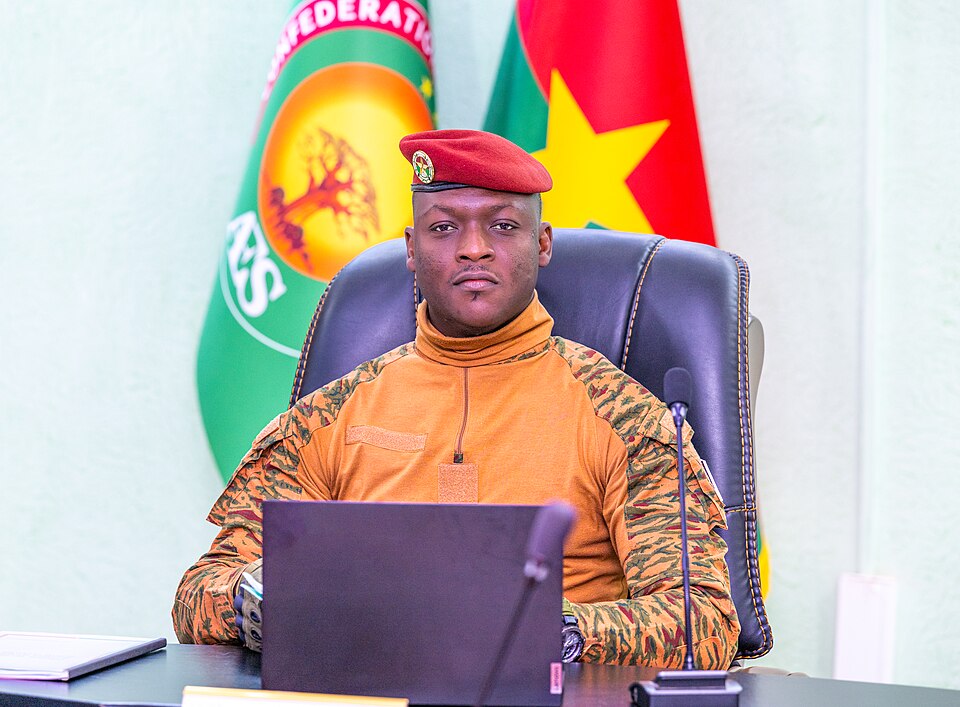

Since coming to power, Captain Ibrahim Traoré has emerged as one of the most widely publicised figures among West Africa’s military-led governments. But beyond his sovereigntist rhetoric, his positions on Islam and the teaching of Sharia point to an apparent determination to shield the state from the influence of religious authorities and counter what he describes as the political exploitation of faith, writes Moulana Usamah Dockrat.
The Burkinabè head of state, often seen wearing his military uniform during media appearances, is known for his statements on the teaching of Sharia, his criticism of certain religious currents and his determination to strengthen state oversight of faith-based organisations. These positions have gradually fuelled controversy. Behind this confrontation lies a deeper question concerning the relationship between Islam and the modern secular nation-state: should religious authority be subordinate to political authority, or should political authority itself be subordinate to Islam?
Born on 14 March 1988 in Kéra, in the commune of Bondokuy, Ibrahim Traoré studied geology at the University of Ouagadougou before joining the military. His university years were reportedly marked by two distinct ideological affiliations. He is said to have been involved with the Muslim Students’ Association at the University of Ouagadougou while also belonging to the National Union of Students of Burkina Faso (ANEB), a Marxist-oriented organisation. This dual affiliation reflects an intellectual environment shaped by different ideological influences.
Although he claims to be a Muslim, the Burkinabè president publicly advocates a conception of the state in which no religious authority can take precedence over national institutions. His position is based on the supremacy of the Constitution, state neutrality and opposition to the “political instrumentalisation” of Islam. This approach is rooted in the principle of secularism already enshrined in Burkina Faso’s institutional framework.
This, however, represents an inversion of the proper relationship between religious and political authority. The ruler is himself subject to the Sharia, and the ulama, as the custodians and interpreters of Islamic law, are entrusted with articulating the legal and moral boundaries within which political authority may be exercised. It is not the prerogative of the ruler to determine the boundaries of Islam; rather, it is Islam that determines the boundaries of his authority.
In his various public appearances, Traoré regularly criticises forms of religious education that he believes could encourage indoctrination, intellectual dependence or ideological domination. He has denounced what he describes as the “misunderstanding” of religions and their use for political purposes. His criticism does not explicitly target Islam as a whole, as he presents the problem as one affecting religions generally. Nevertheless, it reveals his distrust of religious structures whose influence, in his view, could rival that of the state.
The controversy surrounding this approach is particularly pronounced when it comes to the teaching of Sharia. Ibrahim Traoré has questioned the relevance of courses pursued by some young Burkinabè at religious institutions abroad, particularly in Saudi Arabia. He argues that the human and financial resources devoted to such studies should instead contribute more directly to national development and the acquisition of professional skills. His criticism also extends to the possibility that religious legal teachings could provide an alternative to national legislation.
However, some religious leaders argue that automatically equating the study of Sharia with a project to establish an Islamic state amounts to an unjustified generalisation. They maintain that Islamic law is also an academic and theological discipline that students can study in depth without necessarily advocating its application to society as a whole.
“To portray all its students as advocates of political Islam or as threats to the Republic would therefore be unjustified. The compatibility of religious education with national sovereignty, as well as the question of radicalisation, must be addressed without conflating fundamentally different issues,” said an official from the Federation of Islamic Associations of Burkina Faso (FAIB), who requested anonymity.
Such a defence, however, leaves Traoré’s underlying premise unchallenged: that the aspiration to govern according to the Sharia is itself something objectionable. Islam is not confined to personal worship and private morality but encompasses political, judicial, economic and social affairs. The fact that Islamic education may produce scholars who question the supremacy of secular legislation should therefore come as no surprise. It is precisely this comprehensive nature of Islam that brings it into conflict with the modern secular state.
The government’s determination to tighten oversight of faith-based organisations follows the same logic. Burkina Faso’s law on religious freedoms, adopted in June 2026, reflects the authorities’ ambition to exercise greater control over religious activities, places of worship and faith-based organisations. Officially, the aim is to prevent “extremist excesses”, “abuses” and practices that could undermine social cohesion. However, the legislation raises a fundamental question: by what authority does the state assume the right to regulate religious institutions and determine the acceptable expression of Islam?
Tensions surrounding the reform, particularly with certain Muslim leaders, illustrate the difficulties facing this policy. The cases involving Imam Mohamed Ishaq Kindo, Imam Mahmoud Barro and activist Mahamadi Baguian have heightened concerns about the treatment of individuals who challenge the government’s positions. These cases, when viewed alongside Traoré’s statements on the Sharia and his government’s broader legislative measures, point to a systematic policy of curtailing the influence of Islam and bringing its religious authorities under state control.
Beyond these controversies, Ibrahim Traoré’s position reflects a conception of sovereignty that extends beyond international relations and control over national resources. It also encompasses the regulation of ideological and religious influences within society. From this perspective, analysts within Burkina Faso’s religious circles argue that secularism is becoming an “instrument for consolidating state authority”, as well as a means of defining the limits of religious institutions’ involvement in public life.
This, however, is hardly unique to Traoré or Burkina Faso. The modern secular nation-state, whether democratic or authoritarian, claims supreme legal and political authority within its territorial boundaries. It cannot readily accommodate an independent religious authority that claims the right to determine the legitimacy of its laws and policies. Although the mechanisms and extent of control differ from one country to another, the underlying relationship remains largely the same: religious authority is permitted to operate within the parameters established by the state.
Traoré’s approach is therefore not necessarily a departure from the principles of secularism but rather a manifestation of them. Secularism does not merely separate religion from political authority; it empowers the state to determine where religion belongs and the extent to which it may influence public life. Even where religious freedoms are guaranteed, the state ultimately retains the authority to define their parameters.
Ultimately, Ibrahim Traoré’s religious policy appears to be an integral part of his sovereigntist agenda. He seeks to place religious institutions under state authority, prevent religious norms from influencing governance and regulate activities that, in his view, could contribute to radicalisation.
In Burkina Faso, religious leaders wield considerable influence and have a strong capacity to mobilise public opinion. By regulating sermons, monitoring foreign funding and sanctioning critical voices, as illustrated by the cases of Imams Kindo and Barro, the regime seeks to ensure that political opposition cannot organise itself from within mosques. The Burkinabè authorities appear determined to prevent religious figures from acquiring the kind of political influence wielded by certain prominent imams in Mali, particularly Imam Mahmoud Dicko, who demonstrated an ability to put pressure on both civilian and military authorities.
According to Dr Bakary Sambe of the Timbuktu Institute, behind the government’s stated determination to combat “religious excesses” lies a broader strategy of consolidating power, one that could lead to a lasting break with religious figures who once supported the transition.
The fundamental problem with Traoré’s approach is not simply that it restricts religious freedoms but that it subordinates religious authority to political authority. Rather than allowing the ulama to hold rulers accountable according to the teachings of Islam, the ruler assumes the authority to determine what constitutes acceptable Islam.
There is also a deeper contradiction in Traoré’s anti-colonial project. While seeking to liberate Burkina Faso from the influence of its former colonial masters, he remains committed to a conception of the state and its relationship with religion that is itself a legacy of colonialism. Political independence may have changed who exercises authority, but it has not fundamentally changed the conception of authority itself.
Traoré’s confrontation with Islam is therefore not an isolated phenomenon but a manifestation of the broader conflict between the sovereignty claimed by the modern secular nation-state and the supremacy of the Sharia demanded by Islam.