
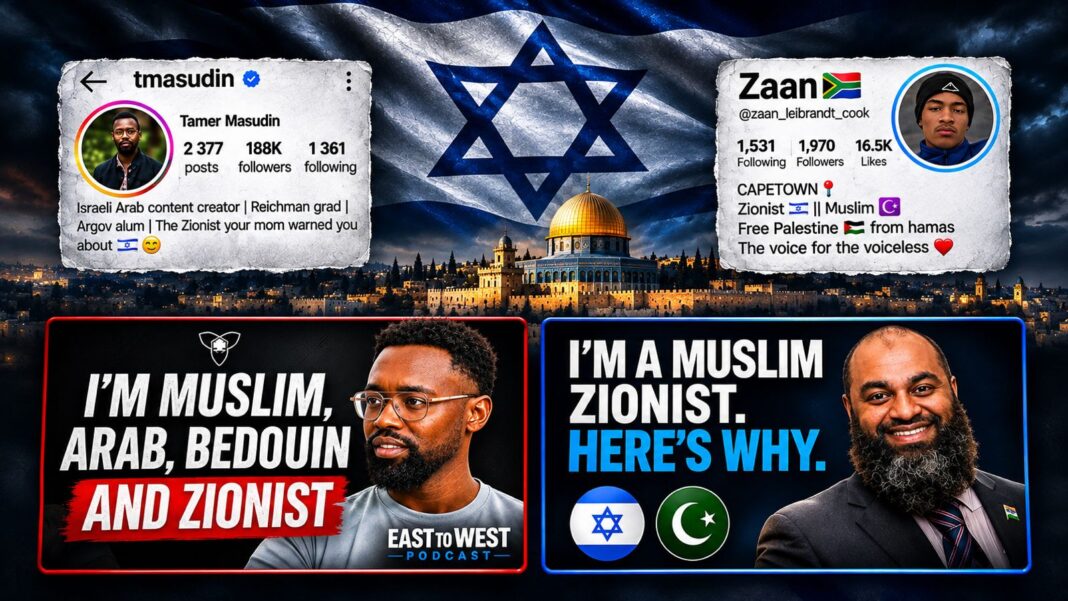

Amid the ongoing devastation in Gaza and unprecedented global condemnation of Israel’s genocide, an unlikely figure has been pushed to the forefront of Western media and social media algorithms: the self-declared ‘Muslim Zionist’. From fringe TikTok profiles in South Africa to polished commentators on international news networks, a small number of individuals claim to reconcile their Islamic faith with Zionism. Yet, for many Muslims and pro-Palestinian advocates worldwide, this identity is not merely an ultra-fringe viewpoint; it represents a profound moral and theological contradiction.
As South Africa pursues its historic genocide case against Israel at the International Court of Justice (ICJ), the prominence of these voices raises pressing questions about whether they reflect genuine personal convictions or are being amplified as part of a wider public relations campaign.
Nowhere is this contradiction more pronounced than in South Africa, a country whose own liberation struggle informs its deep solidarity with the Palestinian people. Within this landscape, a Cape Town-based micro-creator posting under the handle @zaan_leibrandt_cook has attracted attention for openly embracing the label. Alongside a TikTok biography stating “CAPETOWN Zionist Muslim”, Zaan wrote in a late-2026 post, “I’m a proud muslim zionist and I will not feel scared I only fear God.”
When approached by One Nation Media (ONM) for an interview to discuss his views, Zaan declined the invitation to participate in a Google Meet interview, explaining that he was unable to speak. “Salaam neelam unfortunately I’m mute, that’s why im not making videos of me talking so yea sorry but I can’t,” he responded in a direct message. ONM subsequently sought clarification on whether he was referring to a physical disability but had received no response at the time of publication.
To South Africans who regard Zionism as a settler-colonial project bearing similarities to the apartheid system they dismantled, such a declaration appears detached from both the country’s historical experience and fundamental Islamic principles. It has led critics to question the motives behind such posts: are isolated local accounts acting purely out of personal conviction, or are their messages being amplified by pro-Israel advocacy networks seeking to challenge South Africa’s strong solidarity with Palestine? While there is no verified evidence of financial payments or coordinated activity involving Zaan, the broader use of sympathetic voices within pro-Israel advocacy has raised questions about the amplification of minority perspectives.
Further north on the African continent, similar messaging has emerged in countries that have established or normalised diplomatic relations with Israel, particularly Morocco. There, artist and activist Chama Mechtaly has cultivated an online following focused on North African heritage and support for Israel, identifying herself as “50% Jewish, 50% Muslim, and 100% Zionist.” Alongside her, Black Bedouin activist Tamer Masudin frequently addresses African and diaspora audiences, challenging comparisons between Israel and apartheid South Africa. In an interview featured by the Jerusalem Center for Security and Foreign Affairs, he declared, “I’m Black, Muslim, Bedouin and Zionist.”
For pro-Palestinian observers across Africa, these statements raise questions about how such voices are presented and promoted within a broader narrative that seeks to challenge continental solidarity with Gaza by projecting an image of Muslim and African endorsement of Zionism.
On the global stage, this phenomenon becomes more structured, supported by speaking tours, think-tank platforms and regular broadcast appearances. Saudi content creator Loay AlShareef uses his substantial online reach to promote his identification as a Muslim Zionist, arguing that the term is widely misunderstood across the Arab world. In an article published on 28 August 2025, the SA Jewish Report described AlShareef as a self-identified Muslim Zionist who had moved from opposing Israel to supporting the Jewish state. The publication further reported that he had been brought to South Africa that month by the Academy of Jewish Thought & Learning for a series of speaking engagements. Similarly, British-Pakistani activist Kasim Hafeez built a public speaking career after repudiating his former anti-Israel views, describing himself in a 2012 article as “a proud Muslim Zionist”. He has since converted to Christianity but remains an outspoken advocate for Israel.
Other individuals have also received considerable attention. Pakistani-British researcher Noor Dahri spent years delivering talks under the title “From Jihadist to Muslim Zionist, A Personal Journey”, before publicly announcing that he no longer identified as a Zionist, while continuing to affirm his support for Israel’s existence. Bangladeshi-born doctor Shadman Zaman gained international media coverage as a Muslim Zionist and subsequently began a conversion process to Orthodox Judaism, which he later abandoned.
From a pro-Palestinian and mainstream Islamic ethical standpoint, the notion of a ‘Muslim Zionist’ raises fundamental religious and moral questions. Islam places an obligation upon believers to oppose oppression (zulm) and stand alongside the persecuted. Critics argue that political Zionism, associated with the mass displacement of Palestinians during the 1948 Nakba and the continuing occupation, dispossession and suffering of Palestinians, stands in direct opposition to these foundational values.
For those who regard Palestinian liberation as inseparable from the Islamic principles of justice and human dignity, professing devotion to a faith rooted in these values while supporting a political project that denies Palestinians their freedom and sovereignty presents a profound contradiction.
Ultimately, the prominence granted to these individuals offers an insight into the workings of modern narrative warfare. As Israel faces mounting international scrutiny and accusations of genocide, the elevation of Muslim voices sympathetic to Zionism provides pro-Israel advocacy organisations with a potentially valuable public relations asset. Their appearance on influential platforms can be used to challenge the perception that Muslim opposition to Israel’s policies is overwhelming.
Whether motivated by personal conviction, ideological differences or the support of institutional platforms, self-described Muslim Zionists represent a minority perspective that remains deeply contested within Muslim communities. Their visibility online should not be mistaken for a fundamental shift in Muslim attitudes towards Palestine, nor should the promotion of individual voices obscure the continuing suffering, displacement and dispossession of the Palestinian people.


