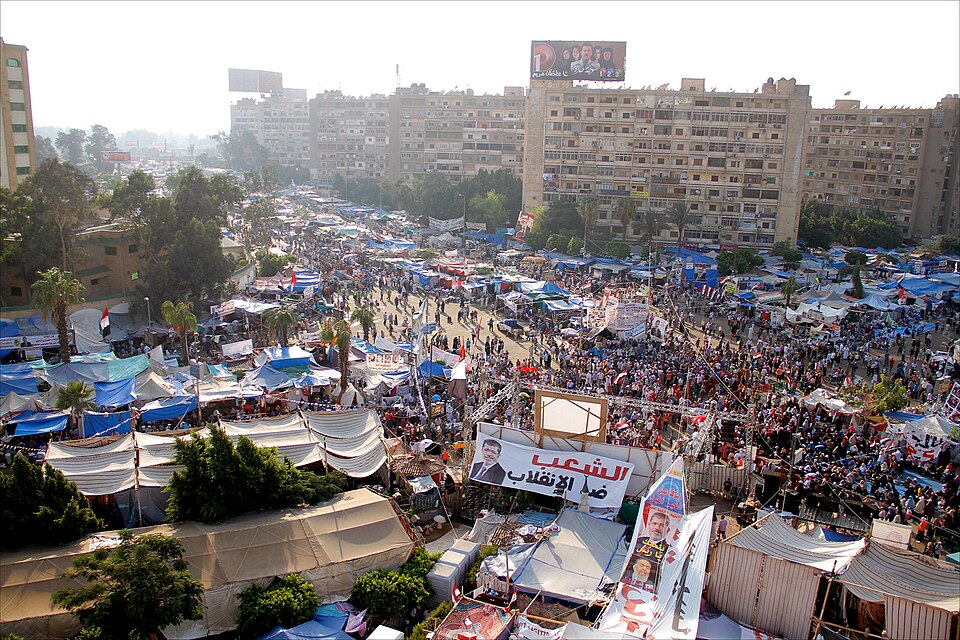

A prominent Egyptian human rights group has launched a renewed campaign demanding truth, accountability and justice on the 13th anniversary of the Rabaa massacre, one of the bloodiest episodes in modern Egyptian history.
The Shehab Centre for Human Rights said the killing of protesters at Cairo’s Rabaa al-Adawiya Square remains an open wound more than a decade later, with victims’ families still waiting for answers and those responsible yet to face meaningful accountability.
The massacre took place on 14 August 2013, weeks after then-defence minister Abdel Fattah el-Sisi led a military coup that overthrew Egypt’s first democratically elected president, Mohamed Morsi, a senior figure in the Islamic political movement Muslim Brotherhood.
Thousands of Morsi supporters had gathered at Rabaa al-Adawiya Square demanding his reinstatement when Egyptian security forces moved in to violently disperse the sit-in.
Rights organisations have estimated that around 1,000 people were killed during the crackdown, with security forces using live ammunition and tear gas as armoured vehicles and bulldozers cleared the protest encampment.
Witnesses and rights groups have documented protesters being shot, beaten and crushed during the operation, which lasted for several hours.
In the aftermath, hundreds of Muslim Brotherhood members and supporters were arrested and later prosecuted in mass trials, while many others fled Egypt amid a sweeping campaign of repression under el-Sisi’s government.
Human rights organisations have repeatedly criticised the authorities for failing to provide protesters with adequate warning or a genuine opportunity to leave the square safely before security forces opened fire.
Despite the scale of the killings, successive Egyptian authorities under el-Sisi have failed to conduct a credible and independent investigation into the massacre or publish a full account of how and why the operation was authorised.
A later fact-finding document cited by the Egyptian Initiative for Personal Rights reportedly concluded that the sit-in could have been dispersed without such extensive bloodshed, but the complete findings of the official investigation have never been made public.
The Shehab Centre is now calling for an independent investigation into the massacre, accountability for those who ordered and carried out the crackdown, and legal action against officials accused of concealing abuses.
Rights groups have continued collecting survivor testimony and documenting the long-term consequences of the massacre, which marked a decisive turning point in Egypt’s descent into authoritarian rule under el-Sisi.
For supporters of Morsi and the Muslim Brotherhood, Rabaa remains a symbol of the brutal suppression of Egypt’s short-lived democratic experiment and the bloody consolidation of military dictatorship that followed.
Morsi later died on 17 June 2019, aged 67, after collapsing during a court hearing following nearly six years in detention under el-Sisi’s regime, amid longstanding concerns over his prison conditions and access to medical care.