
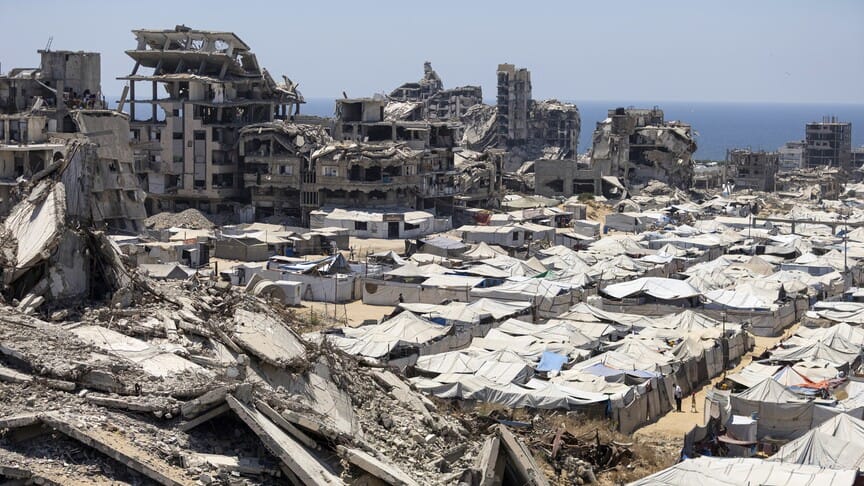

The Trump administration is preparing a $2.8-billion weapons package for Israel that includes 40,000 2,000-pound bombs and a further 20,000 penetrator warheads, drawing scrutiny over the scale of the proposed transfer, its US taxpayer funding and how the weapons could be used in densely populated areas.
The package includes 20,000 MK-84 bombs and 20,000 BLU-117 bombs, each weighing 2,000 pounds, according to Reuters. The Washington Post reported that it also includes 20,000 I-2000 penetrator warheads.
The proposed transfer has drawn criticism from conservative commentator Tucker Carlson and senior Democrats in Congress, with questions focusing on the scale of the shipment, civilian protection and the use of American taxpayer-funded military assistance.
Carlson publicly challenged the proposed deal in a September 15 post on X, focusing particularly on the 40,000 MK-84 and BLU-117 bombs.
“According to an informed federal official, in the coming months the Trump administration plans to send a total of 40,000 Mark 84 and Blu-117 bombs to the government of Israel. Each bomb weighs 2,000 pounds. This appears to be the largest transfer of conventional explosive ordnance from the United States in modern history,” Carlson wrote.
He sought to put the quantity into historical perspective, noting that the shipment “amounts to 40,000 tons of bombs” and comparing it with the volume of explosives dropped during major US bombing operations in the Second World War.
Carlson also questioned what the weapons could mean for a Middle East already facing multiple conflicts.
“By any definition, what the Netanyahu government has done in Gaza is genocide,” he wrote. “The 40,000 new bombs the Trump administration is sending will be used to do the same in Lebanon, and likely in other countries in the region. If you wanted to extend the Iran war into the indefinite future, this is exactly what you’d do.”
Israel has rejected accusations of genocide over its military campaign in Gaza and maintains that its operations are acts of self-defence. A UN inquiry has concluded that Israel committed genocide in Gaza, a finding rejected by the Israeli government.
Congressional scrutiny
The proposed package is also facing resistance in Congress.
US Representative Gregory Meeks, the ranking Democrat on the House Foreign Affairs Committee, announced that he would not clear the $2.8-billion sale, citing unresolved concerns over civilian protection and the potential use of the 2,000-pound bombs in densely populated areas of Gaza and Lebanon.
“The Trump administration’s proposed sale of 40,000 2,000-pound bombs, some of the most destructive munitions in our arsenal, raises grave, unresolved concerns about how these munitions could be used in densely populated areas of Gaza and Lebanon,” Meeks said.
His decision places a hold on the package during the informal congressional review process, although his opposition alone does not permanently prevent the Trump administration from proceeding with the sale.
The MK-84 and BLU-117 are 2,000-pound general-purpose bombs capable of being fitted with guidance systems, while the I-2000 is a penetrator warhead designed for use against hardened targets.
The proposed transfer comes amid continuing scrutiny over Israel’s use of heavy bombs in populated areas. Reuters reported that Israel has used 2,000-pound bombs in Gaza and Lebanon, where their destructive power has prompted criticism from human rights experts and US lawmakers.
Paid for through US military assistance
The financing of the proposed package has become another focus of the debate.
Israel receives billions of dollars annually from Washington through the Foreign Military Financing programme, or FMF, which provides US government grants that can be used to purchase American-made weapons and military equipment.
Under a 10-year US-Israel agreement running from 2019 to 2028, Washington provides Israel with $3.3 billion annually in Foreign Military Financing, alongside $500 million a year for cooperative missile-defence programmes.
Carlson argued that describing taxpayer-funded weapons transfers simply as commercial arms sales obscures how the system works.
“At some point, inevitably, it will be described in media accounts as an ‘arms sale.’ It is not an arms sale. It is a gift, funded by American taxpayers through the Foreign Military Financing program,” Carlson wrote.
While the transaction itself takes the form of an arms sale, Foreign Military Financing allows Israel to use US government grant assistance to purchase eligible American weapons and military equipment.
The proposed $2.8-billion package therefore raises a broader question beyond the sheer number of bombs involved: how US military assistance is being used at a time when Israel’s conduct in Gaza and Lebanon remains under intense international scrutiny.
For now, the proposed sale remains under congressional review, with Meeks’ hold adding another layer of scrutiny to one of the largest reported transfers of 2,000-pound bombs to Israel in recent years.