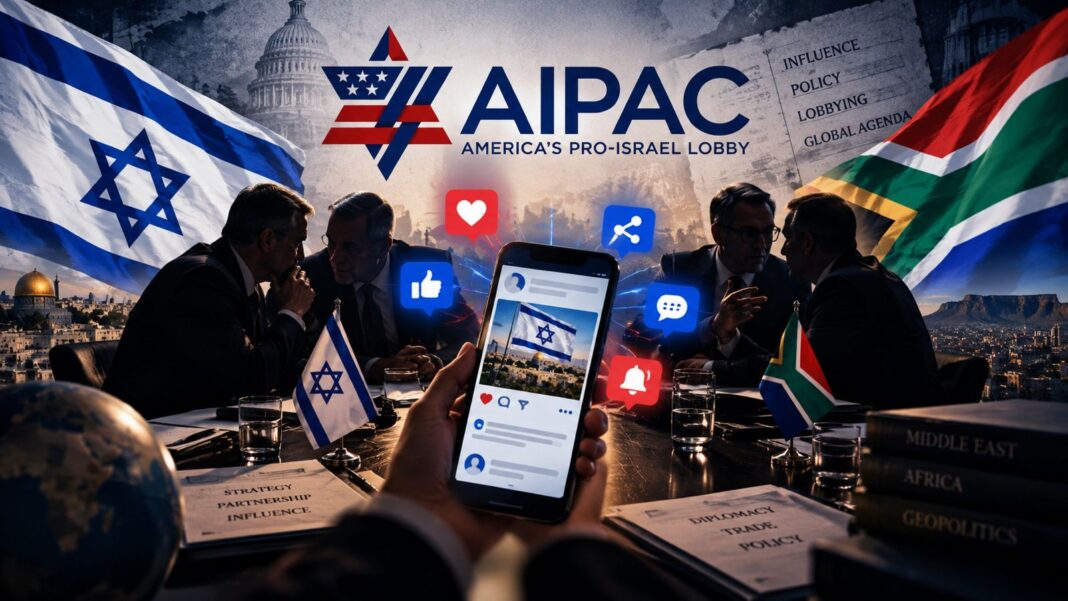

While South Africa has emerged as one of Israel’s fiercest international critics, a far less scrutinised pro-Israel lobbying network continues to operate within the country’s political landscape, writes Neelam Rahim.
One organisation deserving far greater scrutiny is the South African Israel Public Affairs Committee, or SAIPAC.
SAIPAC is not new. It was launched in Cape Town in 2011 and explicitly modelled on the American Israel Public Affairs Committee, AIPAC.
Its founding chairman, David Hersch, said at the time that there was a “desperate need” for a lobby in Parliament, with the organisation seeking to build relationships with MPs and other communities while strengthening South Africa-Israel relations.
Hersch also acknowledged that SAIPAC would remain “in sync” and in close association with the Israeli Embassy, while insisting that the organisation itself was independent.
That history matters because SAIPAC was never presented merely as a social, cultural or communal organisation. Political engagement was central to its stated purpose.
In 2015, SAIPAC demonstrated what that could look like when Hersch wrote to the South African government demanding that prominent Palestinian activist Leila Khaled be prevented from entering the country ahead of a planned speaking tour.
The intervention placed SAIPAC directly inside a political dispute over who should be permitted to participate in South Africa’s public discourse on Palestine.
Hersch remained publicly identified as SAIPAC chairman into 2026, including in material published shortly before his death in May. His public interventions continued to criticise South African policy towards Israel and those advancing anti-Zionist positions.
Yet for an organisation established specifically to lobby and cultivate political relationships, SAIPAC remains remarkably absent from mainstream public discussion.
That is the blind spot.
International relations researcher and social justice advocate Cameron Rodrigues told One Nation Media that South Africans should be careful not to confuse political influence with direct control, but said questions still needed to be asked about the motives of organisations involved in such lobbying.
“I don’t necessarily think that our parliament will entirely be taken over by SAIPAC, but it is important to question the motives behind why you would be working with these organisations,” Rodrigues said.
She added: “We should be concerned about international organisations that operate under the guise of a South African organisation. We ought to be a bit wary, because they are not pushing for the national interests of South Africans; they are pushing for the national interest of the state of Israel.”
So where does SAIPAC fit within South Africa’s wider pro-Israel advocacy landscape?
A broader Zionist advocacy network
Part of the answer lies in examining the organisations operating around it.
The South African Zionist Federation (SAZF) openly describes advocacy and lobbying as part of its work. Its stated mission includes reducing anti-Israel sentiment within South Africa’s political, religious and cultural communities through education, advocacy and lobbying.
The federation has also demonstrated its willingness to use South African institutions to challenge prominent critics of Israel.
Its intervention in the case involving Dr Tlaleng Mofokeng provides one example.
The SAZF lodged the complaint that led to disciplinary proceedings by the Health Professions Council of South Africa (HPCSA) over Mofokeng’s social media comments concerning Israeli Prime Minister Benjamin Netanyahu and UN Watch director Hillel Neuer.
The HPCSA subsequently found her guilty of unprofessional conduct and imposed a R10,000 fine.
However, that decision did not stand. On September 9, the Pretoria High Court set aside both the finding and the sanction.
One Nation Media approached the SAZF for comment regarding its relationship with SAIPAC, the extent of its advocacy work and the wider questions raised in this article. The federation had not responded by the time of publication.
Then there is the South African Jewish Board of Deputies (SAJBD).
When approached by ONM, national director Wendy Kahn gave an unequivocal response: “We have had no relationship with SAIPAC, past or present.”
That distinction is important. SAIPAC’s independence from the SAJBD was also asserted by Hersch when the organisation was launched in 2011.
But the absence of a relationship with SAIPAC does not mean the SAJBD has been absent from the broader political contest over Israel’s place in South African public life.
Its own record shows sustained advocacy on Israel-related issues.
In 2021, the SAJBD opposed calls for a boycott of Israel and argued that South Africa should pursue engagement rather than withdrawal from relations with the country. It specifically defended South Africa’s participation in the Miss Universe pageant held in Israel.
In another intervention, the Board wrote to President Cyril Ramaphosa and then International Relations and Cooperation Minister Dr Naledi Pandor opposing South Africa’s campaign against Israel’s observer status at the African Union.
The letter criticised what it described as the government’s “anti-Israel” approach and called instead for engagement with Israel.
The Board has also acknowledged the extent of its political engagement, stating that it maintains ongoing relationships with government at different levels and has a liaison officer in Parliament. It has further said that Israel-related matters are taken to the Department of International Relations and Cooperation together with the SAZF.
More recently, the SAJBD sought to intervene in the University of Cape Town dispute over resolutions supporting a boycott of Israel, applying to join proceedings as an amicus curiae. It said it intended to place information before the court concerning what it described as hostility towards Jewish students and academics.
Again, this is not SAIPAC.
But it illustrates the broader political environment in which SAIPAC operates: one in which several organisations have, over many years, advocated positions supportive of Israel, challenged boycott campaigns and opposed aspects of South Africa’s increasingly critical policy towards the Israeli state.
The questions that remain unanswered
The issue is not whether these organisations are entitled to hold or advocate pro-Israel views. They are.
The more important question is how organised, connected and influential Zionist advocacy in South Africa has become — and how much of that influence is visible to the public.
SAIPAC was founded to lobby Parliament.
Its chairman openly discussed maintaining close contact with the Israeli Embassy.
The organisation directly intervened with government over the attempted entry of a prominent Palestinian activist.
The SAZF openly identifies lobbying and advocacy as part of its mission and has used institutional and legal channels in Israel-related disputes.
The SAJBD has engaged the Presidency, Cabinet ministers, Parliament and government departments on Israel-related policy.
These activities form part of the public record.
What remains far less visible is the full extent of the relationships between the different actors within South Africa’s pro-Israel advocacy landscape, the resources underpinning their campaigns, the scale of their political access and, most immediately, SAIPAC’s current operational structure following Hersch’s death.
That is precisely why SAIPAC deserves renewed scrutiny.
For 15 years, an organisation explicitly modelled on one of the United States’ most powerful pro-Israel lobbying groups has operated in South Africa while attracting relatively little sustained public attention.
South Africans may now need to look more closely at what SAIPAC has been doing, who it speaks to, who now speaks on its behalf and, ultimately, how far its influence reaches.