
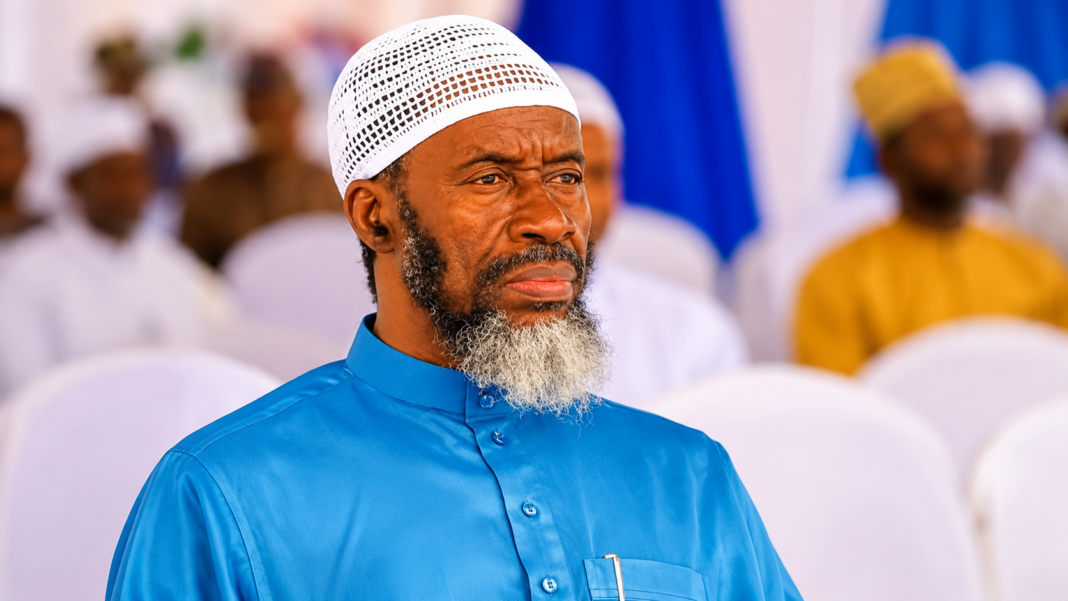

Imam Mohamed Ishaq Kindo, an influential figure within Burkina Faso’s Sunni Muslim community, has become an increasingly sensitive figure for the country’s military authorities. Once supportive of the military transition, he has gradually distanced himself from certain decisions taken by the regime. His arrest, followed by the mobilisation of his followers and his release under restrictions, has exposed the junta’s growing mistrust of his standing and influence within Burkina Faso’s Muslim community.
Kindo, better known as Imam Kindo or Dr Kindo, is an influential figure in Burkina Faso’s Sunni movement. This respected preacher has gradually found himself at the centre of a standoff between sections of the Muslim community and the military authorities. Born in 1961, Kindo completed his entire university education at the Islamic University of Madinah in Saudi Arabia. He subsequently became one of the leading figures in Burkina Faso’s Sunni movement and served as imam of the Grand Sunni Mosque in Ouagadougou. He also headed Al-Uda radio station, helping to disseminate Islamic teachings to an audience extending far beyond his mosque’s congregation.
His influence stems as much from his religious authority as from his popular following. His teachings, reputation as a spiritual guide and the community networks built around him give him influence that extends well beyond the strictly religious sphere. Some of his followers refer to him as “Amir al-Mu’minin”, a title associated with religious leadership. The Sunni community under his leadership has also contributed to the construction of universities and other infrastructure projects in Burkina Faso, further strengthening its presence in the country’s social life.
Kindo’s relationship with the authorities has not always been confrontational. During the military transition, he was among the religious leaders who expressed support for the new authorities at a time when the country was grappling with a persistent security crisis. However, this support did not amount to unconditional approval of their decisions.
People close to the religious community describe him as someone who has generally avoided direct involvement in party politics and previous political regimes. According to them, his interventions have focused primarily on defending religious freedoms and urging the authorities to reconsider certain decisions affecting Muslim worshippers and their religious practices. This position became particularly visible following the introduction of a draft law governing the exercise of religious freedoms. Certain provisions, particularly those relating to the establishment and operation of places of worship, as well as religious activities in public spaces, raised concerns among religious leaders.
On 24 May 2026, during a religious teaching session widely circulated on social media, Kindo warned the authorities against imposing restrictions on prayer in public places. His intervention was seen as a direct challenge to the government’s approach to regulating religious activities. Two days later, on 26 May, he was arrested in Ouagadougou by members of the security services. As the precise reasons for his arrest were not officially disclosed, the incident quickly triggered strong reactions within the Sunni community.
Fear of a religious counterweight
Behind this confrontation lies a deeper disagreement over the limits of state authority and the autonomy of religious organisations. According to sources close to the military authorities, the junta had sought to compel Islamic organisations and Muslim humanitarian associations to channel their financial assistance through the public Treasury. The same sources claim that Imam Kindo receives substantial funding from Madinah, a situation that reportedly contributed to tensions with the authorities after he opposed the proposed measure.
Beyond the financial issue, however, it is Kindo’s growing influence that appears to be a source of concern for the regime. His ability to mobilise followers, his standing within the Sunni community and his capacity to voice criticism that could resonate beyond religious circles may help explain the authorities’ mistrust of him. For the junta, the emergence of a religious authority with such a strong popular base and a degree of independence represents a potential centre of influence beyond its control.
Within the Sunni community, some fear that tighter controls over funding could undermine the autonomy of organisations in managing resources intended for religious and social activities. The authorities, for their part, present the monitoring of financial flows within the religious sector as necessary to strengthen transparency and safeguard social cohesion.
Released, but still silenced in public
After more than five months in detention, Kindo was released in early November 2026. However, his release reportedly did not restore his freedom of movement or his right to speak publicly. According to several sources within the Sunni community, he was placed in isolation at a location described as a “rest facility”, partly to prevent gatherings of his supporters. Visits, photographs and public statements are reportedly prohibited.
A community member who claimed to have visited him described him as being “in good health”, despite considerable weight loss. Another source believes that the conditions surrounding his release amount to a form of house arrest. The precise legal basis for these restrictions has not, however, been made public. His Grand Sunni Mosque also remains closed.
What makes Kindo particularly sensitive in the eyes of the authorities is not simply his criticism of the draft law on religious freedoms. Rather, it is the combination of his religious legitimacy, popular following, community networks and capacity to mobilise supporters.
Unlike a political opposition figure seeking to gain power through the ballot box, Kindo’s influence is rooted primarily in his religious authority and the trust placed in him by his followers. A confrontation with him can therefore extend beyond a dispute between an individual and the state, potentially affecting the authorities’ relationship with a section of the Muslim community.
For now, the restrictions reportedly imposed on him, together with the continued closure of his mosque, are fuelling uncertainty. Kindo remains a figure whose influence extends well beyond the pulpit, illustrating the weight that spiritual authority can carry in shaping relations between the state and Burkinabè society.


