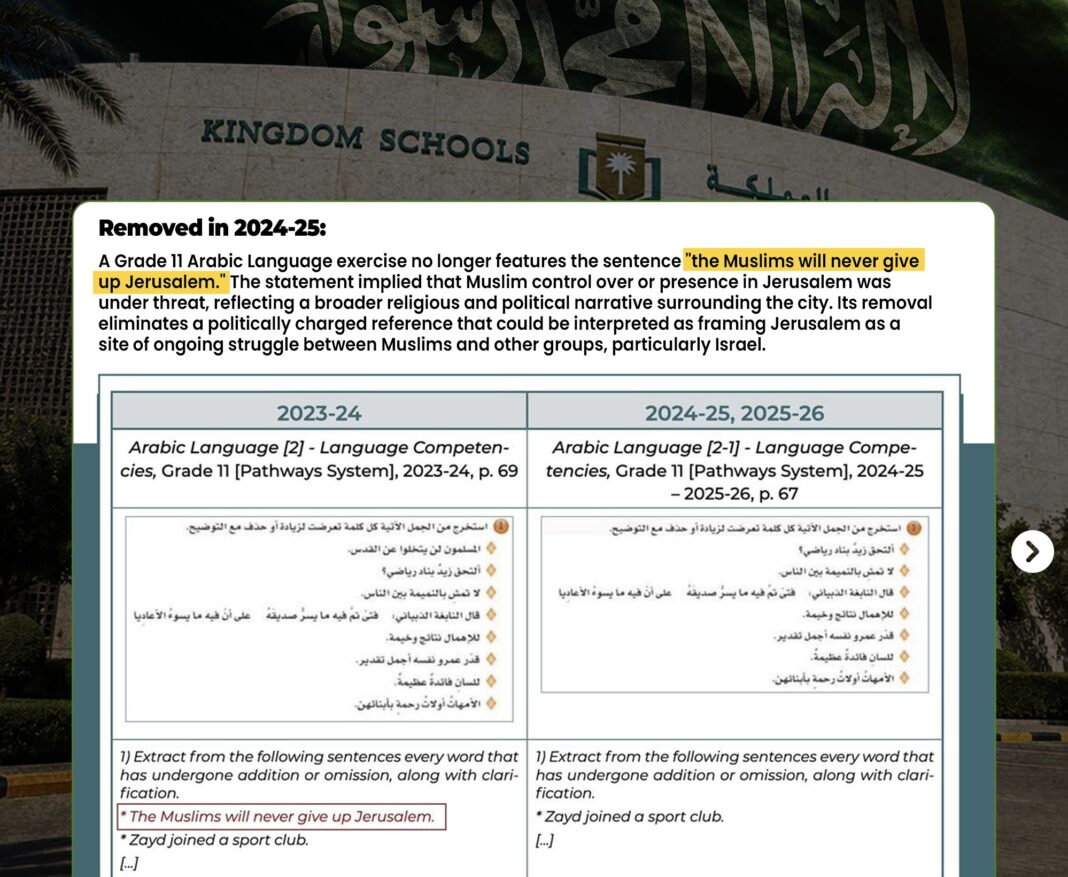

An Israeli organisation has praised Saudi Arabia for continuing to reform its school textbooks, including the removal of the phrase “Muslims will never give up Jerusalem” from material taught to Year 11 students.
The changes were documented by IMPACT-se, an Israel-based organisation that monitors school textbooks and educational material across the Middle East and other regions.
Its July review examined Saudi textbooks used during the 2025-26 academic year and identified further changes to material relating to Israel, Jews, Jerusalem and other religious groups under Crown Prince Mohammed bin Salman’s Vision 2030 programme.
Among the most notable revisions is the removal of the phrase “Muslims will not give up Jerusalem” from an Arabic-language textbook used by Year 11 students.
The sentence appeared in the 2023-24 edition but was removed from the 2024-25 edition and has remained absent from subsequent versions reviewed by IMPACT-se.
The Israeli organisation also reported broader changes in the treatment of Jews, Christians, Shi’a Muslims and Sufis. According to the review, comparisons between Jews and Christians and “maimed” animals have been removed, while material describing Shi’a Muslims and Sufis as inherently evil or associating their practices with idolatry has also been deleted.
References to the eternal punishment of polytheists and non-Muslims have also been reduced, although the report said atheists continue to be portrayed negatively and associated with moral corruption.
Saudi textbooks continue to strongly condemn organisations and movements designated by the Kingdom as extremist or terrorist, including ISIS, al-Qaeda, the Muslim Brotherhood, Hezbollah and Yemen’s Houthi movement.
The curriculum also continues to reflect Saudi Arabia’s political rivalry with Iran, including through discussions surrounding Tehran’s regional role and Saudi involvement in the Yemen conflict.
Despite the wider reforms, the IMPACT-se review noted that Saudi textbooks continue to cover the Second World War without explicitly teaching about the Holocaust.
Marcus Sheff, the British-born chief executive of IMPACT-se, welcomed the changes and said the latest textbooks continued what his organisation described as a six-year shift towards greater religious tolerance, moderation and coexistence.
He said the Saudi curriculum was now free of antisemitic material and claimed its portrayal of religious minorities had become increasingly positive.
The findings have fuelled renewed speculation among some observers that Saudi Arabia’s educational reforms could form part of a broader effort to prepare society for closer relations with Israel.
However, no formal Saudi-Israeli normalisation agreement has been announced, and the textbook changes alone do not establish that such a deal is imminent.