
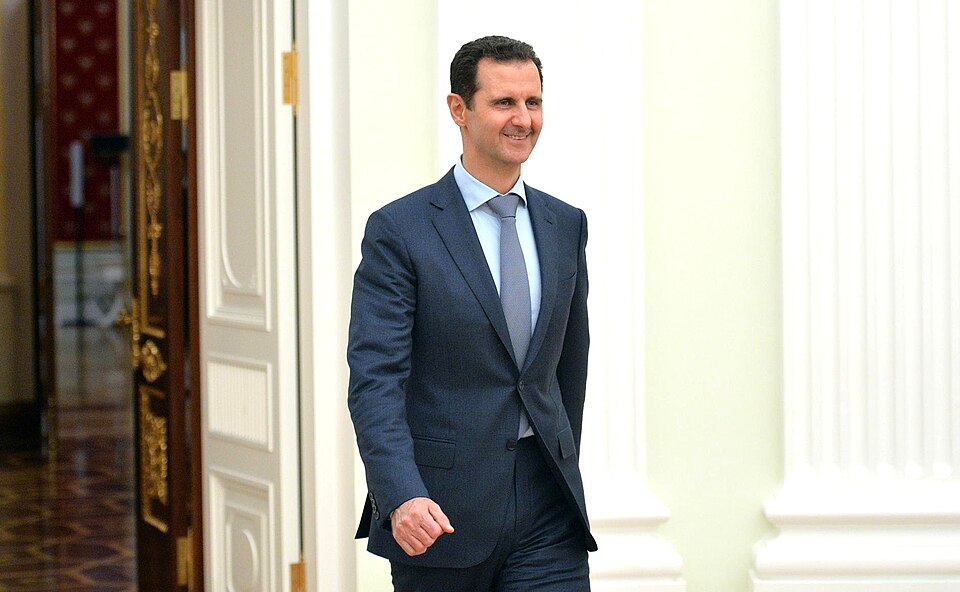

A criminal court in Damascus has sentenced former Syrian dictator Bashar al-Assad to death in absentia after convicting him of murder, torture, arbitrary detention and crimes against humanity committed during his regime’s brutal suppression of the Syrian revolution.
Seven other former regime security officials, including Assad’s brother Maher al-Assad, were also handed death sentences over crimes committed against Syrians during the uprising and subsequent war.
According to Syria’s SANA news agency, the court found Assad responsible for the premeditated murder of multiple victims, including children, as well as systematic torture and arbitrary detention.
Judge Fakhareddine al-Aryan said Assad had been “the highest decision-maker” behind the crimes and had used Syria’s state institutions and security apparatus to facilitate widespread abuses.
“Bashar Assad used state agencies to commit war crimes and crimes against humanity,” Al-Aryan told the court during proceedings broadcast on Syrian state television.
Assad remains in exile in Russia, where he fled after the collapse of his regime in December 2024 following a lightning offensive by opposition forces led by Ahmed al-Sharaa.
The verdict represents one of the most significant attempts by post-Assad Syria to hold senior figures from the former regime accountable for atrocities committed during nearly 14 years of repression and war.
Maher al-Assad and former security chiefs sentenced
Maher al-Assad, the former commander of the regime’s powerful Fourth Division and one of the most feared figures within Assad’s security establishment, was among those sentenced to death.
He was convicted of premeditated murder and torture resulting in death and remains a fugitive.
Atef Najib, Assad’s cousin and former head of the Political Security Branch in Daraa, was also sentenced to death after being convicted over the torture and killing of detainees.
Najib played a central role in the events that helped ignite the Syrian revolution in 2011.
More than a dozen teenagers in Daraa were detained and tortured after writing anti-regime graffiti on walls. Their treatment triggered demonstrations demanding their release, which quickly developed into nationwide protests against decades of Ba’athist authoritarian rule.
The regime responded with arrests, torture and lethal force.
The court said Najib had participated in the interrogation of detainees and later oversaw a security crackdown against civilians in Daraa.
“The acts attributed to Atef Najib, according to investigations and witness statements, are crimes against humanity,” the judge said.
Daraa subsequently became widely regarded as the cradle of the Syrian revolution.
Fourteen years of killing and displacement
Assad inherited power in 2000 following the death of his father, Hafez al-Assad, who had ruled Syria since 1971.
When peaceful demonstrations erupted in 2011 demanding political reform and an end to authoritarian rule, the Assad regime responded with extraordinary violence.
Security forces fired on protesters, carried out mass arrests and subjected detainees to torture, while the uprising gradually developed into an armed revolution and nationwide conflict.
Human rights organisations have attributed hundreds of thousands of deaths to the Assad regime and its allies during the conflict.
Estimates vary considerably, but monitoring groups have documented mass killings, deaths under torture, indiscriminate bombardment and enforced disappearances on an enormous scale.
The Syrian Observatory for Human Rights has estimated that almost 657,000 people were killed between the beginning of the uprising in 2011 and March 2025.
The conflict also produced one of the world’s largest displacement crises.
According to UN refugee figures, more than 12 million Syrians were displaced during the war, including millions forced from their homes internally and millions more driven into neighbouring countries and further abroad.
Torture, chemical attacks and mass detention
The Assad regime became internationally notorious for the extensive use of torture, arbitrary detention and enforced disappearance.
Thousands of Syrians disappeared into a sprawling network of prisons and intelligence detention centres where survivors described beatings, starvation, sexual violence, electrocution and other forms of torture.
Photographs smuggled out of Syria by the military defector known as “Caesar” documented thousands of bodies of detainees who had apparently died in regime custody.
Assad’s forces were also repeatedly accused of using chemical weapons against opposition-held areas.
The most notorious attack took place in Eastern Ghouta in August 2013, when rockets containing the nerve agent sarin struck opposition-controlled suburbs of Damascus, killing large numbers of civilians.
Regime forces were also accused during the war of carrying out repeated chlorine attacks against civilian-populated areas.
Alongside conventional bombing, artillery and siege warfare, such attacks became symbols of the lengths to which Assad’s government was prepared to go to crush the revolution and remain in power.
The fall of the Assad regime
Despite years of military support from Russia and Iran, as well as Iran-backed armed groups, Assad’s government ultimately collapsed in December 2024.
Opposition forces launched a rapid offensive across northern and central Syria before entering Damascus, bringing more than five decades of Assad family rule to an end.
Assad fled Syria for Moscow as government institutions collapsed and opposition forces took control of the capital.
His downfall marked the conclusion of one of the most brutal authoritarian regimes in the modern Arab world and brought an end to a war in which successive Syrian governments had relied heavily on foreign military intervention to survive.
For many Syrians who participated in the 2011 uprising, however, the regime’s collapse was not merely the end of a civil war.
It represented the culmination of a revolution that began with young people writing anti-regime slogans on the walls of Daraa and endured nearly 14 years of bombardment, imprisonment, displacement and mass killing.
The latest verdict places Assad and senior figures from his former security apparatus formally in the dock for some of those crimes.
Whether Assad will ever be returned from Russia to face punishment remains uncertain.
But for a country where victims of the former regime spent decades denied justice, the convictions represent an attempt to establish a principle long absent under Assad rule: that those who ordered torture, murder and repression can themselves be held accountable.