
Ziyad Motala Professor of Law, Howard University School of Law
There are moments when a political system inadvertently explains itself.
One occurred recently on a London street, not in a palace, ministry or carefully choreographed “tolerance” conference. Sheikh Mohammed bin Rashid Al Maktoum, ruler of Dubai and prime minister of the United Arab Emirates, was walking through Knightsbridge when a Sudanese man confronted him from across the road.
“Stop killing my people,” he shouted. “Stop killing Sudanese.”
The charge was political. The answer from a man appearing to be part of the ruler’s entourage was something else entirely: repeated obscenities, abuse of the Sudanese people and then the words “Black bitch.”
One might have expected embarrassment. Perhaps an apology. Perhaps a statement that such language is beneath the dignity of a country forever advertising its modernity, tolerance and cosmopolitanism. As of 14 August, none has emerged that I can find. The UAE embassy in London did not respond when Middle East Eye sought comment. The Metropolitan Police, apparently possessing a more developed sense of civic responsibility than the entourage of a prime minister, said it would review the footage.
The silence is revealing.
The obscenity matters not merely because a badly behaved man lost his temper. People lose their tempers every day. It matters because the anger stripped away ceremony. When the accusation concerned Sudan, the instinctive reply was not argument but racial degradation. A Black African challenged power, and someone walking with power reached immediately for Blackness as the insult.
This was less a Freudian slip than a social X-ray.
The United Arab Emirates has spent fortunes manufacturing an international personality. There are skyscrapers, museums, airlines, artificial islands, universities, Formula One races, football sponsorships and ministerial portfolios with uplifting names. The country has mastered the modern autocrat’s discovery that architecture, glitz and sports washing can be offered as evidence of civilisation.
It cannot. A civilisation is not measured by the height of its buildings but by the moral distance between the powerful and the powerless. On that measure, the UAE’s glitter deserves rather less applause.
Its social order rests upon an extraordinary hierarchy of status. Emirati citizens sit at its summit. Beneath them is a vast expatriate population whose security, mobility and economic worth can vary dramatically according to occupation, nationality and origin. Academic research on African migrants in the UAE describes race, ethnicity, nationality and gender as important vectors of inequality. Human Rights Watch has repeatedly documented the vulnerabilities created by the sponsorship system. Amnesty International reported that in 2021 at least 375 African migrant workers were arbitrarily detained in sweeping night raids and deported without due process in what it described as racially motivated detentions. (JSTOR)
So the racial epithet in London did not arrive from nowhere. It landed on already prepared ground.
This does not mean every Emirati is racist, any more than racism in America makes every American a racist. It means something more serious than the failings of individuals: a society can normalise gradations of human worth. Passport, profession, ancestry and skin colour can become social coordinates. The Westerner arriving with a consultancy contract inhabits one Emirates. The South Asian labourer building it inhabits another. The African domestic worker may encounter another still.
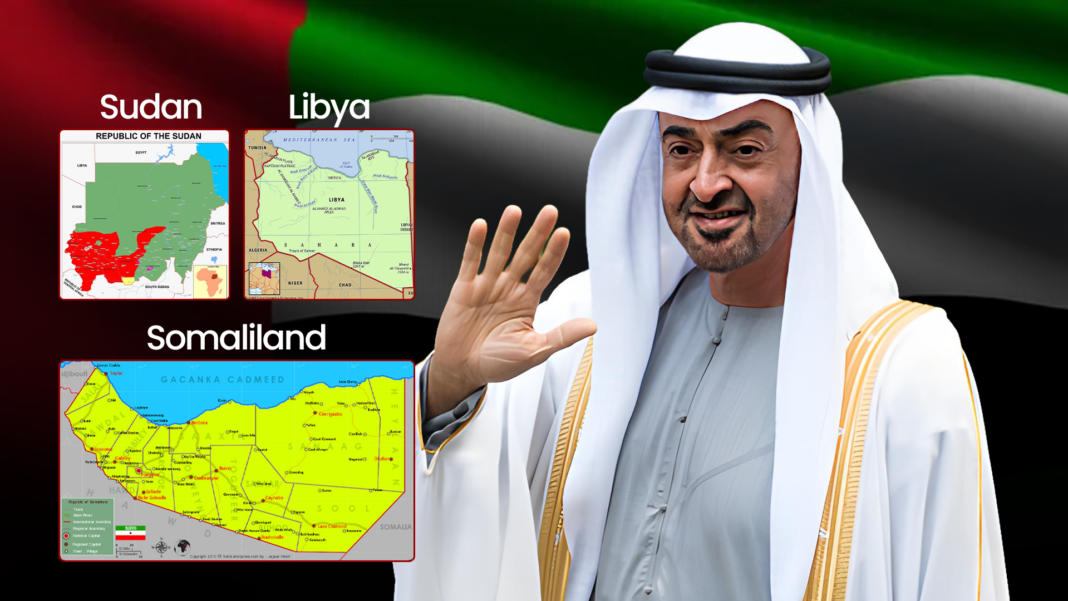
One country. Several valuations of humanity. The Sudanese man in London also raised the question that polite diplomacy prefers to discuss in whispers. The UAE has repeatedly been accused of supplying or facilitating support to Sudan’s genocidal Rapid Support Forces, whose atrocities have devastated Darfur and other parts of the country. The UAE denies arming the RSF. But this is no longer an allegation confined to Sudanese rhetoric. Amnesty International has identified Chinese weapons it says were re-exported by the UAE and used in Sudan. Human Rights Watch reported this year that Colombian contractors who later supported the RSF had transited UAE military bases and said the evidence indicated substantial Emirati contribution to the RSF’s capacity to commit war crimes. U.S. lawmakers have also said they found evidence of Emirati weapons transfers. (Reuters)
The UAE may dispute every accusation. It is entitled to do so. What it is not entitled to do is answer a Sudanese man’s anguish with contempt for his race.
And then there is the particularly grotesque religious contradiction. The UAE’s own Constitution declares Islam its official religion and Islamic Shari’a a main source of legislation. Yet the prophetic tradition has a remarkably precise description for racial arrogance: jahiliyyah.
When Abu Dharr disparaged another man through his mother’s origins, the Prophet Muhammad (S.A.W.) did not excuse it as irritation, banter or cultural misunderstanding. He rebuked him: “You are a man in whom there is ignorance (jahiliyyah).”
Jahiliyyah is usually translated as ignorance, but the term carries a larger moral meaning. It evokes the pre-Islamic order of tribal vanity, inherited superiority and the ranking of human beings by blood. Islam’s answer was unequivocal. The Qur’an rejects inherited hierarchies of human worth: all human beings share a common origin, peoples and tribes exist so that they may know one another, and the only measure of nobility is righteousness. The Prophet Muhammad (S.A.W.) made the principle even more explicit in his Farewell Sermon: no Arab is superior to a non-Arab, nor a non-Arab to an Arab; no white person is superior to a Black person, nor a Black person to a white person. The only distinction that matters before God is piety and righteous conduct.
The man in Knightsbridge managed, in two words, to travel fourteen centuries backwards.
The greater embarrassment is that Western governments, normally equipped with an inexhaustible vocabulary about anti-racism and human rights, have found remarkably little to say. As of this writing, I can find no public ministerial condemnation of the racial abuse. One can imagine the reaction had an Iranian leader been confronted on a London street over alleged human rights abuses and a member of his entourage responded with a vile racial epithet. The footage would have travelled through Western newsrooms, foreign ministries and think tanks in an instant, accompanied by solemn commentary about the brutality and moral character of the Iranian state. With the UAE, there is scarcely a murmur.
This silence should not be confused with principle. It is expediency. The UAE is rich, strategically useful, closely aligned with Israel, a voracious purchaser of Western weapons and a lavish investor abroad. It has made itself indispensable to people whose moral convictions become wonderfully flexible in the presence of sovereign wealth.
Human Rights Watch has recently criticised both European and French reluctance to confront the UAE over the mounting evidence concerning Sudan. The pattern is familiar. Western moral vocabulary is often fiercest when deployed against adversaries and grammatically complicated when directed at a wealthy ally.
Money, it seems, is an excellent speech therapist.
The UAE’s defining delusion is that wealth can perform the work of civilisation. A skyline is not a moral philosophy. A seven-star hotel is not a value system. Hosting interfaith conferences does not confer tolerance. Calling a ministry a Ministry of Tolerance does not make a society tolerant any more than calling North Korea democratic makes it Denmark.
Modernity is not glass, steel or air-conditioning. It is the recognition that the dignity of the cleaner is not less than that of the sheikh; that the African is not a lesser species of guest than the European banker; that wealth does not purchase exemption from elementary decency.
The Sudanese man asked a question about death in his country. The response supplied an unintended answer about moral life in the Emirates.
Dubai has proved that money can build almost anything, including a spectacle capable of seducing the gullible and impressing those for whom glitter is a substitute for values. What it has not yet built is a civilisation worthy of the skyline.
Professor Ziyad Motala is a legal scholar and Professor at Howard University School of Law. He previously served as the Director of the Comparative and International Law Program at the University of the Western Cape in South Africa and held the position of Honorary Professor of Law at the University of the Western Cape School of Law.