
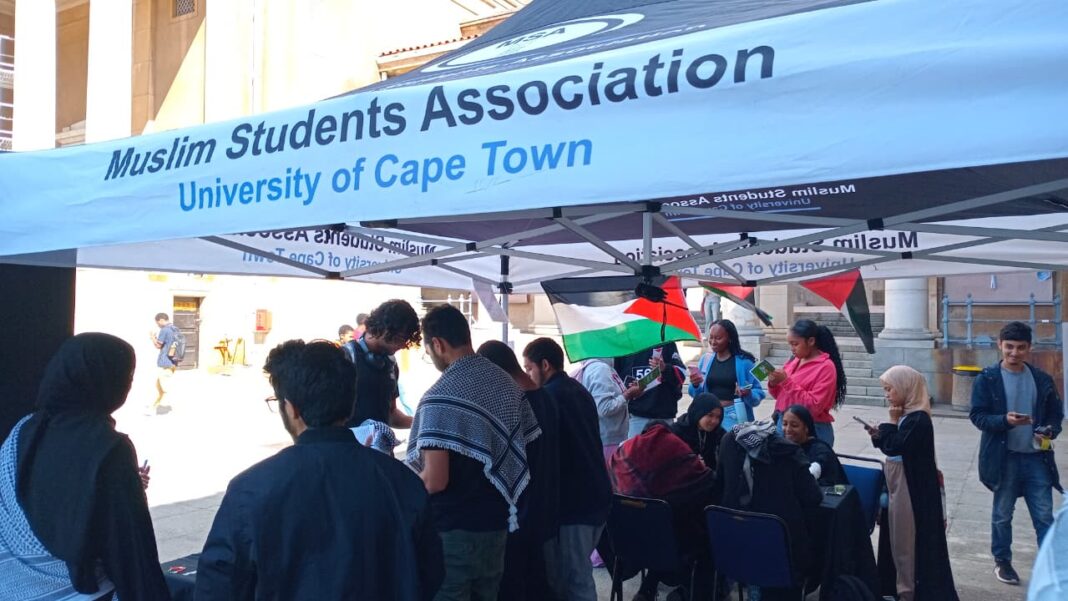

The University of Cape Town’s (UCT) Muslim Students’ Association (MSA) has defended the institution’s Gaza-related resolutions, urging the university not to retreat from its position despite a reported R250 million loss in donor funding.
The controversy stems from two resolutions adopted by the UCT Council in 2024. The first affirmed that criticism of Israel and Zionism should not automatically be conflated with antisemitism, while the second prohibited institutional affiliations with the Israeli military, including research collaborations with entities linked to the Israel Defense Forces (IDF).
The resolutions have since prompted legal challenges and significant donor withdrawals.
The financial pressure has unfolded in several stages. On 7 February 2025, the White House issued an executive order signalling the termination of US aid and assistance to South Africa, resulting in the cancellation of grants from the US Agency for International Development (USAID).
The move also exposed UCT’s reliance on funding from US federal agencies, particularly the National Institutes of Health (NIH), leaving approximately R113.9 million in health and science-related research projects outstanding, including programmes at the Desmond Tutu Health Centre.
Separately, on 10 June 2026, Vice-Chancellor Professor Mosa Moshabela told Parliament’s Portfolio Committee on Higher Education that UCT had lost around R200 million in pledged funding for a neuroscience institute.
He said other donors had withdrawn a further R50 million following the university’s Gaza-related resolutions, including an estimated R15 million in annual funding earmarked for student bursaries and financial assistance.
Speaking to One Nation Media (ONM), Zaynib Khan, Current Affairs Manager of the UCT Muslim Students’ Association, said the identities of the donors had not been publicly disclosed.
“The exact organisations that have withdrawn funds aren’t really known, as the statement given by the Vice-Chancellor on 10 June was a little vague. The focus was more on the financial losses than on who specifically was withdrawing those funds.”
While acknowledging the financial implications, Khan said the MSA believes UCT’s position should be rooted in principle rather than money.
“We’re concerned about UCT backpedalling on its stance and that this will discourage other institutions from taking a stance,” she told ONM.

She warned that any reversal could discourage universities and other institutions from speaking out on humanitarian issues for fear of financial consequences.
Khan described the withdrawn funding as what she termed “blood money”, arguing that the university should not compromise its values in exchange for financial support.
“It is a good thing to see that we are no longer using blood money and are no longer being supported by blood money, but there is this concern about financial stability,” she said.
Rejecting the idea that universities should remain neutral, Khan said the MSA views Israel’s war on Gaza as a moral issue.
“The MSA’s view is strictly that it is a moral obligation because, in this genocide, we don’t believe neutrality exists. It is either compliance or opposition.”
She added that UCT, as South Africa’s leading university, has a responsibility to exercise moral leadership.
“Why should we have access to education while every educational institution in Gaza has been bombed to rubble?”
“It is good to take a stance. Why would we welcome being controlled by the money of a foreign nation over the human rights of another?”
Although the donor withdrawals emerged during the university’s semester break, Khan said the MSA remains confident that UCT can withstand the financial pressure.
“UCT is such a large institution that we believe it will be able to overcome this.”
She said the university’s position sends an important message beyond its own campus.
“UCT is the leading university in South Africa. For such a large institution to take a stance, it really sets an example. Integrity cannot be bought.”
Khan believes the donor withdrawals were, at least in part, intended to pressure the university.
“It is partly an attempt to silence the view because it almost shows that this is a punishment for taking a stance.”
She acknowledged that the funding losses had already affected research projects and student bursaries, but said comments from university staff suggested UCT’s overall financial position remained stable.
The MSA has not formally engaged UCT’s leadership since the donor withdrawals became public. However, it joined other student organisations during Israeli Apartheid Awareness Week in calling on the university to maintain its position.
“We are very proud of UCT for taking this stance. We would like to see it remain firm, showing once again that integrity cannot be bought.”
The association argues that UCT’s Gaza-related resolutions are consistent with the university’s stated commitment to engaged citizenship and social justice, as reflected in its mission and Vision 2030.
The resolutions remain the subject of legal proceedings. UCT Professor Adam Mendelsohn has challenged the Council’s decision, arguing that it failed to adequately consider the financial implications and governance processes before adopting the measures.
Supporters, however, argue that universities have a responsibility to uphold human rights and academic ethics and should not allow donor pressure to determine their institutional values.
UCT has maintained that the resolutions were adopted following extensive internal consultation and remain consistent with the university’s governance processes and institutional values.