
Journalist Neelam Rahim examines the pro-Israel lobbying networks seeking to shape public opinion, political debate and South Africa’s historic support for Palestine.
South Africa’s support for Palestine is deeply rooted in its own liberation history. For many South Africans, the Palestinian struggle echoes the country’s experience of land dispossession, racial oppression and resistance to apartheid.
That shared history has helped shape a foreign policy that remains firmly critical of Israel’s occupation of Palestinian territory and its military assaults on Gaza and the occupied West Bank.
As South Africa has emerged as one of Israel’s most vocal international critics, particularly through its case against Israel at the International Court of Justice (ICJ), attention has increasingly turned to organisations seeking to influence public opinion and political debate on Israel and Palestine.
Few pro-Israel lobbying organisations are as influential as the American Israel Public Affairs Committee (AIPAC). For decades, AIPAC has helped shape US policy on Israel through campaign spending, lobbying and sustained engagement with lawmakers from both major political parties.
Through affiliated political action committees, including the United Democracy Project (UDP), AIPAC has spent tens of millions of dollars supporting candidates who align with its policy positions while financing campaigns against politicians viewed as critical of Israel.
Beyond election spending, it maintains an extensive lobbying network that engages members of Congress and advocates for continued US military, diplomatic and political support for Israel.
Supporters describe AIPAC as a legitimate advocacy organisation exercising the same democratic freedoms as other interest groups. Critics, however, argue that its financial resources and political reach have narrowed debate on Israel and placed growing pressure on elected representatives who depart from its positions.
The AIPAC model has also influenced organisations elsewhere, including the South African Israel Public Affairs Committee (SAIPAC), which was established in Cape Town in 2011. According to reports, one of SAIPAC’s founders said the organisation would remain “in sync and in close association with the Israeli Embassy”.
Extensive online and other searches for contact details for SAIPAC’s offices or officials were unsuccessful.
The comparison has prompted broader questions about whether lobbying models that have proved highly influential in Washington could also shape public debate and political decision-making in South Africa.
Lobbying or advancing foreign interests?
Cameron Rodrigues, an intersectional social justice advocate, academic coordinator and Master’s candidate in International Relations, said the issue was not whether states should be permitted to seek influence abroad.
“It doesn’t necessarily mean that countries are not allowed to have some form of influence in different countries, because that is what diplomacy is,” Rodrigues told One Nation Media.
“The thing is, SAIPAC is not working with our country to come to a conclusion that could work for both states. It is trying to push for the interests of solely one state.”
Rodrigues argued that organisations operating within South Africa should ultimately be assessed according to whether they serve the interests of people living in the country.
“When we look at organisations such as SAIPAC, as well as the South African Zionist Federation and the Jewish Board of Deputies, they oftentimes are pushing for the national interest of Israel itself, and not necessarily for the betterment of South Africans,” she said.
Her comments reflect broader debates surrounding AIPAC in the US, where critics argue that lobbying, campaign financing and close relationships with elected representatives have helped shape American policy on Israel for decades.
Influence can also extend beyond campaign financing or parliamentary lobbying. Advocacy may take the form of public relations campaigns, engagement with political leaders, sponsored visits, legal action, religious mobilisation and media campaigns that shape how issues relating to Israel and Palestine are understood.
The debate over antisemitism and criticism of Israel
Questions about influence and public narratives have also emerged in media reporting on allegations of antisemitism.
A report by Middle East Eye examined a controversy surrounding allegations of antisemitism at a tennis match involving a Jewish day school in Johannesburg.
According to the publication, the incident developed into a national controversy through institutional pressure, public accusations and demands for an apology, despite continuing disputes over the facts.
The case has contributed to a wider discussion about the distinction between antisemitism and criticism of the Israeli state.
Antisemitism is a genuine and serious form of prejudice that must be confronted wherever it occurs. At the same time, criticism of Zionism, the Israeli government, the occupation of Palestinian territory or Israel’s military operations cannot automatically be equated with hatred of Jewish people.
Many legal scholars, human rights groups and Jewish organisations have argued that conflating the two risks narrowing democratic debate and placing advocacy for Palestinian rights under continual suspicion.
Christian Zionist networks
The debate over influence also extends beyond conventional lobbying organisations.
An Al-Shabaka policy brief examining Christian Zionism in South Africa argues that some churches, evangelical movements and prosperity-gospel networks promote political support for Israel as a religious obligation while paying little attention to the realities of Palestinian dispossession.
The brief identifies organisations such as the International Christian Embassy Jerusalem, Bridges for Peace and the South African Friends of Israel as part of a broader network of religious advocacy and political engagement.
It also argues that coalition politics may allow smaller pro-Israel parties to exercise influence beyond their level of electoral support.
Rodrigues said South Africans should remain alert to organisations that present themselves as local while pursuing what she described as external interests.
“We ought to be concerned about international organisations that operate under the guise of a South African organisation,” she said.
“They are not pushing for the national interests of South Africans; they are pushing for the national interest of the state of Israel.”
Influence in Parliament
The debate also extends to Parliament, where lobbying and advocacy can shape discussions on South Africa’s foreign policy towards Israel and Palestine.
While engagement between civil society and elected representatives is a normal part of any democracy, concerns arise when organisations perceived to represent foreign interests gain disproportionate influence over public policy.
Critics argue that if lobbying efforts succeed in shaping parliamentary positions or public policy in favour of a foreign state, the consequences extend beyond diplomatic relations.
Such influence can affect how South Africa responds to international human rights issues, votes in multilateral forums and upholds the principles that have long informed its support for Palestinian self-determination.
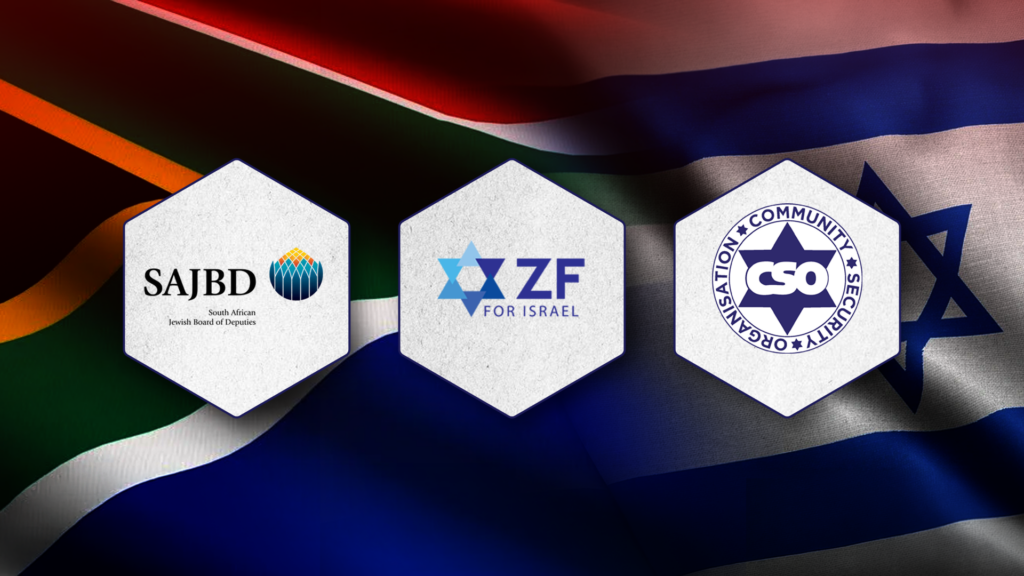
One Nation Media (ONM) approached the South African Zionist Federation (SAZF) and the South African Jewish Board of Deputies (SAJBD) with a series of questions regarding their advocacy, funding, relationships with political parties and responses to criticism that Zionist organisations advance Israeli state interests in South Africa.
ONM also requested assistance in identifying an authorised representative or obtaining contact details for the South African Israel Public Affairs Committee (SAIPAC), whose publicly available contact information could not be located.
No response had been received from any of the organisations by the time of publication.