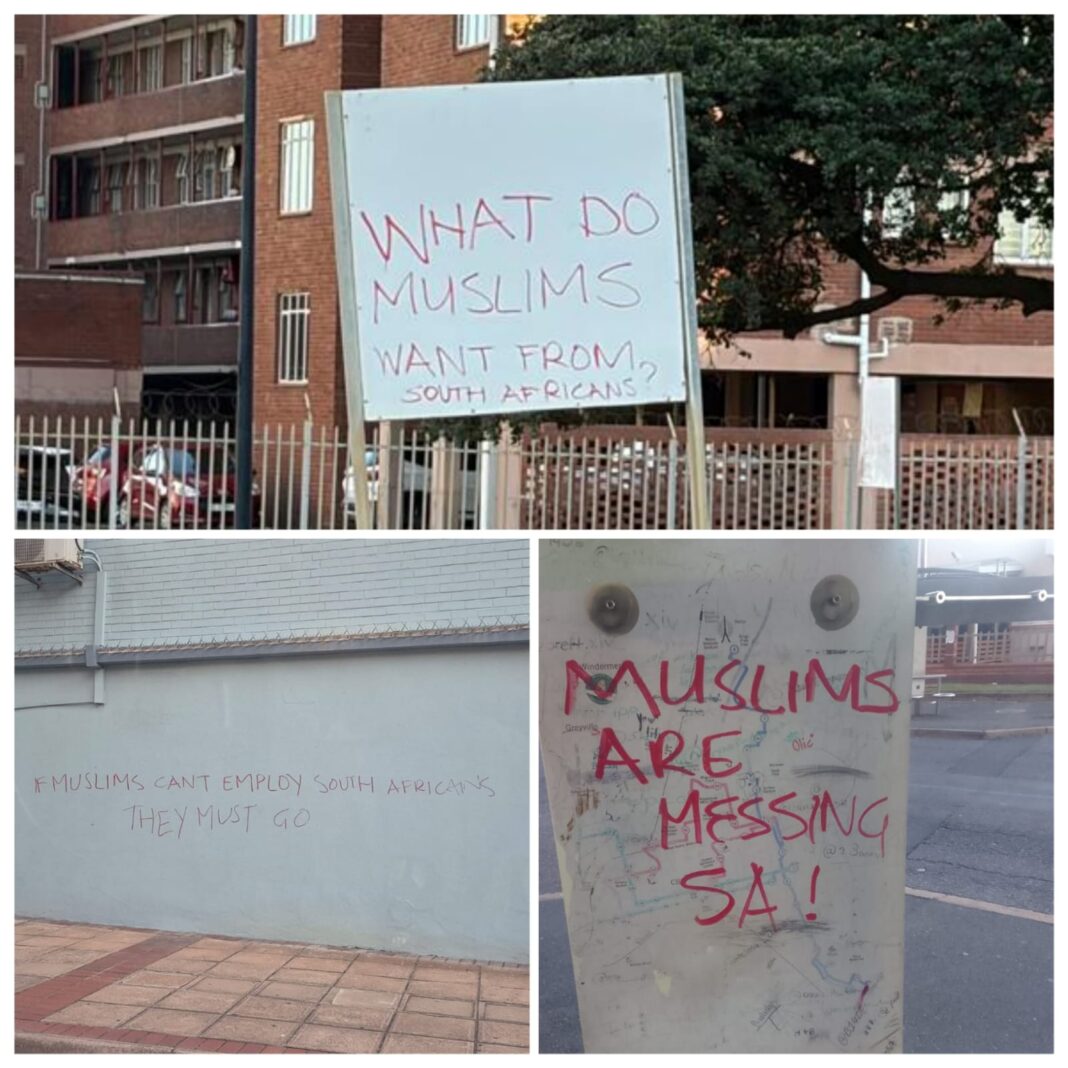

A growing wave of Islamophobic content on social media is raising concerns that anti-Muslim hostility is being deliberately cultivated as part of a broader effort to deepen political and social divisions in South Africa.
For years, online political discourse has been shaped by inflammatory narratives around race, crime, immigration and land. More recently, Muslims have increasingly become targets of hostile messaging, imported slurs and conspiracy-driven content that bears little resemblance to South Africa’s own political language or social reality.
Mp and Rise Mzansi National Leader Songezo Zibi believes the pattern is neither accidental nor organic.
“The Islamophobic campaign on X looks very orchestrated. In fact, it is orchestrated,” Zibi told One Nation Media.
His warning comes at a time when digital platforms have become central to the spread of political hostility. X, Facebook and other social media platforms allow anonymous accounts, influencers and coordinated networks to amplify content at speed, often before claims can be verified or challenged.
Islamophobia is not new in South Africa. Muslims have faced prejudice, stereotyping and suspicion for decades, particularly during periods of global conflict involving Muslim-majority countries. However, the current online climate has taken on a more aggressive character, with anti-Muslim narratives increasingly woven into wider debates about immigration, national identity and political loyalty.
Zibi said one indication of possible outside influence is the language being used in online attacks. He pointed to the use of “towelhead”, an anti-Muslim slur more commonly associated with the United States than South Africa.
“For example, they call Yusuf a towelhead. Nobody uses that here, first of all. It’s an American term,” he said.
The use of imported language is significant because it suggests that local hostility may be drawing on political narratives developed elsewhere. South Africa’s social media ecosystem does not exist in isolation. Content moves rapidly across borders, allowing foreign political campaigns, international conflicts and global disinformation networks to shape local debate.
Zibi said his research into manipulated messaging on Twitter, now known as X, had revealed recurring patterns in the movement of divisive narratives across different time zones.
“What I’ve seen over the years is that a lot of the manipulation begins in Asia at around 4am. It goes to Eastern Europe. It then comes to South Africa. And then in the evening, South African time, it’s accounts based in the US,” he said.
These claims require thorough investigation by digital forensics specialists, social media companies and law enforcement agencies. However, the political consequences of online manipulation are already becoming increasingly visible.
South Africans are being pushed into hardened camps, with immigrants blamed for unemployment, Muslims portrayed as outsiders, and racial anxieties repackaged into viral political content. The objective is not necessarily to persuade people through facts, but to provoke fear, anger and mistrust.
Zibi believes this forms part of a broader effort to fracture South Africa’s political landscape.
“Over the years, there appears to have been an attempt to make political consensus impossible in South Africa,” he said.
He said the country’s online political environment increasingly resembles the polarisation witnessed in the United States during the rise of the Make America Great Again movement, in Britain during Brexit, and in election campaigns elsewhere around the world.
“In the same way that we’ve seen with MAGA in the US, we’ve seen with Brexit in the United Kingdom, and in the recent elections in France, those patterns exist in South Africa,” Zibi said. “The heat maps look the same.”
For Muslim South Africans, the danger extends beyond the spread of offensive language. Islamophobic messaging can create an environment in which Muslims are portrayed as suspicious, disloyal or foreign, despite being an integral part of South Africa’s history, communities and liberation struggle.
It can also fuel hostility beyond the digital space. Online campaigns often rely on repetition: a slur is repeated, a false claim is shared, a video is stripped of context, and an entire community is blamed. What begins as a social media post can gradually shape public opinion.
Zibi also raised concerns about possible pro-Israeli influence in South Africa’s online discourse, particularly in light of the country’s strong public and legal stance against Israel’s war on Gaza. He stressed that he had no proof, but said he would not be surprised if such interests were involved.
“I don’t have proof,” he said, “but if I see what has happened with Brexit, what has happened with MAGA, what has happened with the Brazilian election, et cetera, et cetera, I really would not be surprised if the pro-Israeli hand is very strong in this case as well.”
That allegation should be treated with caution. However, the broader concern remains significant: Islamophobia is increasingly being deployed online not simply as an expression of prejudice, but as a political tool capable of deepening social divisions and influencing public discourse.
South Africa’s democracy cannot thrive if communities are turned into targets whenever the country faces political or economic challenges. Exposing coordinated hate campaigns, demanding greater accountability from digital platforms, and resisting efforts to scapegoat Muslims, migrants or any other community remain essential to protecting both social cohesion and democratic debate.