
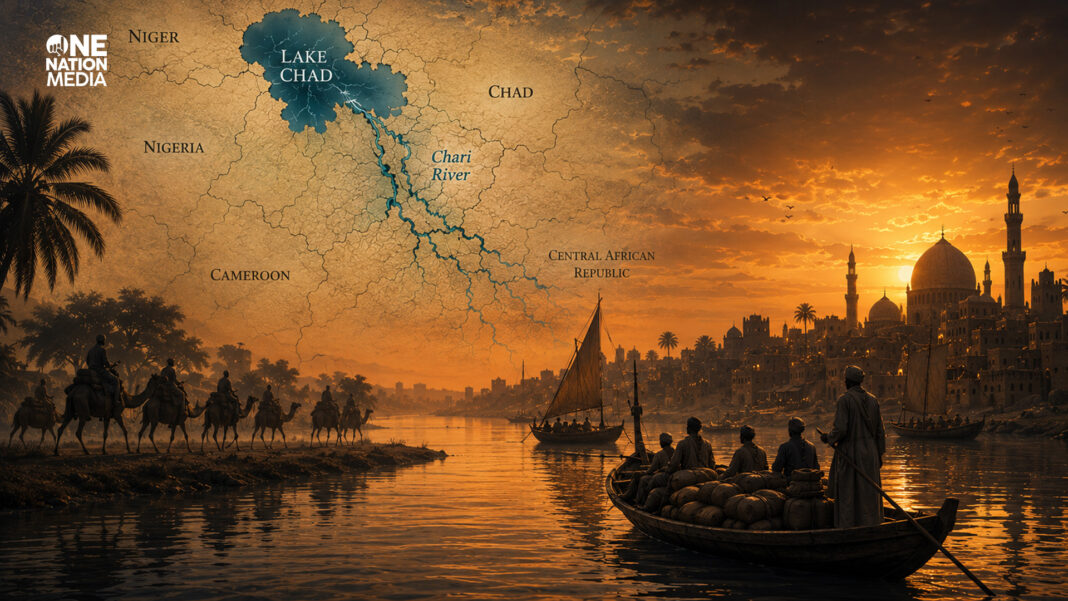

South-east of Lake Chad, along the fertile plains of the Chari River basin, the Sultanate of Bagirmi emerged as an important Muslim state in Central Africa, writes Neelam Rahim.
From its capital at Massenya, Bagirmi controlled farming communities, tributary territories and commercial routes linking the African interior with the wider Lake Chad region and trans-Saharan markets.
Its rulers built a state that survived for several centuries, navigating periods of expansion, subordination and renewed independence between more powerful neighbours, particularly the Bornu Empire to the west and the Sultanate of Wadai to the east.
Islam gradually transformed Bagirmi’s royal court and political institutions, connecting the sultanate to the wider Muslim world. However, its history was also marked by warfare, slave raiding, internal instability and, eventually, French colonial conquest.
The emergence of Bagirmi
The precise origins of Bagirmi remain uncertain. Royal traditions and surviving king lists offer different accounts of its foundation. Some identify Abd al-Mahmud Begli as an early founder during the late 15th century, while others trace the establishment of the kingdom to Birni Besse around 1522.
What is clearer is that Bagirmi developed into a centralised state during the late 15th or early 16th century, with Massenya becoming its political and economic centre.
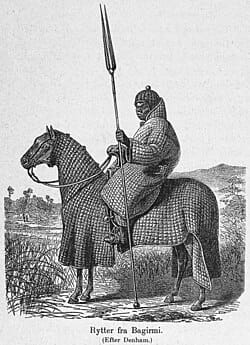
The ruler carried the title of mbang, while a royal court, administrative system and tributary network gradually emerged around the capital.
Bagirmi’s heartland benefited from fertile land watered by the Chari River and its tributaries. Agriculture supported the population, while the kingdom’s position between Lake Chad, the Sahara and communities further south gave it access to important commercial routes.
The state governed a diverse region inhabited or regularly crossed by Bagirmi-speaking communities, Shuwa Arabs, Kanuri merchants, Fulani pastoralists and other peoples of the central Sudan. By consolidating control over neighbouring chiefdoms, Bagirmi’s early rulers created a kingdom capable of collecting tribute, raising armies and competing for influence in the politically fragmented region south-east of Lake Chad.
Islam and the transformation of the state
Islam reached Bagirmi through its expanding links with the Muslim societies of the Lake Chad Basin.
Merchants, scholars, officials and travellers carried Islamic beliefs and practices across the region, while Bagirmi’s relationship with Bornu brought its rulers into direct contact with one of Africa’s oldest Muslim states.
The decisive stage in Bagirmi’s Islamisation came during the reign of Abdullah, commonly dated to the late 16th century.
Abdullah adopted Islam as the religion of the court, and Bagirmi increasingly assumed the character of a Muslim sultanate. Islamic judicial and administrative practices were introduced into government, while the ruler continued to retain the indigenous title of mbang.
The adoption of Islam did not mean that every community under Bagirmi’s authority converted immediately. Older religious practices continued, particularly beyond the royal court and principal settlements.
Islamisation was therefore gradual and uneven. It initially strengthened the Muslim identity of the ruling elite before spreading more widely through trade, scholarship, political authority and contact with neighbouring Muslim societies.
Bagirmi’s embrace of Islam also gave its rulers access to a shared diplomatic and political culture. Arabic literacy, Muslim legal traditions and relations with scholars helped connect the court at Massenya to a much larger network stretching across Bornu, Wadai, Darfur, the Sahara and North Africa.
The surviving evidence does not provide a detailed account of everyday religious institutions throughout the kingdom. However, Bagirmi developed its own written historical traditions, and Muslim learning became part of the political and intellectual life of the sultanate.
Islam did not erase Bagirmi’s local identity. Instead, the kingdom combined Islamic government with established political titles, social customs and indigenous forms of authority.
Subordination to Bornu
Bagirmi’s political development was closely tied to the rise and decline of the Bornu Empire.
During the reign of Mai Idris Alooma in the late 16th century, Bornu expanded its influence over several smaller states along its southern and eastern frontiers.
Bagirmi was brought under Bornu’s authority and required to pay tribute. Its position also made it dependent on Bornu-controlled routes to participate fully in trans-Saharan commerce.
Relations between the 2 states were not permanently stable. Bagirmi’s rulers resisted Bornu’s dominance when opportunities arose, while Bornu repeatedly attempted to preserve its political and commercial supremacy.
After the death of Idris Alooma in the early 17th century, Bornu’s control weakened and Bagirmi acquired greater room to assert itself. However, the relationship continued to fluctuate between autonomy, tributary dependence and open rivalry.
During the reign of Mbang Burkomanda in the mid-17th century, Bagirmi expanded its influence northwards towards Lake Chad and deeper into the Chari basin. Its forces even carried out raids into Bornu territory.
Bagirmi appears to have secured fuller independence from Bornu during the reign of Muhammad al-Amin in the second half of the 18th century.
This independence was nevertheless fragile. Bagirmi remained surrounded by ambitious states, while its wealth and strategic position made it both a regional power and a target for conquest.
Trade, wealth and slave raiding
Bagirmi’s economy rested on agriculture, tribute and regional commerce. Its markets handled products including cotton, ivory, animal skins and locally manufactured goods. Copper, cowrie shells and other commodities arrived through commercial networks linking Central Africa with the Sahara and North Africa.
Massenya developed into an important political and trading centre, while skilled craftspeople produced cloth and other goods for local and regional consumption.
However, warfare and slave raiding also became central to Bagirmi’s economy and expansion.
The kingdom’s armies raided communities to the south, capturing people who were retained within Bagirmi or transported north through trans-Saharan trading networks.
Enslaved people worked in agriculture, domestic service, crafts and the military. Others were exchanged for imported goods or paid as tribute to stronger neighbouring states.
Slave raiding brought wealth to the ruling elite, but devastated many communities across the wider region. Settlements were attacked, families were separated and populations were displaced by the repeated threat of capture.
This violent political economy was not unique to Bagirmi, but it formed an important part of the system through which the sultanate financed its court, armies and regional ambitions.
Bagirmi’s Islamic identity did not prevent its rulers from participating in slavery or raiding predominantly non-Muslim communities. Its history therefore reflects both the spread of Muslim political and intellectual culture and the brutal realities of power in the pre-colonial central Sudan.
The rise of Wadai
From the 17th century onwards, Bagirmi faced a growing challenge from the Sultanate of Wadai to the east.
Wadai emerged as an increasingly powerful Muslim state and gradually restricted Bagirmi’s ability to expand. As Bornu weakened, Wadai became the principal regional threat to Massenya.
By the end of the 18th century, Bagirmi had lost control over several tributary territories and was weakened by internal political struggles.
In 1805–06, Sultan Sabun of Wadai launched a major invasion of Bagirmi.
Wadai’s forces captured and sacked Massenya, killed the reigning mbang and members of his family, and took thousands of captives. Contemporary estimates claim that as many as 20,000 people were enslaved, although such figures should be treated cautiously.
Wadai installed a surviving member of Bagirmi’s royal family and reduced the sultanate to tributary status.
Bagirmi’s monarchy survived, but the kingdom had lost much of its former independence. Its rulers were forced to manoeuvre between submission, resistance and attempts to recover their authority.
Wadai invaded again in 1870, causing further destruction in Massenya and deepening Bagirmi’s decline.
Rabih az-Zubayr and the destruction of Massenya
Bagirmi suffered another major blow during the rise of Rabih az-Zubayr in the late 19th century.
Rabih was a Sudanese military commander who built a powerful state across parts of Central Africa through conquest, taxation and slave raiding.
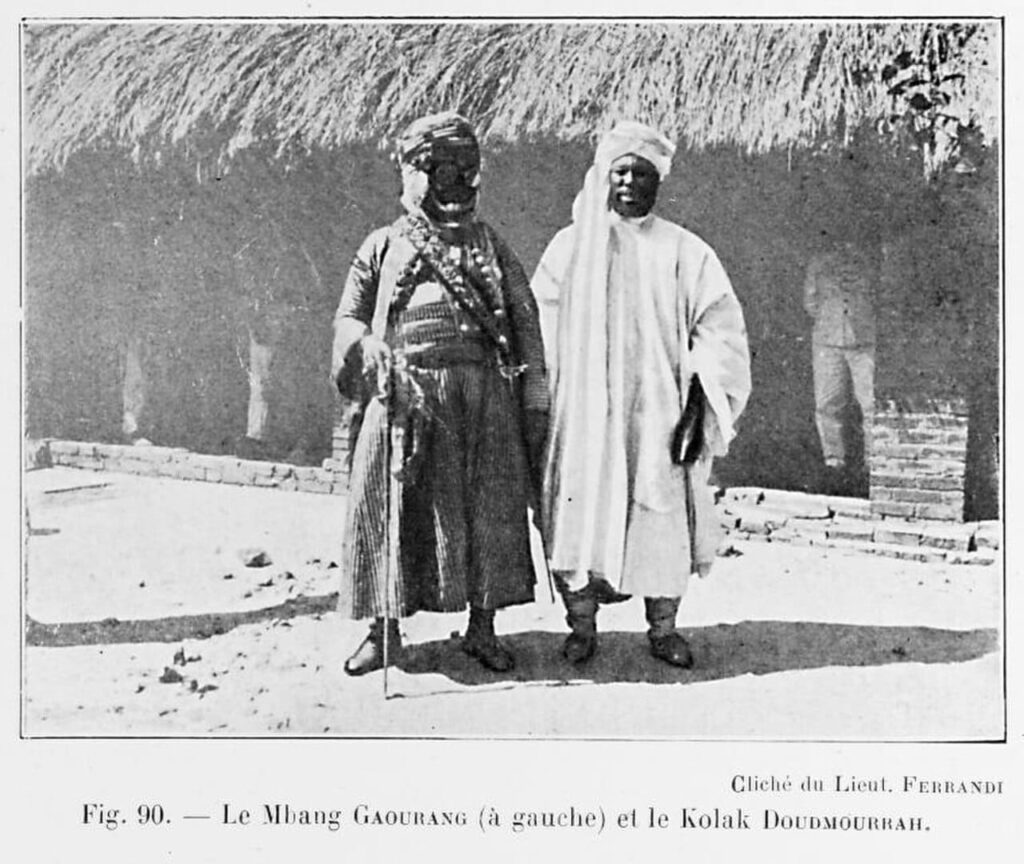
In 1893, his forces conquered Bagirmi and destroyed Massenya, forcing Mbang Abd ar-Rahman Gaourang II to flee.
Rabih’s conquest further weakened the sultanate and transformed the balance of power around Lake Chad. He went on to overthrow the ruling dynasty of Bornu and establish his headquarters at Dikwa.
Facing the loss of his kingdom, Gaourang sought military assistance from France, which was advancing into Central Africa as part of its imperial expansion.
In 1897, Gaourang signed a treaty placing Bagirmi under French protection.
The agreement allowed the mbang to seek French help against Rabih, but it also opened the way for the loss of Bagirmi’s sovereignty. France did not intervene out of concern for the survival of the sultanate. Its objective was to defeat regional resistance and extend colonial control across the Lake Chad Basin.
Fighting continued between Rabih’s forces, the French and their African allies. Rabih was eventually killed at the Battle of Kousséri in April 1900.
His death removed the strongest military obstacle to French expansion in the region.
French colonial rule
Following Rabih’s defeat, France consolidated its control over Bagirmi and the surrounding territories.
By 1902, the protectorate had been incorporated more firmly into the colonial administration that would become French Chad.
Bagirmi’s rulers retained limited ceremonial and local authority, but the sultanate ceased to exist as an independent state.
French officials redirected taxation, trade and political administration towards colonial priorities. Military posts and administrative centres increasingly replaced Massenya as the principal centres of power.
Colonial rule disrupted the political networks through which Bagirmi’s rulers had governed for centuries. It also subordinated local communities to a foreign state that redrew borders and reorganised the region without their consent.
The mbang survived as a traditional ruler, but his authority was subject to colonial approval and restriction.
After Chad gained independence in 1960, the status of the traditional sultanate continued to change under successive governments. The institution endured, however, and the title of mbang remains part of Bagirmi’s historical and cultural legacy.
An enduring Muslim legacy
The history of Bagirmi challenges the idea that Central Africa possessed no organised states, intellectual traditions or international connections before European colonisation.
For centuries, the sultanate governed a diverse population from Massenya, maintained diplomatic relations with neighbouring powers and participated in commercial networks reaching across the Sahara.
Its adoption of Islam placed Bagirmi within the broader Muslim world while allowing the kingdom to preserve its own political titles and social traditions. Yet its history should not be romanticised.
Bagirmi’s rulers built mosques, employed Muslim political and judicial traditions and supported a court connected to wider networks of Islamic culture. They also fought wars, extracted tribute and participated extensively in slave raiding.
The sultanate was repeatedly subjected by stronger Muslim neighbours before finally losing its sovereignty to French colonial rule.
Bagirmi’s importance lies in this complexity. It was neither an isolated African kingdom nor a simple extension of Arab or North African civilisation.
It was a Central African Muslim state shaped by the peoples, rivers and political struggles of the Lake Chad Basin.
Its story remains an essential chapter in the history of Islam in Africa — one that reveals how Islamic civilisation took root through local institutions and regional interaction, while also confronting the violence, rivalry and imperial conquest that shaped the continent’s past.
You can read more of One Nation Media’s Islamic civilisation and African history features here.