
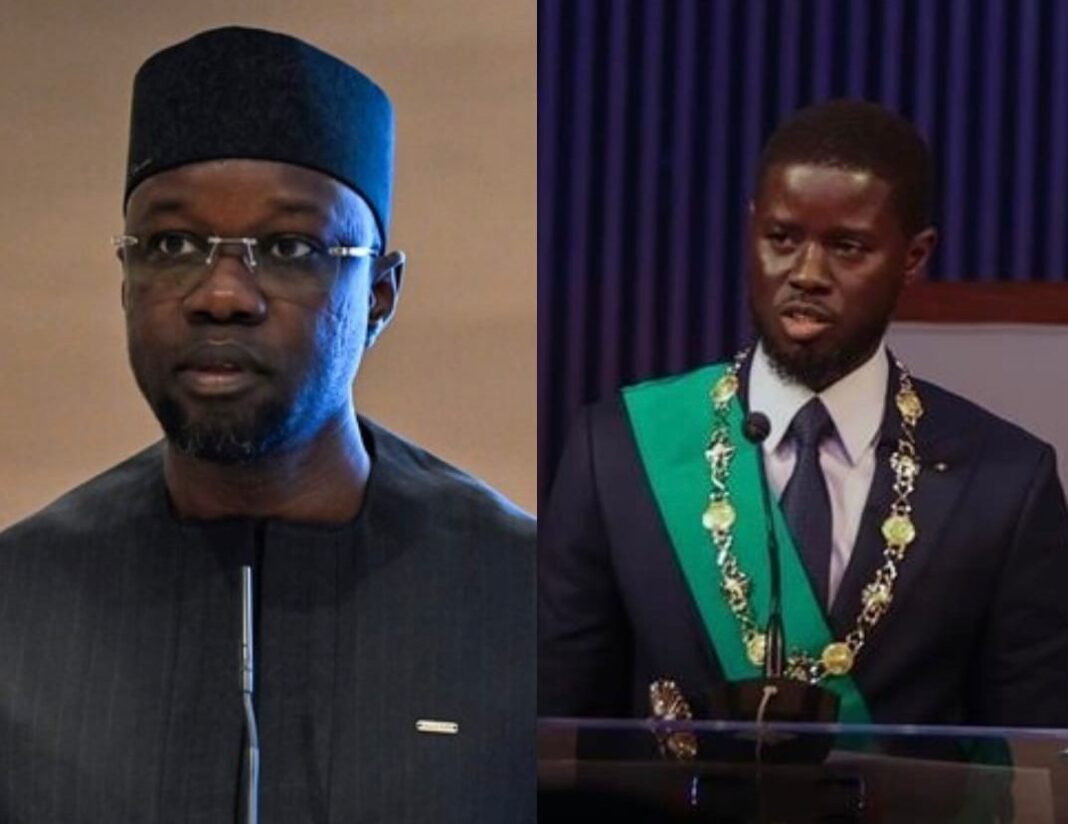

Senegal, long regarded as one of Africa’s most stable democracies, is facing growing tensions at the highest levels of government. Just over two years after Bassirou Diomaye Faye swept to power with the backing of Ousmane Sonko, the alliance that reshaped Senegalese politics appears to be fracturing in public view, Alassane Cisse reports for ONM.
A Muslim-majority country of around 19 million people, Senegal has avoided the coups and prolonged instability that have shaken several states across West Africa in recent years. Since independence from France in 1960, the country has had only five presidents and has built a reputation for democratic continuity, religious coexistence and political maturity.
That reputation is now being tested by mounting tensions between the two most powerful figures in the state.
Faye, a former tax inspector and senior figure within the PASTEF movement, was elected in March 2024 and sworn in the following month as Senegal’s youngest president after winning more than 54% of the vote in the first round.
His rise was closely tied to the popularity of Sonko, founder of PASTEF, who was barred from contesting the election and instead backed Faye as his preferred successor. Their political partnership inspired many Senegalese voters, particularly younger citizens frustrated with economic hardship, corruption allegations and the political establishment.
The Diomaye-Sonko partnership once symbolised a new political era for Senegal. Two years later, however, the alliance has evolved into an increasingly public power struggle, with both men signalling differences over governance, reform and political direction.
This is no longer simply a personal dispute between former allies. It has become a test of whether Senegal’s anti-establishment, sovereignty-focused political project can survive the pressures of power, debt, institutional rivalry and public expectation.
Sonko’s dismissal and parliamentary comeback
According to Senegalese political reporting, President Bassirou Diomaye Faye dismissed Ousmane Sonko as Prime Minister on May 22, 2026, and dissolved the government.
Four days later, the political landscape shifted dramatically when Sonko was elected President of the National Assembly, backed by 132 lawmakers despite an opposition boycott.
His election immediately restored him to one of the most influential positions in the Senegalese state and reinforced his continued political relevance despite his departure from government.
“A dismissal is not synonymous with political dishonour,” Sonko declared after his election.
Presenting himself as a figure with enduring “popular legitimacy”, Sonko said there would be no “blockage”, “personal vendetta” or “institutional chaos”, while also warning that parliament retained the constitutional tools necessary to exercise oversight over the executive branch.
His rapid transition from Prime Minister to Speaker of Parliament has introduced fresh uncertainty into Senegalese politics. The rivalry has now shifted from inside the executive to a possible confrontation between the presidency and a parliament led by Faye’s former ally.
Governance, reform and economic pressure
When Faye and Sonko entered office in 2024 under the slogan “Jub Jubal Jubbanti” — loosely translated as law, righteousness and redress — they promised sweeping institutional reform, greater transparency and a stronger assertion of national sovereignty.
Their administration moved quickly to launch financial audits, review public debt figures and renegotiate several strategic contracts in the oil, gas and mining sectors.
Supporters of the government point to the start of production at the Sangomar oil field, with projected production of around 100,000 barrels per day, as a major milestone in Senegal’s economic ambitions. Officials have also highlighted progress in the Greater Tortue Ahmeyim gas project shared with Mauritania.
But these economic ambitions are unfolding against a difficult financial backdrop. Senegal is facing a serious debt crisis, suspended IMF support and growing investor concern over the country’s fiscal direction. The split between Faye and Sonko has therefore become more than an internal political rupture. It is also a test of Senegal’s ability to manage economic pressure while maintaining political stability.
For many Senegalese, the dispute raises uncomfortable questions. Can the reformist project that swept PASTEF to power survive once its leading figures are divided? Can Senegal preserve its reputation for democratic maturity while its two most powerful politicians pull in different directions? And can a government elected on promises of sovereignty, justice and accountability deliver meaningful change while facing debt pressure, institutional tension and public impatience?
Senegal has long been seen as an exception in a region marked by coups, foreign interference and fragile state institutions. The coming months may determine whether that reputation endures, or whether the country’s new political era becomes consumed by the rivalry at its heart.