
By Mxolisi Ncube
Delegates from more than 30 countries gathered in Johannesburg for the 12th Southern Africa Ulama Forum (SAUF), bringing together local and international Muslim scholars to confront the challenges of preserving Islamic identity amid rapid social, political and technological change.
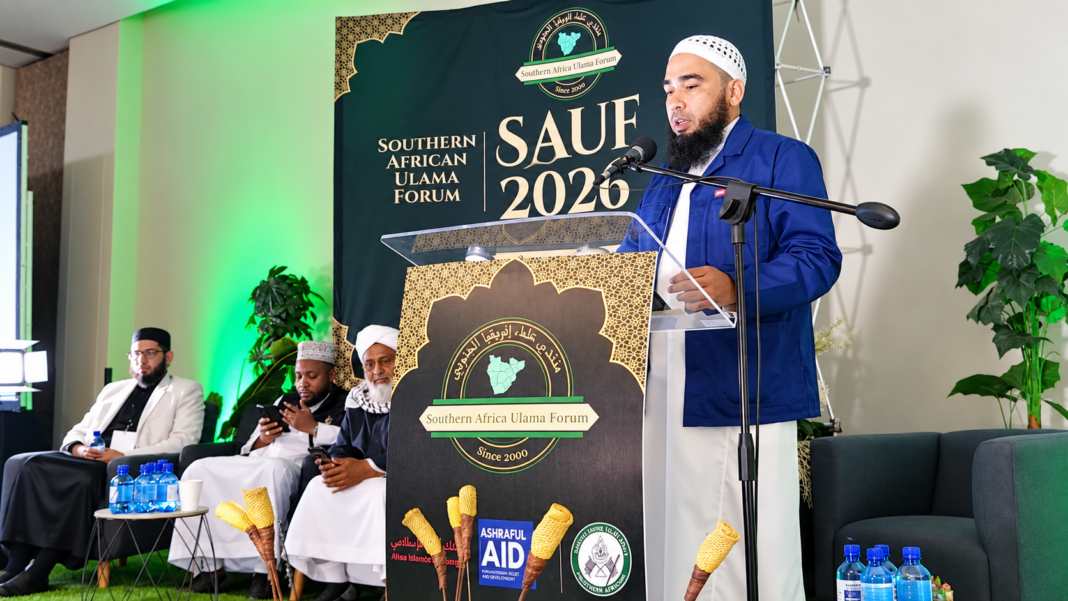
Hosted by Jamiatul Ulama South Africa and Ashraful Aid, the three-day gathering was held at the Lakewood Hotel Conference Centre from October 2–4, 2026.
Under the theme, “The Role of ‘Ulama in Preserving Islamic Identity in an Era of Rapid Social, Political and Technological Change”, the forum drew scholars from across Africa and beyond, including prominent international figures such as Sheikh Zahir Mahmood, Sheikh Dr Haitham al-Haddad and Mufti Shama’il Nadwi.
Organisers said the forum sought to equip scholars with the knowledge and strategies needed to communicate Islam to a new generation in a language and context young people understand, navigate modernity without compromising Islamic tradition and values, and preserve a clear Muslim identity within an increasingly secular global order.
Sessions addressed education, the role of the masjid, youth challenges, social issues, digital engagement and the future of Islamic scholarship.
Against this broader backdrop, one of the forum’s most closely watched discussions centred on Islam in Africa and the need to cultivate a confident, decolonised African Muslim identity.
A central panel on the second day featured Sheikh Abdur Raheem Nkomane, Maulana Salman Frederick and Maulana Ismail Moosa.
“Before we can speak about Islam in Africa, we must speak about Africa itself,” Nkomane told delegates.
He argued that centuries of imperialism and colonialism had produced distorted perceptions of the continent and its history.
“The one who tells the story always glorifies themselves,” he said.
Nkomane said colonial-era maps and modern media representations had contributed to misconceptions about Africa’s true scale, wealth and significance, frequently reducing the continent to images of poverty and underdevelopment.
He highlighted Africa’s enormous geographical size, vast natural resources and growing demographic significance, arguing that global powers increasingly recognise the continent’s strategic importance even as negative narratives about Africa persist.
Other scholars reinforced the importance of reclaiming Africa’s Islamic history.
Maulana Dawood Ndlovu of the Soweto Muslim Association welcomed the attention given to African Muslim scholarship and civilisation, highlighting figures and traditions associated with Sheikh Ibrahim Fadl, the Songhai Empire, Sheikh Ibrahim Nias and Sheikh Ahmad Bamba.
“Islam started in Africa and even the protection of Islam, as well as the security of Islam, was sought in Africa before it went elsewhere,” Ndlovu said.
He expressed hope that African Muslims would deepen their understanding of their religious heritage and ensure that relevant Islamic content reaches the next generation.
Speakers also reflected on Africa’s demographic trajectory, with the continent expected to account for roughly a quarter of the world’s population by 2050.
They called for a decolonial approach among African Muslims and pointed to the early relationship between Islam and the continent, recalling how companions of the Prophet Muhammad (SAW) migrated to Abyssinia, where they found justice, sanctuary and protection.
The forum also addressed wider challenges facing the Ummah, with sessions examining Muslim leadership in the digital age, the Muslim world at a crossroads and responses to the ongoing Zionist agenda.
Parallel tracks explored online learning, supporting learners with special needs, managing ideological differences in the masjid, youth apostasy and career guidance, modern addictions, mental health counselling for ulama, the future of udhiyah and the revival of the waqf system.
On the final day, attention turned to preparing the next generation of ulama, strengthening international scholarly collaboration and safeguarding the future of Islamic scholarship.
Throughout the gathering, speakers repeatedly stressed the need for cultural confidence among African Muslims.
They urged communities not to allow colonial narratives to define their understanding of themselves and argued that da’wah and Islamic education must be rooted in local languages, cultures and social realities.
“Let us enjoy the biryani, but we must also enjoy the pap,” Nkomane said, underscoring the need for Islamic outreach that feels authentic and accessible to African communities.
Maulana Ismail Moosa also returned to the classical understanding of the ulama as heirs of the prophets.
Because da’wah formed a central part of the prophetic mission, he argued, scholars must move beyond conferences and discussion towards practical service and community-level engagement.
The message emerging from the forum was clear: African and global Muslim communities must reclaim truthful narratives of their history, resist frameworks that diminish Africa’s scale and potential, cultivate cultural and religious confidence, and ensure the ulama lead through both scholarship and practical service.
In an era of rapid transformation, speakers argued, the preservation of Islamic identity will depend on historical clarity, confidence in Islam and leadership that remains rooted, relevant and engaged.