
An Islamophobic video mocking Islam could have deepened religious tensions in a Johannesburg community. Instead, Northcliff Masjid and Madressa chose an unexpected response: it invited the man behind the video through its doors, turning an act of hostility into an opportunity for dialogue, understanding and mutual respect.
In South Africa, Islamophobia does not always take the form of physical attacks or threats against mosques. It can also spread through social media, where videos mocking Islam and derogatory comments about Muslims can fuel prejudice and deepen divisions between communities.
At Northcliff Masjid and Madressa, the Muslim community decided to respond differently.
On Saturday, 19 September, the mosque opened its doors to people of all cultures, religions and backgrounds — not for a protest or a press statement, but for conversation.
The Open Day followed an incident in which a young Christian man, Daniel Theunissen, recorded a video at the masjid making derogatory statements about Islam.
Rather than allowing the incident to deepen divisions, Northcliff chose a different response: invite him in.
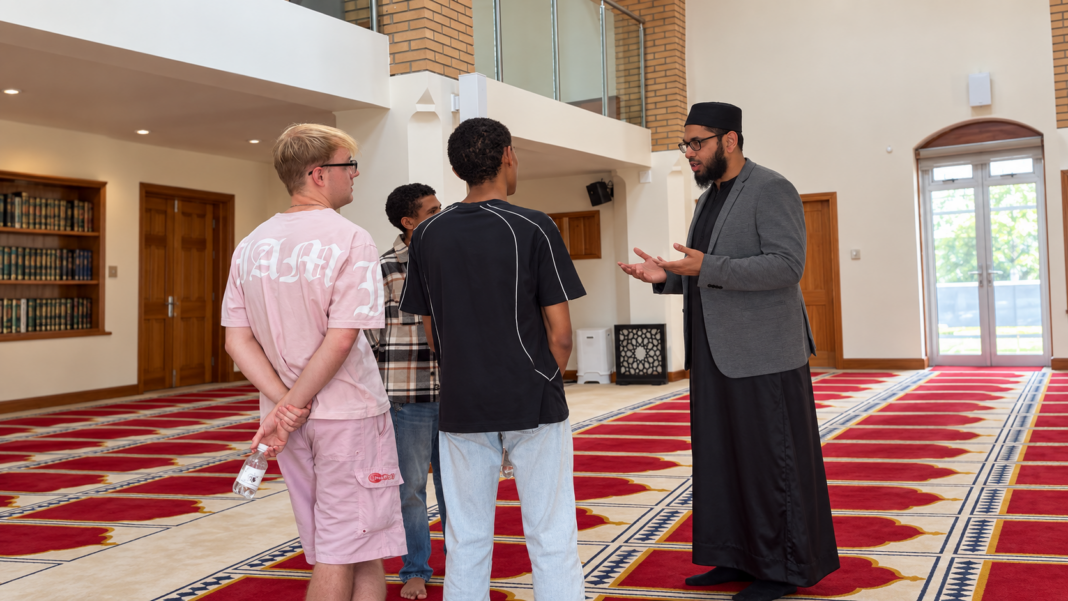
Theunissen accepted the invitation and attended the Open Day with two friends, Keenan and Ronaldo Otto. What they encountered was not anger or confrontation, but a warm welcome.
“It was positive, everyone welcoming and greeting and having nice debates and interesting discussions,” they told One Nation Media.
The encounter highlighted the importance of direct engagement in challenging religious prejudice. Misconceptions about Islam can persist when people have little opportunity to interact with Muslims, visit a mosque or ask questions about Islamic beliefs and practices.
For many, a mosque is a familiar building in their neighbourhood, yet what happens inside remains largely unknown.
Moulana Omar Bham, who hosted visitors, said that was precisely why the Open Day was needed.
“The Open Day allows people who have limited information regarding Islam to learn about Islam; they drive past the mosque but do not know what goes on in a mosque, clarify what Islam is about and see what Muslims do, and also have a better understanding of living with people of different religions in the community,” said Bham.
The programme introduced visitors to the fundamental beliefs of Islam, the purpose of a masjid and Islamic values, while directly addressing common misconceptions about the religion.
Medical screenings and hijab tutorials for women were also offered, demonstrating that a mosque is not only a place of worship but also an important centre of community life.
For visitors, the experience provided an opportunity to move beyond what they had encountered on social media and engage directly with Muslims.
“I’ve seen a lot of good things from the Islamic community and the Muslims as they have been treating us well,” said Ronaldo Otto.
He encouraged others to take the same step.
“I recommend visiting any local mosque and ask questions about what the Islamic religion is about because, at the end of the day, spirituality is a lot more important than what we think.”
For Theunissen, the experience reinforced the importance of dialogue and mutual respect between people of different faiths.
“It is important and valuable for Christians and Muslims to have one-on-one with one another, and it is important that we can respect each other even though we disagree.”
“There is a lot to learn, and I’ve learnt a lot,” added Otto.
The Open Day provided a space for visitors to engage directly with Muslims, Moulanas, Sheikhs and Imams, and have their questions answered in what organisers described as a friendly and respectful environment.
Beyond addressing misconceptions, the initiative highlighted Islam’s emphasis on human dignity, respect and the equality of people regardless of their racial or cultural backgrounds.
“Each and every person is welcome in Islam, and there is no racism in Islam, and the difference or the clear-cut among all of us as individuals is our closeness to Allah,” said Bham.
The message from Northcliff extends beyond one mosque or one Johannesburg suburb.
At a time when Islamophobic content can spread rapidly across social media, the masjid demonstrated how direct engagement can challenge prejudice and create opportunities for greater understanding between religious communities.
What began with a video mocking Islam ended with the man behind it walking through the doors of the very mosque he had targeted — not as an adversary, but as a welcomed guest.