
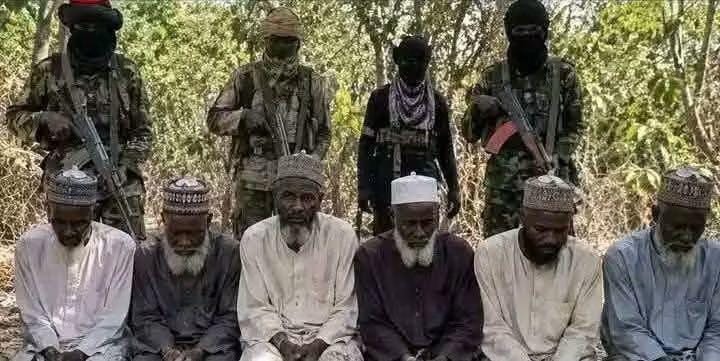

A picture has been released of six Nigerian Muslim clerics abducted earlier this month in Zamfara State by suspected bandits who have demanded a ransom ₦30 million (R367000) for their release. Their abduction has intensified concerns over the security crisis gripping Nigeria’s north-west, where kidnapping for ransom remains a persistent threat to rural communities, travellers and religious leaders.
The clerics were reportedly abducted along the Dakko–Damri feeder road in Bakura Local Government Area on 12 September, while travelling towards Talata Mafara. The Zamfara State Police Command confirmed that six imams were intercepted by armed men at approximately 11:30 am and said security agencies had launched a search-and-rescue operation.
The latest ransom demand was reported by residents and relatives of the victims. According to community sources, two people returning from their farms were subsequently released after their families reportedly paid ₦300,000 each and provided two 25-litre containers of petrol. The driver travelling with the clerics was also released after his family reportedly paid ₦2 million.
The six Islamic clerics remain in captivity, with their families attempting to raise the ₦30 million demanded for their release.
The abducted clerics have been identified as Malam Muhammadu Shehu, Chief Imam of Dakko Juma’at Mosque; Malam Murtala Dakko, his deputy; Malam Muhammad Yahuza, Chief Imam of Dogon Madacci First Juma’at Mosque; Malam Magawata Abdullahi, Chief Imam of Dogon Madacci Second Juma’at Mosque; Malam Bala Hogun, Chief Imam of Hogun Juma’at Mosque; and Malam Muhammad Tasi’u, Chief Imam of Kwatsama Juma’at Mosque.
The clerics were reportedly travelling to Talata Mafara for a gathering associated with former Zamfara governor and serving Senator Abdul’aziz Yari. Thousands of Islamic scholars had reportedly been invited to the event, which included prayers for peace and support for President Bola Tinubu’s 2027 re-election bid.
However, Nigerian security authorities have sought to correct reports suggesting that the clerics were kidnapped at Yari’s residence.
The Nigerian Army said no cleric was abducted at the senator’s home, stating that the victims were intercepted while travelling from the Sububu forest axis in Bakura towards Talata Mafara.
The clarification places the incident within the wider pattern of highway and rural-road kidnappings, rather than an attack directly targeting the gathering itself.
A growing ransom economy
The case also illustrates how Nigeria’s ransom economy operates at several levels. A single attack can result in different ransom demands for different victims, with smaller payments securing the release of some captives while substantially larger sums are demanded for others.
For families in impoverished rural communities, even comparatively modest ransom payments can represent an enormous financial burden.
Zamfara remains one of the states most affected by armed-bandit activity in north-western Nigeria. Criminal groups have exploited vast forests and difficult terrain to establish hideouts, launch attacks and abduct residents and travellers.
Security forces have conducted military and police operations against these groups, but recurring kidnappings highlight the difficulty of providing continuous protection across remote communities and feeder roads.
For the six clerics’ families, however, the broader security debate is secondary to the immediate question of survival. Their relatives are reportedly attempting to raise the ransom while security agencies continue efforts to locate them.
The incident presents a painful contradiction: religious leaders travelling to a gathering centred on prayer and peace became victims of the very insecurity that has destabilised communities across Zamfara.
Until authorities can consistently secure rural roads and disrupt the criminal networks operating in the region, ransom demands such as the ₦30 million sought for the six clerics will continue to place families under immense financial and emotional strain.