
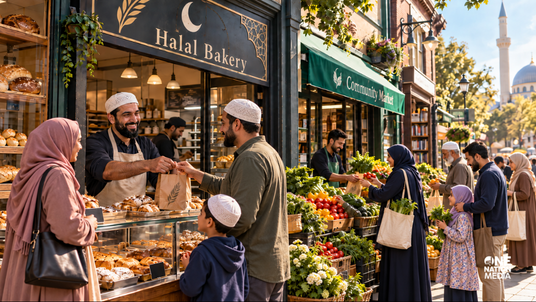

Every rand we spend is more than a transaction. It is a choice about whose business we help grow, whose livelihood we support and which causes our money may ultimately serve. For Muslims, supporting Muslim-owned businesses is not about economic isolation or turning away from others. It is about recognising the power of everyday spending to strengthen the Ummah, create halal livelihoods and build communities rooted in justice, fairness and shared prosperity.
Allah commands believers to “cooperate in righteousness and piety” and not to cooperate in sin and transgression (Qur’an 5:2). This principle extends beyond charity alone. The money we spend every day can help another person build a livelihood, employ someone, support a family or contribute towards something beneficial.
For Muslims, this raises an important question: if two businesses offer similar products at similar prices, but one purchase could also strengthen a Muslim entrepreneur, create halal livelihoods or support a beneficial cause, should that matter?
It should. But supporting Muslim-owned businesses should never mean that Muslims must only buy from Muslims
Islam does not teach economic isolation
There is nothing inherently wrong with purchasing lawful goods or services from a non-Muslim business. In fact, the life of the Prophet Muhammad (SAW) makes this particularly clear.
Aisha (RA) narrated that the Prophet (SAW) purchased food from a Jewish merchant on credit and gave his armour as security for the transaction. The incident is recorded in Sahih al-Bukhari.
This example matters because it prevents the conversation about supporting Muslim businesses from becoming tribal. Islam does not prohibit Muslims from participating in the wider marketplace. What matters is whether the product, service and transaction are permissible, and whether our dealings are honest and just.
A Muslim can therefore support a trustworthy non-Muslim-owned restaurant, shop, designer, mechanic or other business offering lawful products and services. Supporting good businesses, regardless of who owns them, can contribute towards employment, innovation and stronger communities.
At the same time, there is nothing wrong with recognising that strengthening Muslim entrepreneurship has particular benefits for the Ummah.
A purchase can become an investment in a community
Small businesses are significant economic actors. According to the World Bank, micro, small and medium-sized enterprises account for a large proportion of businesses in developing economies and provide around seven out of every ten formal jobs in emerging markets.
That gives everyday spending greater significance.
A Muslim-owned bakery that gains another hundred regular customers may eventually need another baker. A growing modest-fashion business might hire a photographer, designer, courier or social media manager. A successful local restaurant can employ cooks, waiters and cleaners.
Money circulating through productive businesses becomes salaries, supplier payments and new opportunities.
For Muslim communities, successful businesses can also make halal products and services easier to access. They can provide Muslim professionals with opportunities to work in environments that accommodate their religious obligations, while successful entrepreneurs are often better positioned to contribute towards local charities, mosques, schools and humanitarian projects.
Supporting these businesses does not mean overlooking high prices, poor quality or inadequate service simply because the owner is Muslim. Muslim entrepreneurs themselves should be held to Islamic standards of honesty, quality and fair dealing.
Support should strengthen excellence, not excuse mediocrity.
Choosing the better alternative
Perhaps the clearest example of conscious spending is when consumers have two comparable choices in front of them.
Consider a Muslim who normally buys Coca-Cola but finds Palestine Cola available alongside it.
Palestine Cola was launched in Sweden in 2024 by Palestinian brothers who wanted to create an alternative to major soft-drink brands amid consumer boycotts linked to the war in Gaza. The founders have said that profits are intended to support humanitarian and rebuilding initiatives for Palestinians.
Coca-Cola, meanwhile, has become an organised boycott target among some pro-Palestinian campaigners. The Palestinian-led Boycott, Divestment and Sanctions (BDS) movement has listed Coca-Cola among what it describes as grassroots or “organic” boycott targets and has endorsed campaigns calling for consumers to choose alternatives.
This does not mean Islam has declared Coca-Cola itself haram. That is an important distinction.
Rather, it illustrates a broader way of thinking about consumption.
If a consumer has a reasonable alternative that satisfies the same need while also supporting an independent business and a cause they believe is more consistent with justice, choosing that alternative can give an ordinary purchase a wider purpose.
The same thinking can apply far beyond soft drinks.
Instead of automatically reaching for the largest multinational brand, Muslims can ask: Is there a local alternative? Is there a small business producing the same thing? Is there a Muslim entrepreneur I already know whose product is equally good? Which company treats people responsibly? Where will my money do the most good?
That does not require investigating every loaf of bread or cup of coffee before purchasing it. It simply means becoming more conscious of the economic consequences of our spending habits.
Supporting one another without shutting others out
The goal, then, is not to create an economy in which Muslims trade only with Muslims.
The Sunnah itself shows otherwise.
The broader principle is that Muslims should participate confidently and ethically in society while recognising opportunities to uplift one another.
If a Muslim-owned business provides a good product at a fair price, there is value in supporting it. If a non-Muslim-owned business provides something beneficial, lawful and ethical, there is no contradiction in supporting that business too.
Islamic economic consciousness is therefore broader than the identity of the person behind the counter.
It asks whether wealth is being earned lawfully, whether people are being treated fairly and whether our spending contributes towards benefit rather than harm.
Supporting Muslim-owned businesses is one part of that responsibility — not because Muslims are the only people deserving of our trade, but because an economically stronger Ummah is better able to create employment, sustain families, establish institutions, give charity and serve society as a whole.
Our purchases may appear small. Collectively, they determine which businesses grow, which ideas survive and where economic power eventually lies.
Sometimes, supporting the community begins with something as ordinary as deciding where to shop.