
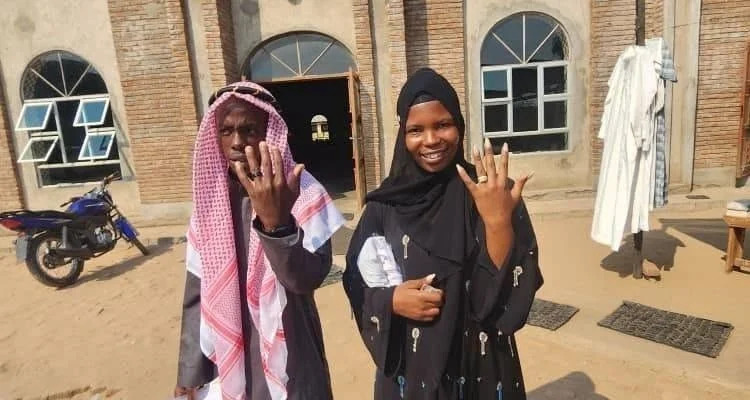

It is a poignant story of a South African woman’s journey from displacement to Shahadah — and a nikah that a Muslim community in Mangochi, Malawi, says it had been waiting to celebrate.
When Abdul Rasheed Kamanika packed up his life in South Africa in recent months, he was not fleeing a natural disaster or economic collapse. He was fleeing an increasingly hostile climate fuelled by xenophobia that has once again left African migrants facing a stark choice between an uncertain life in South Africa and returning to their countries of origin. But he did not leave alone.
Beside him was his partner, Nokwazi, a South African woman who chose to leave her own country behind and follow him to Malawi.
What might have become simply another story of displacement has, in Mangochi, become something very different: a story of Shahadah, nikah and a Muslim community that says it never treated the couple as strangers. Abdul Rasheed’s ties to Mangochi run deep.
Sheikh Mussa Saidan, Imam of Mangochi Main Masjid and treasurer of the Ulama Council of Malawi, recalls the young man — then known as Precious Kamanika and raised in a Christian family in the village of Chisawa arriving at his office with his sister in 2015 to embrace Islam.
Both took new names that day. Precious became Abdul Rasheed, while his sister Chrissy became Shakira. A younger brother would later follow them into Islam.
“We regard him as our own son,” Sheikh Mussa says of the Mangochi Muslim community’s relationship with Abdul Rasheed, who grew into his faith among them before economic necessity took him across the border to South Africa in search of work.
It was the recent wave of xenophobia that brought him home again — this time with Nokwazi by his side.
A journey to Islam
According to Sheikh Mussa, Nokwazi’s path to Islam did not begin through formal preaching or theological debate, but through witnessing the quiet, everyday da’wah of a community simply living its faith.
Mangochi, he explains, has a Muslim population of around 72%, where the rhythm of the five daily prayers, modest dress and open discussion of faith forms part of ordinary life.
In many ways, her journey mirrors Abdul Rasheed’s own nearly a decade earlier.
For him, moving into that same community and observing his friends fasting, praying and practising Islam — rather than merely professing it — was what first moved him towards the faith.
Sheikh Mussa points to a principle he considers central to the Islamic understanding of da’wah: that Muslims sincerely and visibly practising their deen can draw others towards Islam even without a formal invitation.
The Qur’an describes the believers as “the best community brought forth for mankind” (Surah Aal-Imran, 3:110), a community expected to embody goodness in the world around it.
By Sheikh Mussa’s account, Nokwazi was drawn towards Islam by what she witnessed: women in hijab whom he described as embodying modesty and dignity, and a community in which Islam was lived rather than merely spoken about.
Last Friday, Nokwazi recited the Shahadah.
Two days later, on Sunday, she and Abdul Rasheed were married in a nikah ceremony at Mangochi Main Masjid, officiated by Sheikh Mussa alongside fellow scholars from the Ulama Council of Malawi.
Rebuilding from nothing
The couple returned to Malawi, in Sheikh Mussa’s words, “empty-handed”, having left behind their home, possessions and former life in South Africa.
What followed was not simply sympathy, but practical solidarity.
Mangochi’s Muslim leadership contributed two million Malawian kwacha towards helping the newlyweds rebuild their lives, while individual members of the community have continued to give sadaqah — some anonymously — to help the couple establish a new home.
This, too, sits within a clear Islamic framework.
The Prophet Muhammad ﷺ said: “The believers, in their mutual love, mercy and compassion, are like one body; when a limb suffers, the whole body responds with wakefulness and fever.” (Sahih Muslim)
For Sheikh Mussa, supporting Abdul Rasheed and Nokwazi was simply an extension of that principle. They were not viewed as outsiders in need of charity, but as members of a community being helped back onto their feet.
One nation, One Ummah
Perhaps the most striking thread running through Sheikh Mussa’s reflections is his refusal to view the couple’s story through a narrow national lens.
He points to the long and intertwined histories of Malawi, Zambia, Zimbabwe and South Africa — countries whose people have crossed borders, married one another and built families across the region for generations.
He invokes the marriage of former South African President Nelson Mandela to Graça Machel, the widow of Mozambique’s first president, as one example of a continent interconnected in ways that long predate the colonial borders that now determine who is considered a foreigner.
It is a sentiment that echoes the Prophet Muhammad’s ﷺ famous declaration during his final sermon that no Arab is superior to a non-Arab, nor a non-Arab to an Arab, and that no racial superiority exists except through piety and righteous deeds.
Within that Islamic understanding, nationality and race do not determine the worth of a human being, nor should they determine the legitimacy of who a person chooses to marry and build a family with.
On the xenophobia that displaced Abdul Rasheed and Nokwazi in the first place, Sheikh Mussa is unequivocal.
“We totally condemn the way our brothers have been treated there,” he says.
While acknowledging that states have immigration laws and documentation requirements, he insists that this cannot justify mistreatment and says even properly documented Malawians have felt compelled to return home.
His position echoes the Qur’anic command: “Be just; that is nearer to righteousness.” (Surah Al-Ma’idah, 5:8)
Justice, within the Islamic ethical tradition, is not conditional upon race, nationality or citizenship.
Asked what the couple’s story says about love and faith, Sheikh Mussa returns to the same conviction: that the strength of the Muslim Ummah is built family by family, and that geography should not be allowed to determine the limits of Muslim brotherhood and human relationships.
“Let borders not give us borders to our relationships,” he says.
“This should give us a lesson that if our love is for the sake of Allah, we can be settled elsewhere as long as we believe that we will build a good Muslim family.”
For Nokwazi and Abdul Rasheed, a period of upheaval and displacement has, for now, ended with a Shahadah, a nikah and a community in Mangochi that says it has simply welcomed home two more members of its family.
No longer a foreigner and a returnee, but husband and wife — and fellow believers.
This account draws on an interview with Sheikh Mussa Saidan, Imam of Mangochi Main Masjid and treasurer of the Ulama Council of Malawi.