
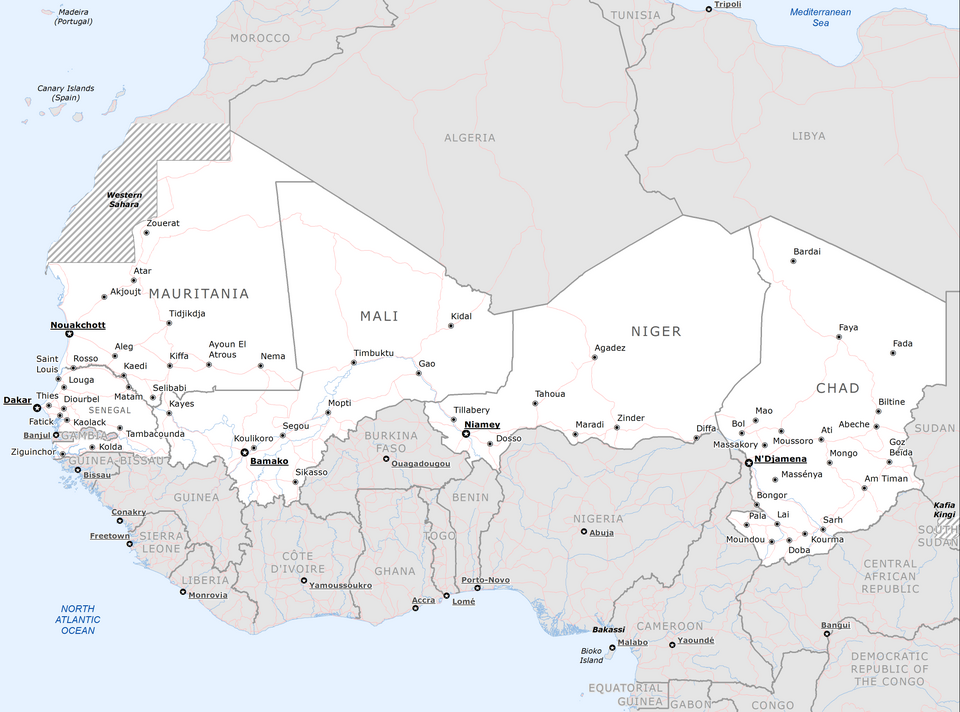

Kidnapping for ransom has become an increasingly important source of funding for religious armed groups across the Sahel, particularly within the Alliance of Sahel States (AES).
A growing number of foreign abductions, coupled with the substantial sums reportedly demanded or paid for hostage releases, points to the emergence of a lucrative captivity economy stretching across Mali, Burkina Faso and Niger.
One of the most striking cases involves a reported ransom of around $50 million linked to the release of hostages in late 2025.
According to information reportedly presented to the United Nations Sanctions Committee, most of the money was intended for fighters operating in the Sahel, while a portion was allegedly distributed to other Al-Qaeda structures, including Al-Qaeda in the Islamic Maghreb (AQIM), Al-Qaeda in the Arabian Peninsula (AQAP) and the organisation’s central leadership.
Security sources in Mali have claimed that Abu Dhabi was behind the $50 million payment to secure the release of Joumoua bin Maktoum Al Maktoum, described as a retired Emirati general and member of Dubai’s ruling family who was involved in business activities in Mali, alongside two other foreign nationals from Iran and Pakistan.
Funds generated through hostage-taking are believed to support fighter salaries, weapons and equipment purchases, movement across territory, intelligence networks and the wider logistical infrastructure of armed groups.
A growing ransom economy
The reported $50 million payment is part of a wider pattern of kidnappings across Mali and neighbouring AES states.
Over the past two years, Jama’at Nusrat al-Islam wal-Muslimin (JNIM) has intensified kidnappings for ransom, with foreign nationals among its most valuable targets.
More than 20 foreigners are believed to have been abducted in and around Bamako and southern Mali, according to diplomatic sources, with several cases reportedly ending in significant ransom payments.
Among the most recent cases is American national Kevin Rideout, who was kidnapped in Niger in October 2025 before being transferred to Mali.
He was released in August 2026 following negotiations reportedly involving Algerian authorities, with some sources citing a ransom figure of $12 million.
Indian-born businessman Dhiru Ramani, 75, was also abducted in Mali after becoming involved in the acquisition of a gold mine.
He was released in July 2026 after almost three months in captivity, with several sources claiming that his family paid around €4 million for his release.
Three Egyptian nationals were also reportedly kidnapped in Mali by JNIM in October 2025, with the group allegedly demanding around $5.8 million before they were freed.
Criminal groups enter the hostage trade
The kidnapping economy is not confined to armed religious insurgents.
The case of Sinan Ulumaskan, a German national of Turkish origin, illustrates how criminal groups can also exploit foreign hostages for profit.
Ulumaskan was kidnapped in Niger in July 2026 while travelling there to purchase gold and was reportedly held for around two weeks by an armed criminal group.
His captors allegedly demanded €2 million from his family and, according to reports, threatened to transfer him to Islamic State in the Greater Sahara (ISGS) if negotiations failed.
He was eventually transferred into Algerian custody on 7 August 2026 following mediation involving Mohamed Mehri, also known as “Rougi”, an intermediary reported to have links to both security and insurgent networks in the Sahel.
Mehri’s name had also previously surfaced in connection with the hostage-release case involving the reported $50 million ransom.
The case underlines a broader concern: criminal gangs can kidnap foreign nationals themselves and then potentially sell or transfer them to armed religuous if direct ransom negotiations fail.
Hostages still in captivity
Several foreign nationals remain in captivity across the Sahel.
Among the most sensitive cases are Austrian national Eva Gretzmacher and Swiss national Claudia Abbt, who were kidnapped in Agadez, northern Niger, in 2025 and are reportedly being held by the Sahelian branch of Islamic State.
Gretzmacher’s condition is said to have deteriorated significantly during her prolonged captivity.
According to an intelligence source from an AES country, her captors have reduced an initial $5 million ransom demand to what has been described as a “symbolic” sum amid fears that she could die before an agreement is reached.
Sources familiar with the case say Austrian and Swiss authorities have since increased cooperation in efforts to secure the release of both women.
More than ransom payments
Foreign nationals remain especially attractive targets because their families, employers or governments may be capable of mobilising substantial sums.
Businesspeople, investors, aid workers, missionaries and those working in the mining sector can therefore become particularly lucrative hostages.
But the same coercive economy also affects local populations.
Communities across parts of the Sahel face kidnappings, forced levies, extortion and threats designed to raise revenue while reinforcing the authority of armed groups over territory.
Kidnapping for ransom is therefore only one element of a much wider underground economy built around coercion, taxation and control.
The cross-border nature of the trade also complicates efforts to dismantle it.
A hostage can be seized in Niger, transferred into Mali, held in territory controlled by an armed group and become the subject of negotiations involving intermediaries, governments and intelligence services across several countries.
The total amount collected through ransom payments remains impossible to establish with certainty.
However, individual figures reported in recent cases — $50 million, $12 million, $5.8 million, €4 million and a separate €2 million demand — indicate the potentially enormous financial value of hostage-taking.
The danger extends far beyond the ransom itself.
Money paid for a hostage’s release can ultimately be redirected into fighter salaries, weapons, intelligence gathering, transport, logistics and future operations.
In a region where religious insurgencies already exploit weak borders, remote terrain and fragile state control, every successful kidnapping risks becoming both a financial windfall and an incentive for the next one.


