
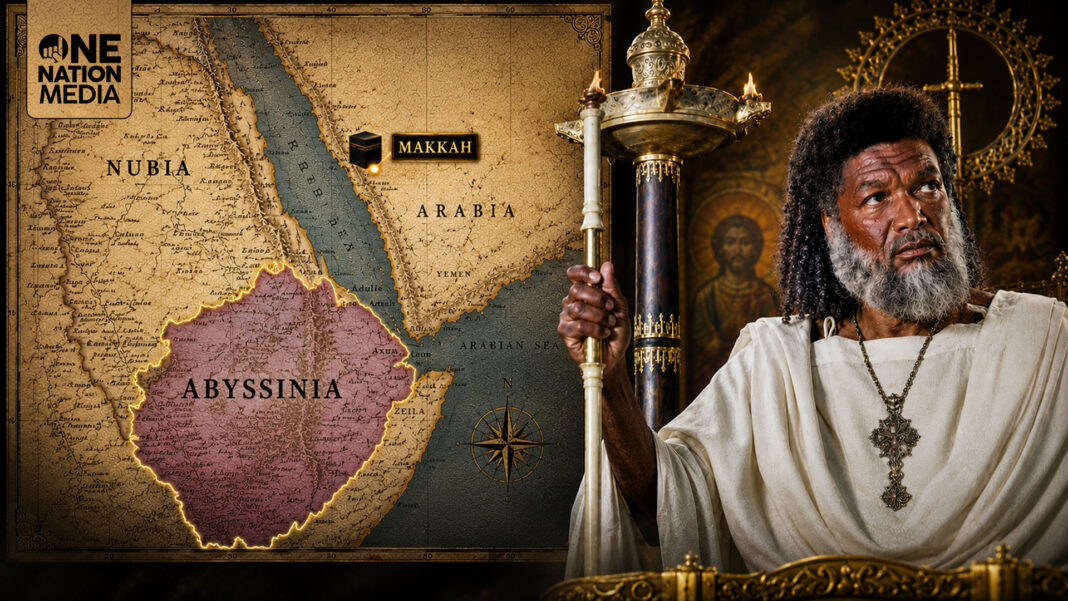

Around eight years before Madinah became the centre of the first Muslim polity, Islam’s first sanctuary was found across the Red Sea in Africa, writes Neelam Rahim.
In one of the earliest and most defining episodes of Islamic history, the persecuted Muslims of Makkah found protection in Abyssinia, modern-day Ethiopia, under King Najashi (Ashama ibn Abjar), an African Christian ruler remembered for his justice. The First Hijrah was not simply a migration for safety; it was an early test of faith, diplomacy and survival for a vulnerable Muslim community facing persecution at home.
The migration took place around 615 CE, at a time when the early Muslims were facing severe oppression in Makkah. Converts to Islam were harassed, tortured, socially isolated and stripped of tribal protection. It was in this context that the Prophet Muhammad (SAW) instructed a group of his companions (RA) to seek refuge in Abyssinia, describing it as a land ruled by a king “under whom none are wronged.” [Ibn Ishaq/Ibn Hisham] This was both a search for safety and a strategic effort to preserve the Muslim community while it was still small, exposed and politically vulnerable.
The first group to migrate included notable companions such as Uthman ibn Affan (RA) and Ruqayyah (RA), the daughter of the Prophet (SAW). A second and larger group later followed, led by Ja’far ibn Abi Talib (RA), the Prophet’s (SAW) cousin. Historical reports indicate that around 80 men, along with several women, eventually settled temporarily in Abyssinia under Najashi’s protection.
The court of Najashi
When the Quraysh learned that the Muslims had found refuge under one of their key trading allies, they sent emissaries to the Abyssinian court with gifts, demanding their return to Makkah. Among them was Amr ibn al-As (RA), who had not yet accepted Islam.
Their aim was to persuade Najashi to extradite the Muslims and return them to persecution. But Najashi refused to decide without hearing directly from the refugees themselves. Ja’far (RA) was then summoned to the court. In his famous address, he described the condition of pre-Islamic Arabia and the transformation brought by Islam.
He said: “O King, we were a people in ignorance, worshipping idols, eating dead animals, committing immoral acts, breaking ties of kinship, and the strong among us exploited the weak. Then Allah sent to us a Messenger from among ourselves whose lineage, truthfulness, trustworthiness and chastity were known to us.” [Musnad Ahmed]
Ja’far (RA) went on to explain that Islam called people to the worship of one God, honesty, charity, moral reform, protection of the weak and the abandonment of oppression.
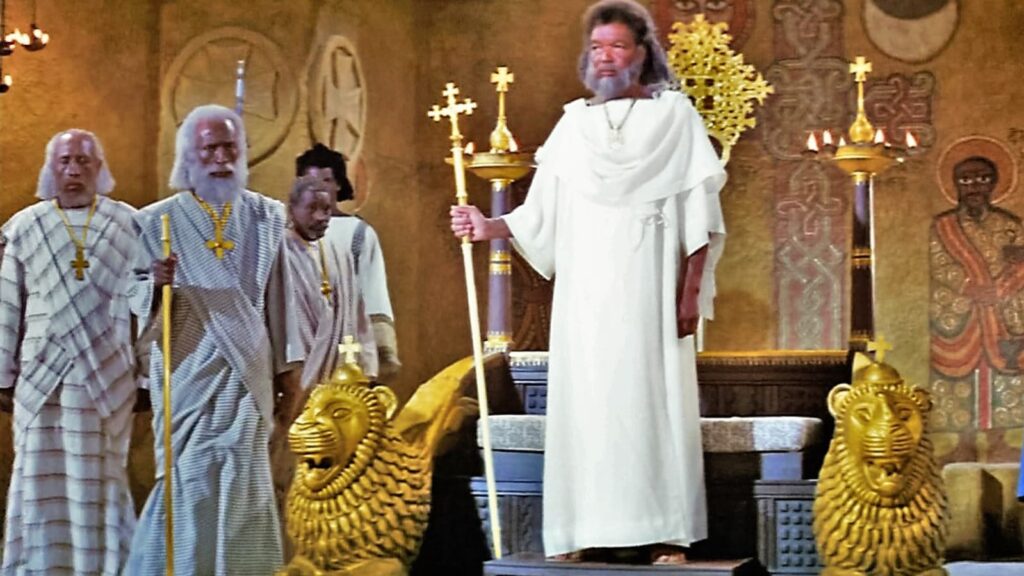
Ja’far’s defence of Islam
Najashi then asked Ja’far (RA) what Muslims believed about Prophet Isa (AS) and his mother Maryam (AS). In response, Ja’far (RA) recited verses from Surah Maryam, beginning with the account of Maryam withdrawing from her family to a place in the east.
The recitation continued with the story of the Angel Jibreel, the miraculous birth of Isa and the suffering of Maryam during childbirth. Islamic narrations report that Najashi and the bishops in his court were moved to tears, recognising the spiritual closeness between the message of Prophet Isa (Jesus) and the message of Islam.
Najashi is reported to have said that the light brought by Isa (AS) and the light brought by Muhammad (SAW) came from the same divine source. He then rejected the demands of the Quraysh emissaries, returned their gifts and declared that the Muslims would remain under his protection.
Najashi’s justice and legacy
This episode established Abyssinia as the first land to offer formal refuge to Muslims. It also highlighted a powerful historical reality: Islam’s early survival was not confined to Arabia. It was also shaped by Africa, where a Christian ruler protected a persecuted Muslim minority at political and economic risk to himself.
The Prophet (SAW) later sent a letter to Najashi inviting him to Islam. Historical accounts indicate that Najashi accepted Islam, though he is believed to have concealed his faith within his court to preserve political stability in his kingdom.
When Najashi later died, the Prophet (SAW) informed his companions in Madinah and performed Salat al-Gha’ib, the funeral prayer in absence, for him. Many scholars cite this rare honour as evidence of Najashi’s Islam.
But Najashi’s legacy extends beyond debates of historical detail. He represents moral courage in the face of political pressure. He chose justice over alliance, principle over expediency, and humanity over diplomatic convenience. He did not share the faith of the Muslims when they first arrived, yet he upheld their right to safety, dignity and protection.
The First Hijrah was therefore not only an escape from persecution. It was an early step in the preservation of Islam as a lived community beyond Makkah.
The Prophet (SAW) did not send the Muslims to Abyssinia merely because it was ruled by a just king. He sent them because it offered the possibility for Islam to survive, for worship to continue freely and for a persecuted community to find stability beyond the reach of Quraysh oppression.
In this sense, the road to Islam’s preservation first passed through Africa. And at its centre stood an African Christian ruler whose justice became one of the earliest safeguards of the Muslim community at its most vulnerable moment.
You can read more of One Nation Media’s Islamic civilisation and African history features here.



Hamdulilla
For completeness , reference ought to be made to Najashi’s subsequent embracing of Islam