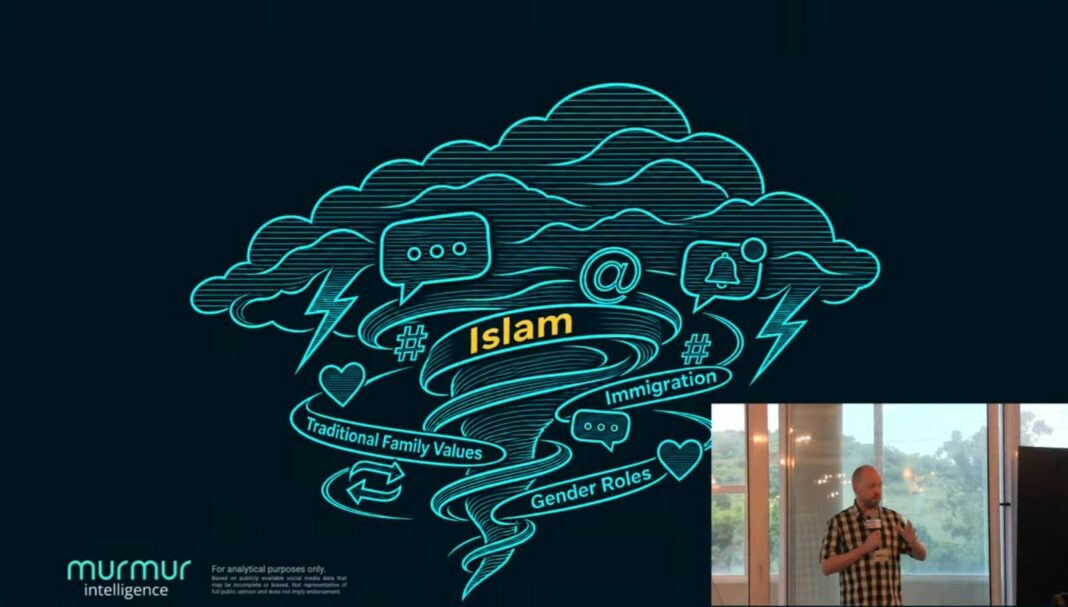

In the same week that South Africa celebrated the University of Cape Town honouring Gift of the Givers’ founder Dr Imtiaz Sooliman, the internet did what it does best — it turned on the very organisation he built. One timeline was full of pride. The other was full of poison. At a national symposium on “Who Benefits from Fear and Hate?”, organised by the United Ulama Council of South Africa (UUCSA), researcher Kyle Findley of Murmur Intelligence put those two reactions side by side.
What he found tells a much bigger story about who gets to define Muslim life in South Africa and why a small, vocal minority of accounts can end up shouting louder than the whole country.
The presentation tracked public online conversations from 1 August 2024 to 31 July 2026. Its clearest finding was how concentrated the conversation on X was. A single cluster, which researchers called “Global Right & Iran Monarchy Opposition”, accounted for 14% of users and 41% of posts in the X network they mapped. South African users picked up and adapted arguments from prominent overseas accounts, drawing international disputes over Iran, Gaza, migration and religious dress into local discussions about Islam.
That imbalance matters because X supplied most of the material in the study. Across the seven themes tracked, agreement with narratives that presented Islam positively fell over the two years, a trend the researchers attributed largely to X. Facebook, TikTok and online news generally leaned towards agreement with those narratives, while online forums leaned towards disagreement. Some platforms yielded far less material than X.
The figures show how a message can dominate the online conversation the researchers captured. The study leaves open the questions of how widely South Africans share those views offline and whether the most active accounts were acting in concert.
Where Islamophobia meets xenophobia
Findley’s report says imported arguments gain traction when they attach themselves to existing fears. In one South African anti-foreigner cluster on X, the report found discussions of Islam alongside references to Boko Haram, ISIS and crime, as well as threads about immigration that invoked Gaza and Gift of the Givers. Put those topics together often enough and the insinuation starts to do the work. A person’s faith becomes a reason to question their loyalties, and a migrant’s nationality becomes a reason to suspect wrongdoing.
The same logic puts South Africans who stand with Palestine on the defensive. Findley’s presentation found that the legitimacy of Palestinian advocacy was among the issues that divided online audiences. For many Muslims, standing with Palestinians is a matter of faith and justice. So is rejecting antisemitism. Those commitments can be held together, even as advocates insist on the right to speak plainly about Palestinian suffering and to demand accountability from Israel’s government.
The South Africa the feed can miss
The strongest common ground in the study was the contribution Muslims make to South African life. The presentation points to mosques providing welfare and education, Muslim charities serving the public, Cape Muslim heritage and the economic contribution of the halal sector. That is a fuller picture of a community whose faith is lived in daily worship, in work and in service to neighbours. Those contributions are part of South Africa’s story, and Muslims have a right to belong regardless of whether anyone applauds their work.
There is room for hard questions about how any institution raises money, governs itself or accounts for its decisions. The same standards should apply to a mosque, a church or a secular charity. When suspicion attaches to a whole faith, the burden falls even on people who had nothing to do with the conduct being questioned.
The war on Islam online is a fight over whose account of Muslim life South Africans get to hear. A newsroom has a choice each time a hostile post starts circulating. It can let another viral accusation set the terms, or it can ask who is making the claim, what evidence they have and whose voice is missing. Those questions give readers a chance to see their country and their neighbours more clearly.